
What is a Nonprofit Organization in Canada?

Published on
March 4, 2025
Last updated on
July 26, 2026
When thinking about organizations that give back to the community, the term "nonprofit" often comes up. But what does it really mean for an organization to be a nonprofit in Canada? This article will break down the concept, the requirements, and the benefits of nonprofit organizations in Canada. Whether you're considering starting one or just curious, this guide will provide the essential information you need to understand nonprofits in Canada.
What is a Nonprofit Organization?
In Canada, a nonprofit organization (NPO) is a group or entity that is created for a purpose other than making a profit. While they can generate income, that income is used to support the organization's activities and mission, not to benefit any shareholders or owners. The goal of a nonprofit is to serve the public interest or to support a cause, such as education, the arts, social welfare, or the environment.
Nonprofits can operate in many different areas, including:
- Charities: These are nonprofits that focus on activities that help the public, such as providing food, shelter, or medical services.
- Advocacy Groups: Nonprofits that advocate for causes like human rights, environmental protection, or policy change.
- Community Groups: These are local nonprofits that support their communities through activities like sports, arts, and volunteer opportunities.
Types of Nonprofit Organizations in Canada
Canadian nonprofits serve diverse purposes across many sectors. Understanding the different types helps you determine which category fits your mission.
Common types of nonprofits include:
- Social and recreational clubs: Sports leagues, hobby groups, community centres
- Professional associations: Industry groups, trade associations, licensing bodies
- Homeowners and condominium associations: Residential property management groups
- Cultural and arts organizations: Theatres, galleries, music societies, heritage groups
- Environmental organizations: Conservation groups, nature clubs (non-charitable focus)
- Educational institutions: Private schools, tutoring programs, professional development organizations (that don't qualify as charities)
- Membership organizations: Alumni associations, social clubs, fraternal organizations
- Advocacy groups: Policy research organizations, lobby groups, awareness campaigns
The key distinction is that none of these distribute profits to members. All surplus funds support the organization's stated purposes.
Key Differences Between Nonprofits and Charities
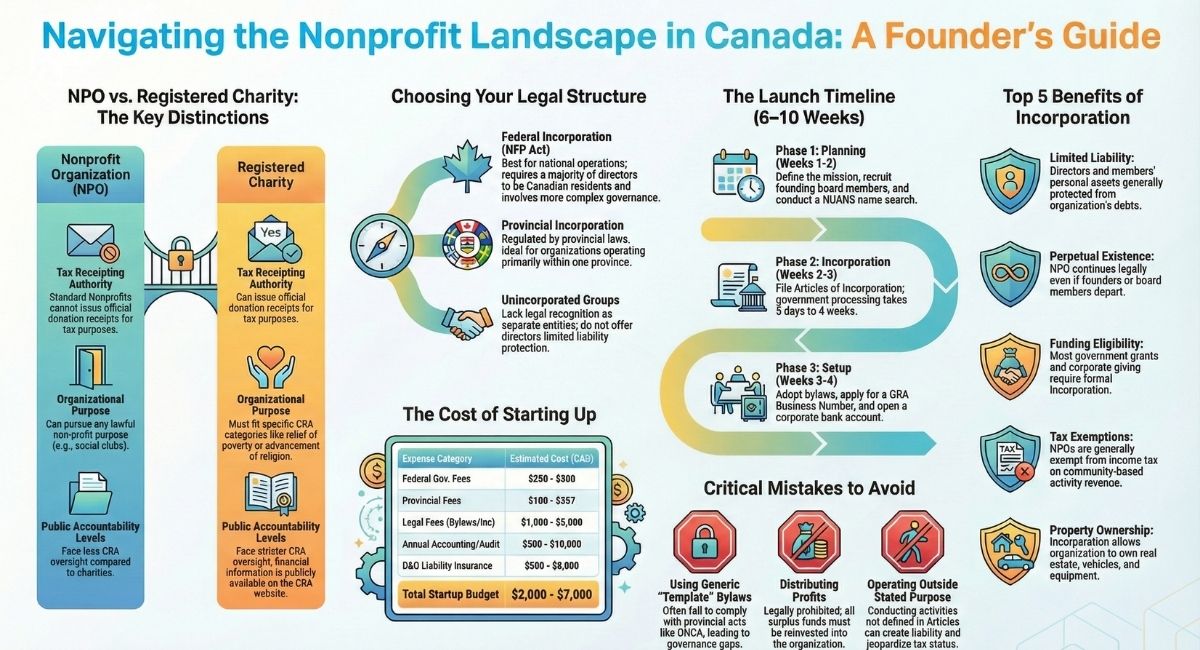
In Canada, nonprofits and charities are sometimes used interchangeably, but they are not the same. All charities are nonprofits, but not all nonprofits are charities. Here's why:
- Nonprofits: These organizations can focus on any number of activities that benefit the community. They might not have the official status of a charity, but they still operate on a nonprofit basis.
- Charities: To be a registered charity in Canada, an organization must apply to the Canada Revenue Agency (CRA) and meet specific criteria. Charities can issue tax receipts for donations, and their activities are generally more focused on public benefits, such as supporting the poor, advancing education, or promoting religion.
Nonprofit vs Charity: Quick Comparison
Legal Framework for Nonprofit Organizations in Canada
Nonprofits in Canada must follow legal rules and regulations. There are two main legal structures under which they can operate:
1. Incorporated Nonprofits
Many nonprofits choose to incorporate under federal or provincial laws. This provides them with legal recognition as a separate entity, and they have the ability to enter contracts, own property, and apply for funding.
- Federal Nonprofits: Registered under the Canada Not-for-Profit Corporations Act (NFP Act). These organizations are governed by the federal government and can operate anywhere in Canada.
- Provincial Nonprofits: Each province has its own nonprofit corporation laws, such as the Ontario Not-for-Profit Corporations Act (ONCA) for organizations in Ontario. These are regulated by the provincial government.
2. Unincorporated Nonprofits
These are informal groups that are not legally registered. While they still operate for a nonprofit purpose, they do not have the same legal protections and benefits as incorporated nonprofits.
Provincial Differences in Nonprofit Incorporation
Each Canadian province has distinct legislation governing nonprofits. Understanding these differences helps you choose the right jurisdiction for incorporation.
Ontario (ONCA)
- Governed by the Ontario Not-for-Profit Corporations Act
- Annual filings required with Ontario corporate registry
- Minimum 3 directors required
- Specific governance requirements for member meetings and voting
- Average incorporation time: 1-2 weeks
British Columbia (Societies Act)
- Governed by the BC Societies Act
- Annual reports due within 2 months of fiscal year-end
- Minimum 3 directors, all must be BC residents or Canadian citizens
- Constitutional documents called "constitution" and "bylaws"
- Incorporation time: 5-10 business days
Alberta (Societies Act)
- Governed by the Alberta Societies Act
- Annual returns required
- Minimum 3 directors
- Must have registered office in Alberta
- Incorporation time: 2-3 weeks
Quebec (Part III, Companies Act)
- Unique structure under Quebec civil law
- Letters patent system (different from articles of incorporation)
- Minimum 3 directors
- Annual declarations required
- Often requires French-language documentation
Federal (Canada Not-for-Profit Corporations Act)
- Can operate in any province
- Annual information returns required
- Minimum 3 directors (majority must be Canadian residents)
- More complex governance requirements
- Incorporation time: 2-4 weeks
- Best for organizations operating nationally
Key considerations when choosing jurisdiction:
- Where will you primarily operate?
- Do you need to operate in multiple provinces?
- What are the annual compliance costs in each jurisdiction?
- Do you have directors who meet residency requirements?
The Benefits of Being a Nonprofit in Canada
Being a nonprofit comes with many advantages. Here are key reasons why many choose to organize as a nonprofit in Canada:
1. Tax Exemptions
Nonprofits in Canada are generally exempt from paying income taxes on revenue that is used for their charitable or community-based activities. However, they must be careful to ensure that their activities remain within the nonprofit's goals.
2. Access to Funding
Many foundations, government programs, and other grant providers prefer to fund nonprofit organizations. Nonprofits can apply for various grants and other funding opportunities available to them.
3. Limited Liability
Incorporated nonprofits enjoy limited liability protection, meaning that the personal assets of their directors or members are generally protected if the organization faces legal issues or financial difficulties.
4. Public Trust
Nonprofits are often seen as trustworthy organizations, especially when they have transparent financial operations and a clear mission. This public trust can help attract donations, volunteers, and supporters.
5. Ability to Hold Property
Incorporated nonprofits can own real estate, vehicles, equipment, and other assets in the organization's name—not in individual members' names.
6. Perpetual Existence
Unlike unincorporated groups that dissolve when founders leave, incorporated nonprofits continue to exist regardless of changes in membership or board composition.
7. Eligibility for Grants
Most government grants, foundation funding, and corporate giving programs require incorporation. Many funders specifically seek registered nonprofits for partnerships.
8. HST/GST Exemptions
Nonprofits may qualify for GST/HST exemptions on certain activities and can claim rebates on taxes paid for purchases related to exempt activities.
9. Professional Credibility
Incorporation signals legitimacy and commitment to stakeholders, donors, and partners. It demonstrates long-term organizational sustainability.
10. Protection of Organization Name
Incorporated nonprofits have exclusive rights to their registered name within their jurisdiction, preventing others from using the same or similar names.
Cost Breakdown: Starting a Nonprofit in Canada
Understanding the financial investment required helps you plan your nonprofit launch effectively.
Incorporation Costs:
Federal Incorporation:
- Name reservation: $50
- Articles of Incorporation: $200 (online) or $250 (paper)
- Total government fees: $250-$300
Provincial Incorporation (varies by province):
- Ontario: $155 (online) or $270 (in-person)
- British Columbia: $100 (online) or $350 (in-person)
- Alberta: $100
- Quebec: $357
Additional Start-Up Costs:
- Legal fees: $1,500-$5,000 for professional incorporation services including bylaw drafting (varies by complexity)
- NUANS name search (federal): $25-$75
- Initial registered office (if required): $0-$500/year
- Corporate seal: $25-$75 (optional in most jurisdictions)
- Minute book: $50-$150
Ongoing Annual Costs:
- Federal annual information return: $0 (free filing)
- Provincial annual returns: $0-$100 depending on province
- Bookkeeping/accounting: $500-$3,000/year
- Audit or review engagement (if required): $2,000-$10,000/year
- Directors' and officers' liability insurance: $500-$2,000/year
- Legal advice: $200-$400/hour as needed
Charitable Registration (if pursuing):
- Application fee: $0 (no fee from CRA)
- Legal assistance for application: $3,000-$15,000
Total realistic start-up budget: $2,000-$7,000 including professional fees.
Many organizations reduce costs by:
- Doing incorporation themselves (higher risk of errors)
- Using volunteer professional services
- Starting provincially if operating in one province only
Need help with cost-effective incorporation? Book a consultation with our charity lawyers.
How Long Does It Take to Start a Nonprofit?
Planning your launch timeline helps set realistic expectations and coordinate with stakeholders.
Typical Timeline Breakdown:
Week 1-2: Planning and Preparation
- Define mission and purposes: 1-2 weeks
- Recruit founding board members: 1-3 weeks (can run concurrently)
- Draft initial bylaws: 1 week
- Conduct name search: 1-3 days
Week 2-3: Incorporation
- Name reservation (if required): 1-3 days
- Prepare and file Articles of Incorporation: 3-5 days
- Government processing:
- Federal: 2-4 weeks
- Ontario: 1-2 weeks
- BC: 5-10 business days
- Alberta: 2-3 weeks
Week 3-4: Post-Incorporation Setup
- First board meeting: Immediate (within days of incorporation)
- Adopt bylaws and appoint officers: Same as first board meeting
- Apply for business number (CRA): 2-3 weeks
- Open corporate bank account: 1-2 weeks (requires corporate documents and business number)
Total Timeline from Start to Operation: 6-10 weeks
If Pursuing Charitable Registration:
- Prepare and submit charitable registration application: 4-8 weeks
- CRA review and approval: 6-12 months (sometimes longer)
- Total with charitable status: 9-15 months
Factors that can speed up the process:
- Using professional legal services
- Having all documents prepared in advance
- Choosing online filing options
- Operating in one province only
Factors that can slow down the process:
- Name conflicts requiring multiple searches
- Complex bylaw requirements
- Multiple rounds of document revision
- Peak filing seasons
- Pursuing federal incorporation with extensive national operations
Not sure which timeline applies to your situation? Contact our nonprofit lawyers for a personalized assessment.
Annual Compliance Requirements for Nonprofits
Maintaining your nonprofit's good standing requires ongoing compliance with federal or provincial regulations.
Federal Nonprofits (NFP Act):
- Annual Information Return: File within 60 days of your financial year-end through Corporations Canada online portal (free)
- Financial Statements: Prepare annual financial statements and present at AGM
- Annual General Meeting (AGM): Hold within 15 months of previous AGM
- Board Meetings: Hold meetings as specified in bylaws (minimum requirements vary)
- Director Updates: File any director changes within 15 days
- Registered Office: Maintain registered office and update address changes within 15 days
- Records Maintenance: Keep corporate records including minutes, resolutions, member lists, financial records
Provincial Nonprofits (varies by province):
Ontario (ONCA):
- Annual information return within 6 months of fiscal year-end
- Financial statements prepared and presented at AGM
- AGM held within 15 months of previous AGM (or as bylaws specify)
- Update director and address changes within specified time
British Columbia:
- Annual report due within 2 months after each anniversary of incorporation
- AGM requirements as specified in constitution
- Update director and address information as changes occur
Alberta:
- Annual return required
- AGM within 18 months of incorporation, then annually
- Financial statements prepared for members
For All Nonprofits:
- Minute Books: Maintain current minute books with all meeting minutes, resolutions, director appointments
- Financial Records: Keep accounting records for required retention period (usually 6-7 years)
- Charitable Registration Compliance (if applicable): File T3010 Registered Charity Information Return annually
- GST/HST Filing (if applicable): File returns as required by CRA
- Workplace Safety Insurance: Maintain coverage where required
- Privacy Compliance: Follow privacy legislation for member/donor information
Consequences of Non-Compliance:
- Late fees and penalties
- Loss of good standing status
- Inability to conduct certain transactions
- Potential dissolution by government
- Personal director liability in some cases
Staying compliant is crucial. Set up annual reminders for all filing deadlines and consider working with a charity lawyer or accountant familiar with nonprofit requirements.
Challenges Nonprofits Face in Canada
While nonprofits play a crucial role in Canadian society, they do face challenges:
Funding
It can be difficult to secure consistent funding for nonprofit activities. Many nonprofits rely on donations and grants, which may not always be reliable or sufficient.
Competition
With so many organizations in Canada working toward similar causes, it can be hard to stand out and get the attention of donors, volunteers, and other supporters.
Administrative Burden
Maintaining compliance with regulations, keeping track of finances, and filing necessary reports can be time-consuming and require expertise, especially for small organizations with limited resources.
Additional Common Challenges:
- Board Recruitment: Finding committed, skilled volunteers willing to serve as directors
- Volunteer Management: Recruiting, training, and retaining quality volunteers
- Financial Sustainability: Balancing mission-driven work with operational costs
- Capacity Constraints: Limited staff and resources stretched across multiple priorities
- Regulatory Changes: Keeping up with changes to nonprofit legislation and tax rules
- Technology Gaps: Limited resources for modern systems, websites, and digital tools
- Measuring Impact: Demonstrating outcomes and value to funders and stakeholders
- Succession Planning: Ensuring leadership continuity when founders or long-term leaders depart
Common Mistakes to Avoid When Starting a Nonprofit
Learning from others' mistakes can save your organization time, money, and legal headaches.
1. Not Having Proper Bylaws
Many new nonprofits use generic templates that don't address their specific needs or comply with current legislation. Bylaws are your organization's rulebook—invest time in getting them right.
Review sample bylaws and understand what not to include in your bylaws.
2. Confusing Nonprofit Status with Charity Status
Being incorporated as a nonprofit doesn't mean you can issue tax receipts. Charitable registration is a separate process with specific CRA requirements. Don't promise donors receipts unless you're a registered charity.
3. Not Holding Proper Board Meetings
Failing to document decisions through formal board meetings and resolutions creates governance gaps. Minutes provide legal protection and organizational memory.
4. Missing Annual Filing Deadlines
Late annual returns result in penalties and can lead to dissolution. Set up automated calendar reminders for all compliance deadlines.
5. Not Keeping Proper Financial Records
Poor bookkeeping makes tax filing difficult, prevents grant applications, and can trigger CRA audits. Implement proper accounting systems from day one.
6. Operating Outside Stated Purposes
Your Articles of Incorporation define what you can do. Operating beyond these purposes creates legal liability and can jeopardize your nonprofit status.
7. Distributing Profits to Members
Nonprofits cannot distribute surplus funds to members, directors, or officers. All funds must be used to further your stated purposes.
8. Ignoring Conflict of Interest Rules
Directors must declare conflicts and abstain from voting on matters where they have personal interests. Document these declarations in meeting minutes.
9. Inadequate Director and Officer Insurance
Without D&O insurance, board members face personal liability risk. This makes recruitment difficult and exposes volunteers to financial harm.
10. Not Understanding Federal vs Provincial Incorporation Implications
Choosing the wrong jurisdiction affects your compliance requirements, operating flexibility, and costs. Understand the differences before incorporating.
Conclusion
Nonprofit organizations in Canada are a vital part of the country's social fabric. They are dedicated to addressing important issues, supporting communities, and helping those in need. Understanding what it means to be a nonprofit organization is essential if you're planning to start one or support an existing one.
Nonprofits have a legal structure, financial advantages, and the ability to make a significant impact in areas like education, healthcare, the environment, and the arts. However, they also face challenges, from securing funding to navigating administrative duties. By understanding the structure and benefits of nonprofits, you can make informed decisions about supporting or starting your own nonprofit organization in Canada.
Ready to start your nonprofit? Our experienced charity lawyers can guide you through incorporation, bylaw drafting, and compliance requirements. With over 5,000 charities and nonprofits served and 915+ 5-star Google reviews, we're Canada's trusted partner for nonprofit legal services.
Book a free consultation or call 416-488-5888 to get started.
Frequently Asked Questions About Nonprofits in Canada
How much does it cost to start a nonprofit in Canada?
Starting a nonprofit typically costs $2,000-$7,000 including government filing fees ($250-$350), legal fees ($1,500-$5,000), and initial setup costs. Federal incorporation costs $250-$300 in government fees, while provincial fees range from $100-$357 depending on your province. Ongoing annual costs include filing fees, accounting, and insurance, typically totaling $1,000-$5,000 per year.
How long does it take to incorporate a nonprofit in Canada?
The incorporation process takes 6-10 weeks from start to operation. Government processing times vary: federal incorporation takes 2-4 weeks, Ontario takes 1-2 weeks, BC takes 5-10 business days, and Alberta takes 2-3 weeks. If you're also applying for charitable registration, add 6-12 months for CRA review.
Do nonprofits pay taxes in Canada?
Incorporated nonprofits are generally exempt from income tax on funds used for their stated purposes. However, they must file annual returns and may pay tax on income from unrelated business activities. Nonprofits may also qualify for GST/HST exemptions on certain activities. Registered charities have additional tax exemptions and can issue donation receipts.
Can a nonprofit make a profit in Canada?
Yes, nonprofits can generate surplus revenue (profit), but they cannot distribute it to members, directors, or officers. All surplus must be reinvested in the organization's stated purposes. This distinguishes nonprofits from for-profit businesses where owners receive profits.
What's the difference between a nonprofit and a charity in Canada?
All charities are nonprofits, but not all nonprofits are charities. Nonprofits can pursue any lawful non-profit purpose, while charities must fit one of CRA's charitable categories (relief of poverty, advancement of education, advancement of religion, or other purposes beneficial to the community). Only registered charities can issue official donation receipts for tax purposes.
The material provided on this website is for information purposes only.. You should not act or abstain from acting based upon such information without first consulting a Charity Lawyer. We do not warrant the accuracy or completeness of any information on this site. E-mail contact with anyone at B.I.G. Charity Law Group Professional Corporation is not intended to create, and receipt will not constitute, a solicitor-client relationship. Solicitor client relationship will only be created after we have reviewed your case or particulars, decided to accept your case and entered into a written retainer agreement or retainer letter with you.
DOV GOLDBERG, J.D. is a lawyer at B.I.G. Charity Law Group and has dedicated his career exclusively to Charity and Not-for-Profit Law for over a decade. Dov guides charities, foundations, and non-profit organizations through every stage of the registration process, offering practical legal advice with a focus on compliance, governance, and long-term success. Known for his hands-on approach and deep knowledge of CRA requirements, Dov is committed to helping clients build strong, sustainable, and legally sound organizations.
.png)


