
How to Register a Nonprofit in Alberta: A Step-by-Step Guide

Published on
March 9, 2025
Last updated on
February 17, 2026
If you're thinking about starting a nonprofit in Alberta, you're on the right path to making a positive impact in your community. In this detailed guide, we will walk you through the essential steps to register your nonprofit organization, whether you're focused on helping people, animals, or the environment. By the end of this blog, you’ll have a clear understanding of the entire registration process for both provincial and federal incorporation, with a specific focus on Alberta.
What Is a Nonprofit Organization?
Before diving into the registration process, it's important to understand what a nonprofit organization is. A nonprofit, as the name suggests, operates without the aim of making profits for its members or shareholders. Instead, any funds or earnings generated are reinvested into the organization's mission, activities, and operations. In Canada, a nonprofit can be registered either provincially (within a specific province like Alberta) or federally (across the entire country).
Nonprofit vs. Charity: What's the Difference in Alberta?
Many people use the terms "nonprofit" and "charity" interchangeably, but they are not the same thing under Canadian law — and the distinction matters in Alberta.
A nonprofit is any organization that does not distribute profits to its members. This includes societies, clubs, associations, and other groups incorporated for non-commercial purposes. A registered charity, on the other hand, is a nonprofit that has been approved by the Canada Revenue Agency (CRA) and granted charitable status.
The key practical difference is this: only a CRA-registered charity can issue official donation tax receipts to donors. Nonprofits that are not registered charities cannot do this, and they do not enjoy the same tax exemptions.
In Alberta, most provincially incorporated nonprofits are structured as societies under the Societies Act. Whether or not your society also registers as a charity with the CRA is a separate decision that depends on your organization's purposes and fundraising needs.
Why Register a Nonprofit in Alberta?
Alberta is home to a growing number of charities and nonprofits, thanks to its vibrant community spirit. Whether your goal is to support environmental causes in Calgary, promote social justice in Edmonton, or provide healthcare services across the province, registering your nonprofit ensures legal protection and access to government funding opportunities.
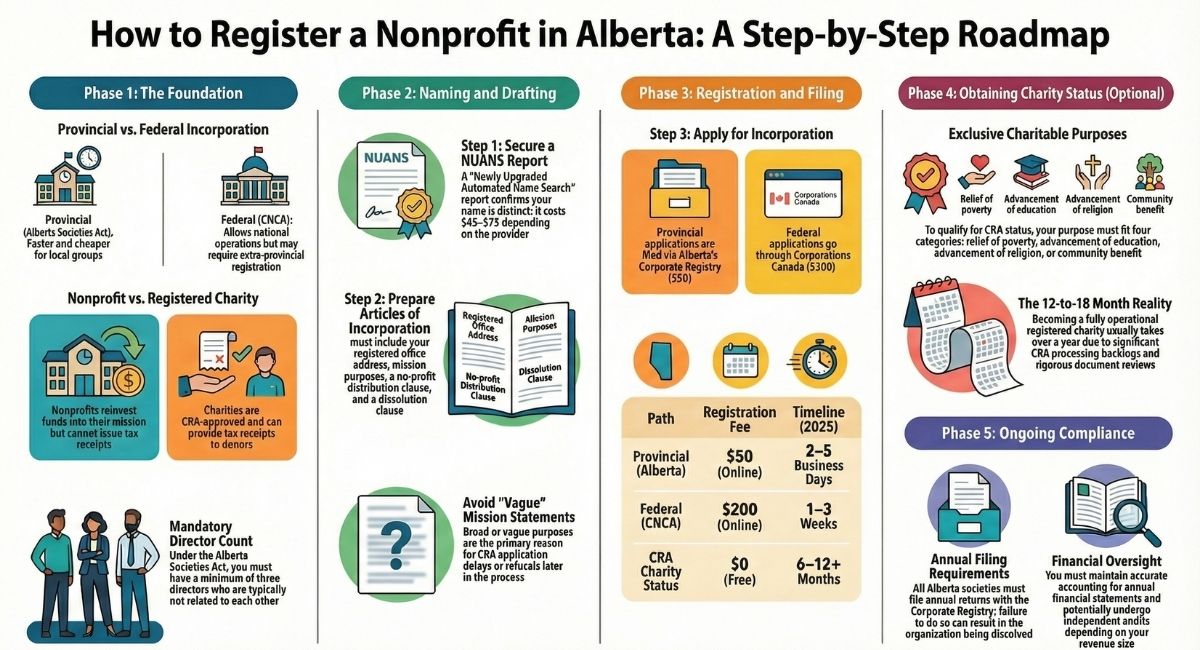
Step 1: Decide on Your Nonprofit's Structure
There are two main types of nonprofit structures in Canada:
Provincial Incorporation under the Alberta Societies Act: If your nonprofit's activities will be limited to Alberta, you may choose to incorporate provincially as a society under the Societies Act (RSA 2000, c. S-14). This process is handled through Alberta's Corporate Registry. Provincial incorporation is generally faster and less expensive than the federal route, and it is the most common choice for community organizations, sports clubs, cultural groups, and local service organizations operating within Alberta.
Federal Incorporation under the CNCA: If your nonprofit plans to operate across Canada or wants national recognition, you may incorporate federally under the Canada Not-for-profit Corporations Act (CNCA) through Corporations Canada. Federal incorporation allows your organization to operate in any province or territory, though you may still need to register extra-provincially in Alberta if you have a physical presence here.
(CHANGE: The original Step 1 did not name the legislation. Both acts are now named, which is important for accuracy and for AI Overview trust signals. The explanation of each is also slightly expanded.)
In this guide, we will walk through both paths.
Step 2: Choose a Name for Your Nonprofit
Your nonprofit's name is one of the first things people will notice about your organization. It should reflect your mission and be distinct enough to stand out. Before proceeding with registration, you must confirm that your desired name is available.
Alberta Provincial Registration: For provincial incorporation in Alberta, you can conduct a name search through a NUANS (Newly Upgraded Automated Name Search) report to check the availability of your proposed name. A NUANS report for Alberta typically costs between $45 and $75 depending on the provider.
Federal Incorporation: If you are incorporating federally, you will also need to complete a NUANS report. This report confirms that the name is available for use across Canada.
Step 3: Prepare Your Articles of Incorporation
The Articles of Incorporation are the foundational legal documents that outline how your nonprofit will operate. These documents must include:
Name of the organization — as confirmed through your NUANS report.
Address of the registered office — this will be the official address for all legal correspondence.
Purpose of the nonprofit — what is the organization's mission, and what activities will it carry out? Your purposes should be clearly and specifically written. Vague or overly broad purposes are a common reason for application delays or refusals, particularly if you plan to apply for CRA charitable status later.
No-profit distribution clause — your Articles must state that no part of the organization's income or property will be paid or transferred to its members, directors, or officers for their personal benefit. This is a requirement under the Societies Act and is also required by the CRA for charitable status.
Dissolution clause — your Articles should specify that upon dissolution, any remaining assets will be distributed to another nonprofit or registered charity rather than to individual members. This is required for CRA charitable status and is considered best practice for all nonprofits.
Board of Directors — how many directors will your organization have? In Alberta, you need a minimum of three directors who are not related to each other.
Bylaws — the rules that govern the organization, including membership classes (if applicable), voting procedures, meeting requirements, and financial oversight. Your bylaws must be consistent with the Societies Act or the CNCA, depending on your incorporation path.
For federal incorporation, your Articles of Incorporation are filed with Corporations Canada. For provincial incorporation, they are submitted to Alberta's Corporate Registry.
Step 4: Apply for Incorporation
Once you have prepared your Articles of Incorporation, the next step is to submit your application.
Provincial Incorporation (Alberta):
- Apply online through Alberta's Corporate Registry at alberta.ca.
- Submit the required documents, including your Articles of Incorporation and NUANS report.
- Pay the registration fee of $50 for online filing.
Federal Incorporation:
- Submit your application to Corporations Canada through the online portal at ised-isde.canada.ca.
- Upload your required documents, including your Articles of Incorporation and NUANS report.
- The federal incorporation fee is $200.
How Long Does It Take to Register a Nonprofit in Alberta?
One of the most common questions from people starting a nonprofit in Alberta is how long the process takes. Here is a realistic breakdown for 2025:
Provincial incorporation (Alberta Societies Act): If you file online through Alberta's Corporate Registry and your documents are in order, incorporation is typically processed within 2 to 5 business days.
Federal incorporation (CNCA via Corporations Canada): Federal incorporation generally takes 1 to 3 weeks, though this can vary depending on application volume and whether any issues arise with your documents.
CRA charity registration (if applicable): This is where the timeline extends significantly. As of 2025, the CRA's processing time for charity registration applications is 6 to 12 months or more. Applications with errors, incomplete purposes, or non-compliant governing documents take even longer or may be returned for revision.
Realistic total timeline: If your goal is to become a fully incorporated and CRA-registered charity in Alberta, you should plan for a timeline of 12 to 18 months from start to finish, and potentially longer if revisions are required by the CRA.
If you only need provincial or federal incorporation (without CRA charitable status), you can be fully operational within a few weeks.
How Much Does It Cost to Register a Nonprofit in Alberta?
Understanding the costs upfront helps you plan properly. Here is a breakdown of the typical fees involved in 2025:
NUANS name search report: $45–$75, depending on the provider.
Alberta provincial incorporation fee: $50 (online filing through Alberta's Corporate Registry).
Federal incorporation fee: $200 (through Corporations Canada).
CRA charity registration application: Free to submit.
Legal fees: Variable. If you hire a charity lawyer to prepare your Articles of Incorporation, bylaws, and CRA application, costs will depend on the complexity of your organization and the services required.
Annual compliance costs: After incorporation, you will have ongoing costs including annual return filings, accounting, and potentially audits depending on your organization's size and revenue.
Keep in mind that the cost of getting your paperwork right the first time is almost always less than the cost of fixing errors after the fact — particularly with CRA charity applications, where revisions can add months to your timeline.
Step 5: Apply for Charity Status (If Applicable)
If your nonprofit plans to issue official tax receipts for donations, you will need to register as a charity with the Canada Revenue Agency (CRA). Charitable status also provides certain tax exemptions that are not available to nonprofits that are not registered charities.
To qualify, your organization must be established exclusively for charitable purposes recognized under Canadian law. These include:
- The relief of poverty
- The advancement of education
- The advancement of religion
- Other purposes beneficial to the community
How to apply: You submit the CRA's Application to Register a Charity through the CRA's My Business Account portal or through Represent a Client if you are a lawyer or authorized representative applying on behalf of the organization.
Common reasons the CRA refuses charity applications:
- The stated purposes are not charitable at law (too vague, too broad, or include non-charitable activities).
- The application does not adequately describe the organization's activities and how they advance the stated purposes.
- The governing documents (Articles and bylaws) are not compliant with CRA requirements — for example, missing a proper dissolution clause or containing provisions that allow private benefit.
Processing time: As of 2025, the CRA is processing most charity applications within 6 to 12 months, though complex applications or those requiring revision can take longer.
The CRA will review your application and, if accepted, grant your organization charitable status. Given the length of this process, it is important to submit a complete and well-prepared application from the start. If your purposes or governing documents are returned for revision, you could add several months to your timeline.
Step 6: Set Up Governance and Operational Systems
After registration, your nonprofit will need to set up operational systems to keep everything running smoothly. This includes:
Board of Directors: Establish your board, ensuring all directors understand their legal responsibilities and fiduciary duties under the Societies Act or the CNCA.
Membership: Define membership criteria if applicable, as well as voting rights and membership classes as set out in your bylaws.
Financial Systems: Set up accounting systems to manage funds, track donations, and prepare for annual reporting. As a nonprofit, transparency is crucial — maintain accurate records and follow the required reporting practices from day one.
Step 7: Apply for Grants and Funding
Once your nonprofit is officially registered, you may want to apply for funding to support your mission. Alberta has various provincial and federal grant programs available for nonprofits, and private foundations and corporations also fund nonprofit activities.
Make sure your nonprofit's goals align with the specific requirements and guidelines of any programs you apply to. Government websites, community foundations, and nonprofit resource organizations are good starting points for identifying funding opportunities in Alberta.
Key Considerations for Nonprofit Registration in Alberta
Ongoing Compliance: As a nonprofit in Alberta, you are required to file annual returns with Alberta's Corporate Registry to keep your incorporation status active. For federally incorporated nonprofits, you must also file annual returns with Corporations Canada. Failure to file can result in dissolution of your organization by the Registrar.
Financial Oversight: Nonprofits in Alberta are required to maintain proper financial oversight, including annual financial statements. Depending on your organization's size and revenue, an independent audit may also be required.
Volunteer and Staff Management: Establish clear policies and guidelines for managing both volunteers and paid staff, including roles, responsibilities, and compensation policies where applicable.
Do I Need a Lawyer to Register a Nonprofit in Alberta?
You are not legally required to hire a lawyer to register a nonprofit in Alberta. Many organizations complete provincial incorporation through Alberta's Corporate Registry on their own without legal assistance.
However, working with an experienced charity lawyer is strongly recommended if you plan to apply for CRA charitable status. The most common reasons charity applications are rejected or delayed are errors in the organization's stated purposes and non-compliant governing documents — both of which a charity lawyer helps you get right from the start. Given that a CRA charity application can take 6 to 12 months to process, submitting a complete and correct application the first time saves significant time and cost.
If your organization has a complex structure, multiple purposes, or is unsure whether its activities qualify as charitable at law, legal advice is especially valuable before you file anything.
Conclusion
Registering a nonprofit in Alberta can be a rewarding experience, but it requires careful planning and attention to detail. Whether you are incorporating provincially under the Societies Act or federally under the CNCA, following these steps will ensure your organization is legally recognized and set up for long-term success.
If you are also pursuing CRA charitable status, give yourself a realistic timeline — 12 to 18 months is common for organizations going through both incorporation and charity registration. Getting your purposes and governing documents right from the start is the single most important factor in avoiding delays.
If you are looking to register a charity or nonprofit in Alberta or across Canada, consulting with an experienced charity lawyer ensures your organization is fully compliant with all legal requirements and positioned for success from day one.
Frequently Asked Questions: Registering a Nonprofit in Alberta
Can a nonprofit in Alberta issue tax receipts for donations?
No — not automatically. Only organizations that have been registered as charities by the Canada Revenue Agency (CRA) can issue official donation tax receipts. Simply incorporating as a nonprofit or society in Alberta does not give you the ability to issue tax receipts.
How many directors does an Alberta nonprofit need?
Under the Societies Act, an Alberta nonprofit (society) requires a minimum of three directors. In most cases, the directors cannot all be related to each other. This requirement must be reflected in your Articles of Incorporation.
Can I register a nonprofit in Alberta online?
Yes. Alberta's provincial incorporation process is available entirely online through the Alberta Corporate Registry at alberta.ca. Federal incorporation through Corporations Canada is also completed online.
What is the difference between a society and a nonprofit in Alberta?
A "society" is the specific legal structure used for most provincially incorporated nonprofits in Alberta, governed by the Societies Act. "Nonprofit" is the broader general term. In practice, when people talk about registering a nonprofit in Alberta provincially, they are incorporating as a society under the Societies Act.
Do Alberta nonprofits need to file annual returns?
Yes. All societies incorporated under the Alberta Societies Act must file annual returns with Alberta's Corporate Registry. Federally incorporated nonprofits must also file annual returns with Corporations Canada. Failure to file can result in the organization being dissolved by the Registrar.
How long does it take to get CRA charity status for an Alberta nonprofit?
As of 2025, the CRA is taking approximately 6 to 12 months to process charity registration applications. Applications that require revision or have incomplete information take longer. It is important to submit a complete and accurate application the first time.
What is the cost to register a nonprofit in Alberta?
The Alberta provincial incorporation fee is $50 for online filing. A NUANS name search report costs approximately $45–$75. Federal incorporation costs $200 through Corporations Canada. CRA charity registration is free to apply for. Legal fees, if you work with a charity lawyer, are additional and vary based on your organization's needs.
The material provided on this website is for information purposes only.. You should not act or abstain from acting based upon such information without first consulting a Charity Lawyer. We do not warrant the accuracy or completeness of any information on this site. E-mail contact with anyone at B.I.G. Charity Law Group Professional Corporation is not intended to create, and receipt will not constitute, a solicitor-client relationship. Solicitor client relationship will only be created after we have reviewed your case or particulars, decided to accept your case and entered into a written retainer agreement or retainer letter with you.
DOV GOLDBERG, J.D. is a lawyer at B.I.G. Charity Law Group and has dedicated his career exclusively to Charity and Not-for-Profit Law for over a decade. Dov guides charities, foundations, and non-profit organizations through every stage of the registration process, offering practical legal advice with a focus on compliance, governance, and long-term success. Known for his hands-on approach and deep knowledge of CRA requirements, Dov is committed to helping clients build strong, sustainable, and legally sound organizations.
.png)


