
What Is ONCA and How Does It Affect Ontario Nonprofits and Charities?

If you run a nonprofit or charity in Ontario, you’ve probably heard of ONCA. But what exactly is it, and what does it mean for your organization?
In this blog post, we’ll explain:
- What does ONCA stand for
- What it means for nonprofits and charities
- The difference between ONCA and CNCA
- What has changed under ONCA
- What to do if you missed the October 2024 compliance deadline
What Does ONCA Mean?
ONCA stands for the Ontario Not-for-Profit Corporations Act. It’s the law that governs most nonprofit organizations and charities incorporated in Ontario.
ONCA came into effect on October 19, 2021. Before that, nonprofits in Ontario were governed by an outdated law from the 1950s. ONCA was created to modernize the rules, make things clearer, and give nonprofits more flexibility.
What Is the Purpose of ONCA?
The goal of ONCA is to:
- Give members stronger rights
- Make it easier to incorporate a nonprofit
- Provide clear rules for governance
- Allow certain nonprofits to skip full audits and use a review engagement instead
- Clarify when nonprofits can make money from business activities
Does ONCA Apply to Your Organization?
ONCA only applies to nonprofits and charities that are incorporated in Ontario.
If your organization is federally incorporated, then you’re governed by the Canada Not-for-Profit Corporations Act (CNCA) — not ONCA. This is true even if your head office is registered in Ontario or have extra-provincial registration in Ontario.
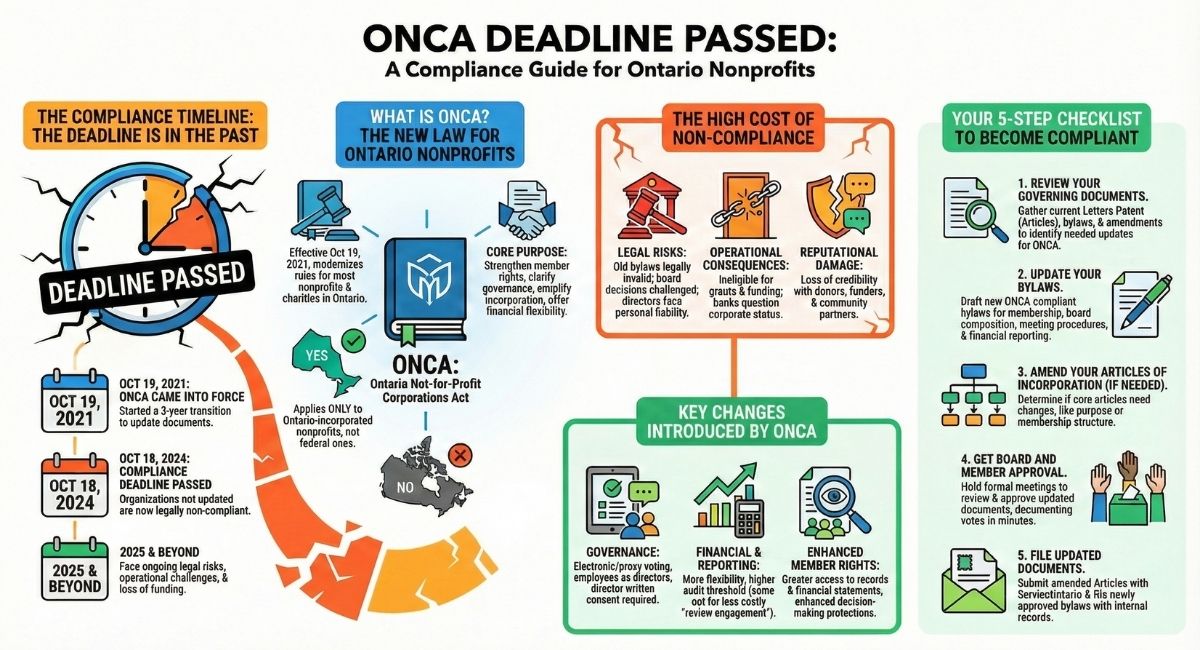
ONCA Compliance Timeline: What Happened and What's Next
Understanding the ONCA timeline helps you see where your organization stands:
- October 19, 2021: ONCA came into force, replacing the old Corporations Act
- October 19, 2021 - October 18, 2024: Three-year transition period for compliance
- October 18, 2024: Compliance deadline passed
- 2025 and Beyond: Organizations still non-compliant face legal risks and operational challenges
- Ongoing: Annual compliance requirements including filing with ServiceOntario
Where are you now? If you haven't updated your bylaws and Articles by October 18, 2024, your organization is currently non-compliant and should take immediate action.
What’s the Difference Between CNCA and ONCA?
Here’s a simple breakdown of the differences:

Some nonprofits are considering moving from ONCA to CNCA if they operate across provinces or prefer the federal rules. This process is called “continuance.”
What Changed Under ONCA?
ONCA introduced several new rules that modernize nonprofit governance. If your organization is incorporated in Ontario, these changes apply to you:
Governance Changes:
- Clear membership structures must be stated in your Articles
- Electronic and proxy voting are now allowed at meetings
- Member proposals at meetings are permitted
- Employees can serve as directors (unless bylaws prohibit it)
- Directors don't have to be members (unless bylaws require it)
- Default rules for quorum and voting at meetings provide clarity
- Directors must give written consent to serve on the board
- Minimum and maximum terms for directors must be specified
Financial and Reporting Changes:
- Flexible financial reporting — you may not need a full audit
- Significantly higher audit threshold requirements
- New rules for Public Benefit Corporations
- Clearer rules about business activities and revenue generation
Member Rights:
- Greater access to corporate records and financial statements
- Ability to requisition meetings with proper support
- Enhanced protection in decision-making processes
These changes are designed to make nonprofit governance more efficient, transparent, and aligned with modern organizational practices.
Common ONCA Compliance Mistakes Ontario Nonprofits Make
Avoid these frequent errors that can put your organization at risk:
- Not updating conflict of interest policies to reflect new ONCA requirements
- Failing to obtain written director consent before directors begin serving
- Ignoring new member rights provisions in your updated bylaws
- Using outdated bylaw templates from pre-ONCA websites or resources
- Not filing amended Articles when required — some changes need government approval
- Assuming federal rules apply when you're actually incorporated provincially
- Copying another organization's bylaws without customizing them to your structure
- Not getting proper member approval for bylaw changes
- Forgetting to update internal policies to match new bylaws
- Thinking compliance is a one-time event — ongoing annual requirements apply
Prevention tip: Work with an Ontario charity lawyer experienced in ONCA to ensure your documents are compliant and customized to your organization's needs.
ONCA Compliance Checklist: 5 Steps to Update Your Nonprofit
To become ONCA-compliant, your organization must complete these steps:
Step 1: Review Your Current Governing Documents
Gather your Letters Patent (or Articles of Incorporation), current bylaws, and any amendments. Identify what needs updating.
Step 2: Update Your Bylaws to Match ONCA Requirements
Your bylaws must address:
- Membership categories and rights
- Board composition and director terms
- Meeting procedures (quorum, voting, notice requirements)
- Financial reporting requirements
- Conflict of interest procedures
- Amendment procedures
View sample ONCA-compliant bylaws here.
Step 3: Amend Your Articles of Incorporation (If Needed)
Determine if your Articles need amendments. Common reasons include:
- Changing your membership structure
- Updating your purposes
- Modifying director qualifications
- Adding or removing restrictions
Step 4: Get Board and Member Approval
- Hold a board meeting to review proposed changes
- Call a special members' meeting (if required by your bylaws)
- Obtain the required votes for approval (typically special resolution)
- Document all approvals in meeting minutes
Step 5: File Updated Documents with ServiceOntario
- Submit amended Articles (if applicable)
- File updated bylaws with your corporate records
- Pay required filing fees
- Update your minute book and internal records
Important: This process requires legal review to ensure compliance. We recommend working with an Ontario lawyer experienced in charity and nonprofit law, particularly ONCA legislation.
What If You Missed the ONCA Deadline?
The compliance deadline for ONCA was October 18, 2024. If you haven't updated your documents yet, your organization is now legally non-compliant.
What Happens If You Don't Comply With ONCA?
Non-compliance creates serious legal and operational problems:
Legal Risks:
- Your bylaws may conflict with Ontario law and be legally invalid
- Board decisions could be challenged in court
- Members may have grounds to sue the organization
- Directors could face personal liability for operating under invalid governance
Operational Consequences:
- You may be ineligible for grants and government funding
- ServiceOntario may refuse to process your filings or registrations
- Banks and financial institutions may question your corporate status
- You risk losing your corporate standing entirely
- Insurance policies may be affected
Reputational Damage:
- Loss of credibility with donors, funders, and partners
- Inability to demonstrate good governance
- Potential negative publicity
The Good News: It's Not Too Late to Fix It
While the deadline has passed, you can still become compliant. Organizations that act now can resolve their non-compliance and protect themselves from ongoing legal risks.
Need Help With ONCA Compliance?
Our team of charity lawyers have helped hundreds of Ontario nonprofits and charities update their documents, stay compliant with ONCA and all relevant provincial and federal legislation, and where prudent, transition to federal incorporation.
Call us at: 416-488-5888
Email: ask@charitylawgroup.ca
Frequently Asked Questions
Here are answers to common questions about ONCA and what it means for Ontario nonprofits and charities.
What is ONCA in Ontario?
ONCA is the Not-for-Profit Corporations Act, 2010. It is the law that governs how nonprofit corporations operate in Ontario. ONCA replaced the old Corporations Act and brought new rules for nonprofits to follow.
What is the purpose of ONCA?
ONCA updates and modernizes the rules for nonprofit organizations in Ontario. Its purpose is to make governance clearer, protect members' rights, and help nonprofits run more effectively. The law sets standards for how boards operate and how organizations make decisions.
What are the new rules for nonprofit organizations in Ontario?
ONCA brought several new rules. Organizations must update their bylaws and governing documents. Boards have clearer duties and responsibilities. Members have more rights, including better access to information. There are also new rules about meetings, voting, and financial transparency.
What does ONCA stand for?
ONCA stands for the Ontario Not-for-Profit Corporations Act. The full name is the Not-for-Profit Corporations Act, 2010.
What is ONCA's mission?
ONCA itself doesn't have a mission since it is a law, not an organization. However, the goal of ONCA is to create a modern legal framework for nonprofits. It aims to improve governance, increase transparency, and make it easier for nonprofit organizations to serve their communities effectively.
The material provided on this website is for information purposes only.. You should not act or abstain from acting based upon such information without first consulting a Charity Lawyer. We do not warrant the accuracy or completeness of any information on this site. E-mail contact with anyone at B.I.G. Charity Law Group Professional Corporation is not intended to create, and receipt will not constitute, a solicitor-client relationship. Solicitor client relationship will only be created after we have reviewed your case or particulars, decided to accept your case and entered into a written retainer agreement or retainer letter with you.
.png)


