
What Are Articles of Incorporation and Why Do They Matter in Canada?

Incorporating a business or charity in Canada requires several key steps, one of the most critical being the filing of Articles of Incorporation. These documents provide the legal foundation for the organization, outlining its structure, purpose, and governance. Whether you're setting up a business or a charity, understanding the importance of Articles of Incorporation is crucial. So, what exactly are they, and why do they matter?
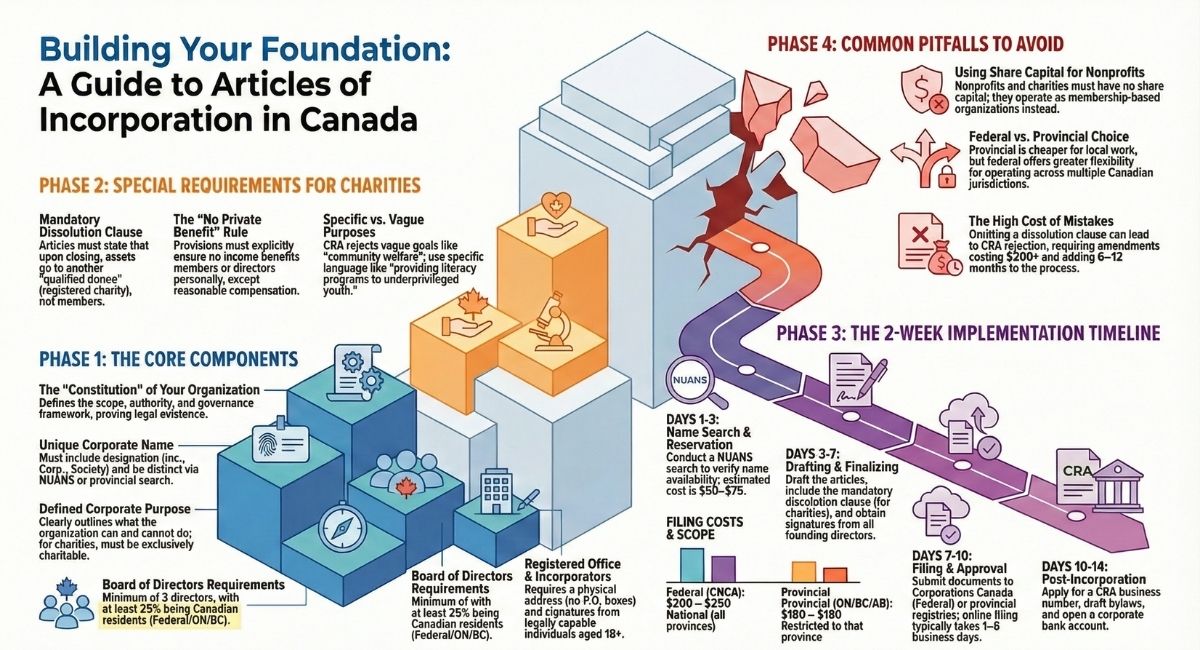
What Are Articles of Incorporation?
Articles of Incorporation are legal documents filed with the appropriate government authority when you want to form a Nonprofit corporation. In Canada, the process differs slightly depending on whether you incorporate federally or provincially. Federally, you would submit the articles to Corporations Canada, whereas, for provincial incorporation, the relevant provincial or territorial registry is used (e.g., British Columbia’s Corporate Registry).
These articles act as the “constitution” of the corporation, setting out key information about the organization’s purpose, structure, and legal status. They help define the scope and authority of your corporation and ensure that it operates within legal guidelines.
Think of articles of incorporation as your organization's birth certificate and rulebook combined. Once filed and approved, these documents:
- Officially create your corporation as a separate legal entity
- Define what your organization can and cannot do
- Establish the framework for governance and decision-making
- Serve as proof of your organization's legal existence
For charities specifically, properly drafted articles are a prerequisite for obtaining charitable registration status with the CRA.
What Information Do Articles of Incorporation Include?
Articles of Incorporation must include specific details about your corporation. Though the exact requirements can vary slightly between federal and provincial incorporations, the general content includes:
1. Corporate Name
This is the official legal name under which the corporation will operate. Ensure that the name is unique and complies with naming rules set by the province or federal government.
Key Requirements:
- Must be distinct from existing corporations
- Cannot suggest government affiliation without permission
- Must include a corporate designation ("Inc.", "Corp.", "Society")
- Cannot be obscene, misleading, or confusing
For Charities: Your name should reflect your charitable purpose and avoid names that suggest commercial activity.
2. Corporate Purpose
This outlines the general purpose of the corporation. For example, a charity may state that its purpose is to provide educational resources, while a business might describe its intention to sell goods or services.
For Charities - Special Requirements:
Your charitable purposes must:
- Align with one of the four recognized charitable categories
- Be exclusively charitable (not mixed with non-charitable purposes)
- Benefit the public, not private individuals
- Be clearly articulated and specific enough for CRA approval
Example of CRA-Compliant Charitable Purpose: "To advance education by providing literacy programs and educational resources to underprivileged youth in Ontario."
Example of Non-Compliant Purpose: "To promote general community welfare and social activities." (Too vague, doesn't clearly fit a charitable category)
3. Share Structure
If the corporation will have shareholders, the articles will need to specify the types of shares available, the number of shares the corporation is authorized to issue, and any special rights or restrictions tied to those shares.
Important for Nonprofits: Most nonprofit corporations and all registered charities should have no share capital. Instead, they operate as membership-based organizations.
4. Directors and Officers
Articles of Incorporation generally include details on the number of directors the corporation will have, as well as the initial directors who will manage the corporation.
Federal Requirements (CNCA):
- Minimum 3 directors (1 for small nonprofits with fewer than 4 members)
- At least 25% must be Canadian residents
Provincial Variations:
- Ontario (ONCA): Minimum 3 directors
- British Columbia: Minimum 3 directors for societies
- Alberta: Minimum 1 director permitted
5. Registered Office
The articles should specify the physical location of the corporation's registered office. This is the address where official correspondence will be sent.
Requirements:
- Must be a physical address (not a P.O. box)
- Must be in the jurisdiction of incorporation
- Can be changed through formal amendment
- Available to public through corporate registry searches
6. Incorporator's Information
The person or people responsible for filing the Articles of Incorporation must include their names and signatures.
Who Can Be an Incorporator:
- Any individual 18 years or older
- Does not need to be a director or member
- Can be a lawyer filing on behalf of founders
- Must be legally capable of entering contracts
Special Considerations for Charitable Organizations
If you're incorporating a charity, your articles must include additional provisions:
Mandatory Dissolution Clause
The CRA requires a dissolution clause stating that upon dissolution, any remaining assets will be distributed to another registered charity or qualified donee, not to members or directors.
Example Dissolution Clause: "Upon dissolution of the corporation, any remaining assets shall be distributed to one or more qualified donees under the Income Tax Act (Canada) that have similar charitable purposes."
Restriction on Activities
Articles should explicitly restrict the organization to charitable activities and related business activities.
Limitation on Political Activities
While charities can engage in some political activities, your articles should acknowledge these limitations or avoid mentioning political activities altogether.
No Private Benefit
Articles must ensure no part of the income can benefit members, directors, or officers personally (except as reasonable compensation for services).
Step-by-Step Timeline: What to Expect
Understanding the timeline helps you plan your incorporation effectively. Here's what to expect:
Days 1-3: Name Search and Reservation
Tasks:
- Conduct NUANS search (federal) or provincial name search
- Choose three name options in order of preference
- Reserve your chosen name (optional but recommended)
- Verify name complies with naming rules
Cost: $50-$75 for NUANS report
Days 3-5: Drafting Articles
Tasks:
- Draft articles of incorporation
- Ensure charitable purposes comply with CRA requirements (for charities)
- Include mandatory dissolution clause (for charities)
- Specify director information
- Determine registered office address
- Review with lawyer (recommended for charities)
Cost: $500-$2,000 for legal review (varies by complexity)
Days 5-7: Review and Finalize
Tasks:
- Review draft articles with founding directors
- Make necessary revisions
- Ensure all incorporators sign the documents
- Prepare payment for filing fees
- Gather supporting documents
Cost: None (unless additional legal consultation needed)
Days 7-10: Filing and Approval
Tasks:
- Submit articles online or by mail
- Pay filing fees
- Wait for government review
- Receive certificate of incorporation
- Download or receive incorporation documents
Cost: $200-$250 (federal), $100-$180 (provincial)
Timeline: 1-5 business days for online filings, 5-10 days for paper filings
Days 10-14: Post-Incorporation Steps
Tasks:
- Apply for business number with CRA
- Register for charitable status (if applicable)
- Draft and approve bylaws
- Hold first directors' meeting
- Open corporate bank account
- Set up accounting system
- Apply for necessary licences or permits
Total Expected Timeline: 2-3 weeks from start to finish for straightforward incorporations. Charitable registrations with CRA take an additional 6-12 months.
The Importance of Articles of Incorporation in Canada
Legal Recognition and Protection: Once you file the Articles of Incorporation, your business or charity becomes a separate legal entity. This separation protects the owners from personal liability for the corporation’s debts and obligations.
Corporate Structure: The Articles of Incorporation provide the blueprint for how the corporation will be run, from who can own shares to who makes decisions. They provide clarity for investors, board members, and other stakeholders.
Fundraising and Donations: For charities, having proper Articles of Incorporation is often a prerequisite for applying for tax-exempt status with the Canada Revenue Agency (CRA). Without it, a charity may be unable to issue donation receipts, making fundraising more challenging.
Governance and Compliance: By establishing clear guidelines for governance, the Articles of Incorporation help ensure that a corporation operates in compliance with relevant laws. For charities, this can be particularly important, as failing to comply with these rules can result in the revocation of charitable status.
Federal vs. Provincial Incorporation in Canada
In Canada, businesses and charities can choose to incorporate either federally or provincially. Each option has its own advantages and requirements:
- Federal Incorporation: Incorporating federally allows your corporation to operate under the same name across all provinces and territories in Canada. This option is ideal for companies or charities that plan to operate in multiple jurisdictions. Federal corporations are governed by the Canada Business Corporations Act (CBCA) or the Canada Not-for-profit Corporations Act (CNCA).
- Provincial Incorporation: If you choose to incorporate provincially, your corporation can only operate within that specific province. Each province has its own legislation for corporations, such as British Columbia’s Business Corporations Act (BCBCA) or Ontario Not-for-Profit Corporations Act (ONCA).
It’s important to note that federal incorporation often involves slightly more administrative work since the corporation must comply with both federal and provincial laws. However, it offers greater flexibility when operating across Canada.
How to File Articles of Incorporation in Canada
Filing the Articles of Incorporation involves submitting the required forms and documents to the relevant government authority. Here’s a general outline of the steps:
- Choose Your Corporate Name: Before filing, you must ensure that your chosen corporate name is available and complies with the applicable naming guidelines. You can conduct a NUANS (Newly Upgraded Automated Name Search) report to check name availability at the federal level or use the provincial search systems in British Columbia, Ontario, or other regions.
- Prepare the Articles: Draft the Articles of Incorporation, including all necessary information such as the corporate name, share structure, and purpose. Templates are often available from government websites to guide you.
- File with the Government: Submit the completed Articles of Incorporation to the appropriate registry. For federal incorporation, this would be through Corporations Canada, while for provincial incorporation, it would be the relevant provincial body.
- Pay the Fees: Incorporation fees vary depending on whether you are filing federally or provincially. For example, federal incorporation costs about $200, while provincial fees can vary depending on the province.
- Receive Your Certificate of Incorporation: Once approved, you will receive a Certificate of Incorporation confirming that your business or charity is officially recognized as a legal entity.
Common Mistakes When Filing Articles of Incorporation
Avoiding these errors can save you time, money, and frustration:
1. Using Non-Compliant Corporate Names
The Mistake: Choosing a name that's too similar to existing corporations or doesn't include proper corporate designation.
The Fix:
- Always conduct a thorough NUANS or provincial name search
- Include "Inc.", "Corp.", "Incorporated", "Society", or other required designation
- Have 2-3 backup names ready
Cost of the Mistake: $100-$200 to resubmit with a new name, plus delays of 5-10 business days
2. Forgetting the Dissolution Clause for Charities
The Mistake: Omitting or improperly wording the mandatory dissolution clause in charitable articles.
The Fix: Use CRA-approved language specifying that assets go to qualified donees upon dissolution.
Cost of the Mistake: CRA will reject charitable registration application; you'll need to amend articles ($200-$300) and reapply, adding 6-12 months to the process.
3. Incorrect Share Structure for Nonprofits
The Mistake: Including share capital in articles for a nonprofit or charity.
The Fix: Nonprofits and charities should have no share capital. They operate as membership-based organizations instead.
Cost of the Mistake: Rejection by CRA for charitable registration; costly amendments required.
4. Missing Canadian Resident Director Requirements
The Mistake: Not meeting the minimum Canadian resident director requirement.
The Fix:
- Federal: At least 25% of directors must be Canadian residents
- Some provinces: Majority must be provincial residents
Cost of the Mistake: Certificate may be revoked; you'll need to appoint new directors and file amendments.
5. Filing in the Wrong Jurisdiction
The Mistake: Incorporating provincially when you need to operate nationally, or vice versa.
The Fix:
- Consider where you'll operate long-term
- If multi-province, choose federal
- If single-province, provincial is cheaper
Cost of the Mistake: Having to dissolve and re-incorporate, or register extra-provincially in multiple jurisdictions ($100-$300 per province).
6. Vague or Non-Charitable Purposes
The Mistake: Writing purposes that are too broad ("helping people") or mixing charitable and non-charitable activities.
The Fix:
- Be specific about activities and beneficiaries
- Ensure every purpose fits a recognized charitable category
- Avoid commercial or social purposes
Cost of the Mistake: CRA rejection; article amendments required; 6-12 month delay.
7. Not Aligning Corporate Purposes with CRA Charitable Categories
The Mistake: Including purposes that don't clearly fit one of the four charitable categories recognized by CRA.
The Fix: Explicitly state how your purposes advance education, relieve poverty, advance religion, or provide another recognized charitable purpose.
Cost of the Mistake: Delayed or denied charitable registration.
8. Using Outdated Templates
The Mistake: Using old templates that don't reflect current legislation (especially common with ONCA transition).
The Fix:
- Download current templates from government websites
- Consult with a lawyer familiar with recent legislative changes
- Verify template matches your jurisdiction and organization type
Cost of the Mistake: Non-compliant articles requiring amendments and refiling.
9. Insufficient Director Information
The Mistake: Not providing complete residential addresses for directors or not meeting minimum director requirements.
The Fix:
- Provide full legal names and residential addresses
- Ensure you meet minimum director numbers (usually 3)
- Verify directors meet residency requirements
Cost of the Mistake: Filing rejection; resubmission fees and delays.
10. Neglecting Post-Incorporation Steps
The Mistake: Getting the certificate but failing to complete necessary follow-up tasks like CRA business number registration or bylaw creation.
The Fix: Create a post-incorporation checklist and complete all steps within 30 days.
Cost of the Mistake: Operating without proper legal structure; potential compliance issues; delayed charitable registration.
Why Should You Incorporate?
Incorporation offers several benefits that make it a popular choice for both businesses and charities in Canada:
- Limited Liability: Incorporation protects the personal assets of the owners from the corporation’s liabilities.
- Credibility: Incorporating can enhance the credibility of your business or charity, making it more attractive to investors and donors.
- Tax Benefits: Corporations, especially registered charities, may be eligible for various tax benefits, including reduced income tax rates and the ability to issue donation receipts.
- Perpetual Existence: Unlike a sole proprietorship or partnership, a corporation has a perpetual existence, meaning it continues to exist even if the original owners or directors leave.
Articles of Incorporation are the cornerstone of forming a business or charity in Canada. They provide the legal framework for your organization and help establish its legitimacy and governance. Whether you choose to incorporate federally or provincially, it’s essential to understand the requirements and processes involved. Incorporating offers many benefits, from limited liability to tax advantages, making it a crucial step for anyone looking to establish a lasting and legally sound organization in Canada.
Frequently Asked Questions
Starting a business in Canada means dealing with paperwork. We know you have questions about articles of incorporation. Here are the answers to help you understand this important legal document and get your business started on the right track.
What Is the Purpose of the Articles of Incorporation?
We use articles of incorporation to create a legal corporation in Canada. This document officially brings your business to life in the eyes of the law. It gives your company the right to operate, own property, and enter contracts. Without articles of incorporation, your business cannot exist as a corporation.
The articles also protect your personal assets. When we incorporate, we create a separate legal entity. This means the corporation's debts and problems stay with the business, not with you personally.
How Do You Write Articles of Incorporation?
We start by gathering key information about our business:
- Company name
- Business address
- Number and type of shares
- Names of directors
- Business purpose
Next, we fill out the required forms. In Canada, we use different forms depending on our province. Most provinces have online systems that make this process easier.
We must include specific details like:
- How many people can serve as directors
- What powers the corporation has
- Any limits on business activities
Many business owners hire lawyers or use incorporation services to help with this step. The paperwork must be perfect to avoid delays.
Can One Person Submit Articles of Incorporation?
Yes, one person can submit articles of incorporation in Canada. We call this a single-shareholder corporation. You can be the only director, officer, and shareholder of your company.
However, we need to meet certain requirements:
- You must be at least 18 years old
- You need to be a Canadian resident
- Some provinces require at least 25% of directors to be Canadian residents
One-person corporations work well for freelancers, consultants, and small business owners who want liability protection.
How to Find Articles of Incorporation in Canada?
We can search for articles of incorporation through government databases. Each province has its own system:
Federal corporations: Search through Corporations Canada online databaseProvincial corporations: Check your province's business registry
Most searches require:
- Company name or registration number
- Province of incorporation
- Small search fee
We can also request copies directly from the government office that handles corporate records in your province.
How to Get a Certificate of Incorporation in Canada?
We receive a certificate of incorporation after our articles get approved. Here's how the process works:
- Submit articles of incorporation with all required documents
- Pay filing fees (usually $200-$500 depending on province)
- Wait for processing (typically 1-5 business days)
- Receive certificate by mail or email
The certificate proves our corporation exists legally. We need this document to:
- Open business bank accounts
- Apply for business licenses
- File tax returns
- Sign contracts as a corporation
Keep multiple copies of this certificate. We'll need it throughout our business operations.
What Is the Certificate Number on Articles of Incorporation in Canada?
The certificate number is our corporation's unique identification number. Every corporation in Canada gets one when we incorporate. This number appears on our certificate of incorporation.
We use this number for:
- Government filings and reports
- Tax documents
- Banking applications
- Business license applications
The number format depends on where we incorporate:
- Federal corporations: Start with numbers like 123456789
- Provincial corporations: Each province has its own format
Write down this number and keep it safe. We'll need it for many business activities throughout our company's life.
Why Do Articles of Incorporation Matter?
Articles of incorporation create the foundation of our business. They establish our corporation as a separate legal entity with its own rights and responsibilities. Without them, we cannot:
- Protect our personal assets from business debts
- Issue shares to investors
- Take advantage of corporate tax benefits
- Build business credit separate from personal credit
These documents also provide credibility with customers, suppliers, and lenders. They show we run a legitimate, properly structured business.
The material provided on this website is for information purposes only.. You should not act or abstain from acting based upon such information without first consulting a Charity Lawyer. We do not warrant the accuracy or completeness of any information on this site. E-mail contact with anyone at B.I.G. Charity Law Group Professional Corporation is not intended to create, and receipt will not constitute, a solicitor-client relationship. Solicitor client relationship will only be created after we have reviewed your case or particulars, decided to accept your case and entered into a written retainer agreement or retainer letter with you.
.png)


