
Social Media Fundraising Strategies for Canadian Charities

Published on
March 12, 2026
Last updated on
March 12, 2026
Social media fundraising allows Canadian charities to reach wider audiences, build donor relationships, and run campaigns at low cost.
Effective strategies include peer-to-peer fundraising, platform-specific content, storytelling, and data-driven targeting.
With the right approach, Canadian nonprofits can significantly increase donations and donor engagement through platforms like Facebook, Instagram, LinkedIn, and TikTok.
What Is Social Media Fundraising for Charities?
Social media fundraising is one of the most accessible tools available to Canadian nonprofits today. Understanding what it means — and what it requires — helps charities use it effectively and responsibly.
Social media fundraising is the practice of using platforms like Facebook, Instagram, LinkedIn, and TikTok to attract donors, collect contributions, and grow a charity's supporter base online.
For registered Canadian charities, it goes beyond simply posting a donation link. It involves building awareness, telling compelling stories, and maintaining the kind of trust that turns followers into long-term donors.
Canadian charities must also keep Canada Revenue Agency (CRA) rules in mind when fundraising online. All fundraising activities — including social media campaigns — must align with the charity's registered purposes and comply with CRA guidelines on fundraising costs and transparency.
Why Canadian Charities Are Turning to Social Media Fundraising
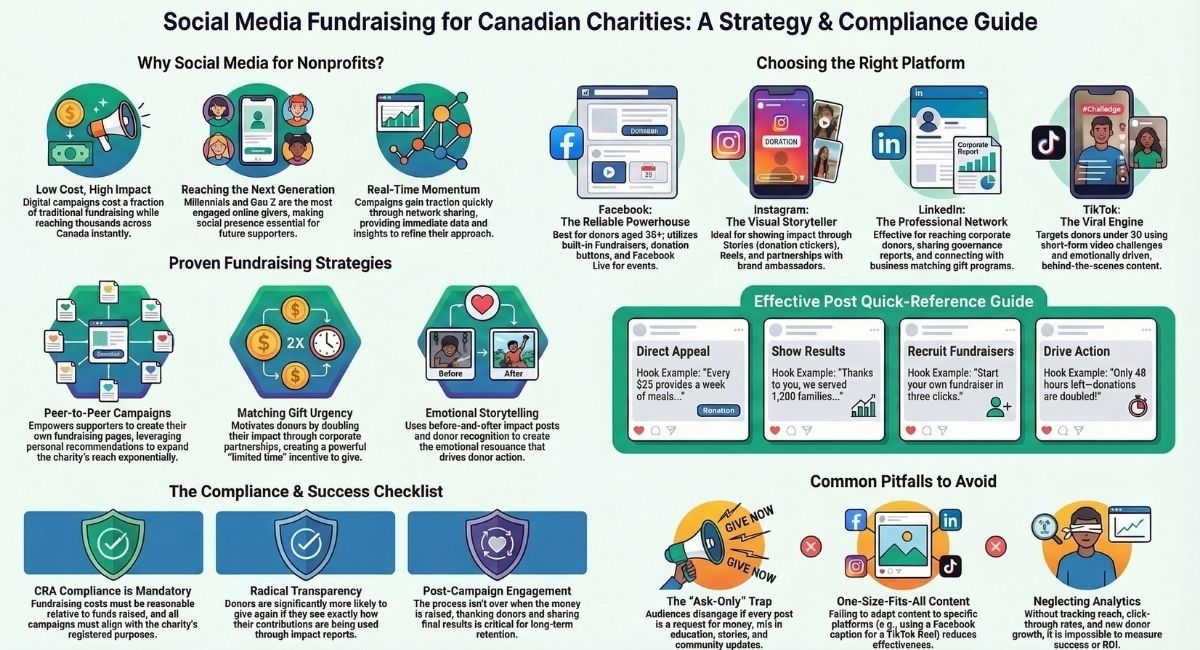
Canadian charities of all sizes are increasing their investment in social media — and for good reason. The combination of low cost, wide reach, and real-time engagement makes it a powerful fundraising channel.
Here is why more Canadian nonprofits are making social media central to their fundraising strategy:
- Low cost: Running a social media campaign costs a fraction of traditional direct mail or event-based fundraising.
- Wider reach: A single post can reach thousands of people across Canada and beyond.
- Younger donors: Millennials and Gen Z are among the most engaged online givers, and social media is where they respond to causes.
- Real-time momentum: Campaigns can gain traction quickly, especially when supporters share content within their own networks.
- Data and insights: Every platform provides analytics that charities can use to improve future campaigns.
Online giving in Canada has grown steadily, with more donors choosing digital channels over cheques or in-person events. Charities that are not visible on social media risk being overlooked by an entire generation of potential supporters.
Best Social Media Platforms for Canadian Charity Fundraising
Choosing the right platform is one of the most important decisions in any social media fundraising strategy. Each platform serves a different audience and requires a different approach.
Facebook remains one of the most effective platforms for Canadian charity fundraising, particularly for reaching donors aged 35 and older.
Key features include:
- Facebook Fundraisers, which allow supporters to raise money directly on the platform
- Donation buttons on charity pages
- Facebook Live for real-time campaign launches and donor events
Instagram is built for visual storytelling, making it ideal for charities that can show — not just tell — their impact.
Useful tools include:
- The donation sticker in Instagram Stories
- Reels for short, shareable awareness content
- Influencer and ambassador partnerships to expand reach
LinkedIn is often overlooked by nonprofits, but it is highly effective for reaching corporate donors and professional networks.
Charities can use LinkedIn to:
- Share impact reports and governance updates that appeal to professional donors
- Connect with businesses that offer matching gift programs
- Build credibility with foundations and institutional funders
TikTok
TikTok has become a genuine fundraising channel, especially for charities targeting donors under 30.
Short-form video challenges, behind-the-scenes content, and emotionally driven storytelling perform well on this platform. The viral nature of TikTok means a single well-crafted video can reach audiences far beyond a charity's existing followers.
Top Social Media Fundraising Strategies for Canadian Charities
A strong strategy is what separates a one-time viral moment from a sustainable fundraising programme. These are the most effective social media fundraising strategies for Canadian nonprofits.
Peer-to-Peer Fundraising Campaigns
Peer-to-peer fundraising turns supporters into fundraisers. Instead of the charity asking for donations directly, individuals create their own fundraising pages and share them with their personal networks.
This approach works well on Facebook and Instagram, where personal recommendations carry significant weight. It also reduces the burden on the charity's own channels while expanding reach exponentially.
Storytelling and Impact Content
Donors give to causes they feel connected to. Sharing real stories — from beneficiaries, volunteers, or staff — creates emotional resonance that drives action.
Effective storytelling content includes:
- Before-and-after impact posts
- Donor recognition and thank-you content
- Milestone announcements ("We've raised $50,000!")
- Behind-the-scenes glimpses of the charity's work
Fundraising Challenges and Viral Campaigns
A well-designed fundraising challenge can spread rapidly across social media. The ALS Ice Bucket Challenge remains the most well-known example, raising over $115 million globally.
Canadian charities can replicate this model by designing challenges that are simple, fun, and tied to a clear fundraising goal. Asking participants to nominate others keeps the chain going organically.
Matching Gift Campaigns
Matching gift campaigns create urgency by telling donors their contribution will be doubled. This is one of the most effective motivators in online fundraising.
Charities should promote matching gift campaigns prominently across all platforms and set a clear deadline to drive action before the match expires.
Live Fundraising Events
Live video on Facebook, Instagram, and YouTube allows charities to connect with donors in real time. Whether it is a charity gala broadcast, a Q&A with a program director, or a live progress thermometer, these events generate engagement that pre-recorded content cannot replicate.
Social Media Fundraising Post Examples for Canadian Charities
Knowing what to post — and how to write it — is one of the most common challenges for charity social media managers. Here are five post types with brief templates.
Each post type serves a different moment in the donor journey. A strong social media fundraising strategy rotates between all five rather than relying solely on donation asks.
Social Media Fundraising Best Practices for Canadian Nonprofits
Consistency and intention are what make social media fundraising work long-term. These best practices help Canadian charities build momentum and maintain donor trust.
- Post consistently: Irregular posting erodes audience trust. Aim for a minimum of three to five posts per week during active campaigns.
- Use analytics: Every major platform offers free insights. Track reach, engagement, and click-through rates to understand what resonates.
- Stay CRA-compliant: Fundraising costs must be reasonable relative to funds raised. Charities should ensure their online campaigns are documented and transparent.
- Be transparent: Share how donations are used. Donors who see the impact of their giving are significantly more likely to give again.
- Engage after the campaign: Thanking donors, sharing results, and following up with new supporters builds the long-term relationships that sustain a charity's fundraising efforts.
Common Mistakes to Avoid in Social Media Fundraising
Even well-intentioned charities make avoidable mistakes in their social media fundraising efforts. Recognizing these patterns early saves time, resources, and donor goodwill.
- Posting only donation asks: Audiences disengage quickly when every post asks for money. Mix in impact stories, educational content, and community updates.
- Ignoring platform differences: A Facebook post and an Instagram Reel serve different purposes. Content should be adapted for each platform, not copied and pasted.
- No post-campaign follow-up: Failing to thank donors or share results leaves supporters feeling undervalued.
- Not tracking performance: Without analytics, it is impossible to know what is working. Every campaign should have measurable goals.
- Inconsistent branding: Donors who encounter different messaging across platforms lose confidence in the organization.
Conclusion
Social media fundraising gives Canadian charities a powerful, cost-effective way to grow their donor base and deepen community connections. With the right strategy — grounded in storytelling, platform knowledge, and consistent engagement — nonprofits across Canada can raise more and build lasting relationships with supporters.
The legal and compliance side of fundraising matters just as much as the marketing side. Canadian charities must ensure their online campaigns meet CRA requirements and reflect their registered charitable purposes accurately.
B.I.G. Charity Law Group helps Canadian charities navigate registration, compliance, and governance so they can focus on their mission. To speak with a charity lawyer, contact us at dov.goldberg@charitylawgroup.ca, call 416-488-5888, or book a free consultation.
Frequently Asked Questions
What is the most effective social media platform for charity fundraising in Canada?
Facebook remains the highest-performing platform for donation volume among Canadian charities, particularly for donors over 35. Instagram and TikTok are more effective for awareness and reaching younger donors.
How do Canadian charities use social media for peer-to-peer fundraising?
Supporters create personal fundraising pages — often through Facebook Fundraisers or third-party platforms — and share them with their own networks. The charity provides assets, messaging, and encouragement to keep fundraisers motivated.
Are there CRA rules that apply to online social media fundraising?
Yes. The CRA requires that all fundraising activities align with a charity's registered purposes and that fundraising costs remain reasonable. Charities should also ensure that any online campaign clearly identifies the organization and avoids misleading claims.
What should a charity include in a social media fundraising post?
A strong fundraising post includes a clear ask, a specific dollar amount with impact context, an emotional hook, a deadline if applicable, and a direct link to donate.
How do I measure the success of a social media fundraising campaign?
Key metrics include total funds raised, number of new donors, reach and impressions, click-through rate on donation links, and follower growth during the campaign period.
The material provided on this website is for information purposes only.. You should not act or abstain from acting based upon such information without first consulting a Charity Lawyer. We do not warrant the accuracy or completeness of any information on this site. E-mail contact with anyone at B.I.G. Charity Law Group Professional Corporation is not intended to create, and receipt will not constitute, a solicitor-client relationship. Solicitor client relationship will only be created after we have reviewed your case or particulars, decided to accept your case and entered into a written retainer agreement or retainer letter with you.
.png)


