
Peer-to-Peer Fundraising: Guide for Charities & Supporters

Published on
April 11, 2024
Last updated on
March 12, 2026
Peer-to-peer fundraising is one of the most effective ways for Canadian charities to raise money and build strong communities.
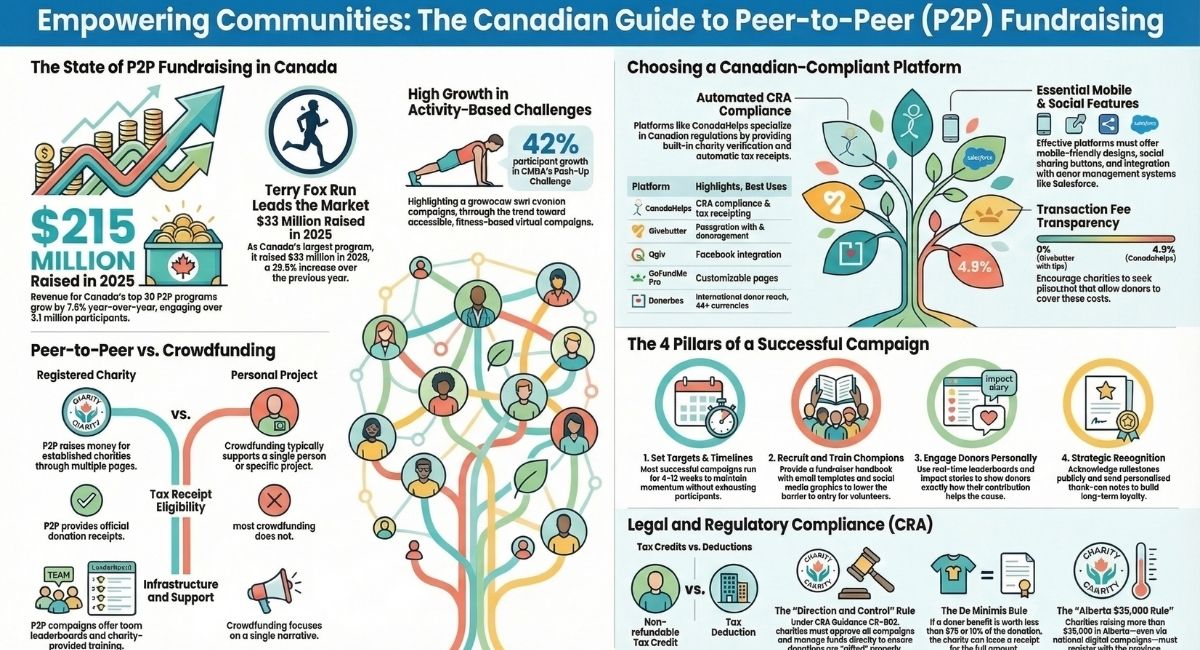
In 2025, Canada's top 30 peer-to-peer programs raised $215 million and engaged 5.1 million participants, showing 7.6% growth in revenue compared to the previous year.
This approach lets supporters create their own fundraising pages and ask friends and family to donate.
Every day, people become fundraising champions for causes they care about.
The success of programs like the Terry Fox Run, which raised $33 million in 2025, shows how powerful this fundraising method can be.
Canadian organizations are connecting with supporters through both in-person events and online campaigns.
Understanding how to set up and run these programs helps charities reach more donors and raise more funds.
This guide explores how peer-to-peer fundraising works in Canada, from choosing the right platform to running successful campaigns.
It covers current trends, legal requirements, and proven strategies that help organizations make the most of community-driven giving.
Whether planning a first campaign or looking to improve existing programs, these insights provide practical steps for success.
What Is Peer-to-Peer Fundraising in Canada?
Peer-to-peer fundraising empowers supporters to raise money for a charity by reaching out to their personal networks.
This approach turns donors into active fundraisers who create their own campaigns and share their connection to the cause with friends, family, and colleagues.
How Peer-to-Peer Fundraising Works
Supporters create individual fundraising pages connected to a main campaign.
Each fundraiser sets a personal goal and shares their page through email, social media, and text messages.
The charity provides the tools and resources needed, such as the online platform, marketing materials, and support for fundraisers.
Fundraisers then reach out to people they know and ask for donations.
People are more likely to give when someone they trust makes the ask.
Friends and family members feel a personal connection to the fundraiser's story, which brings in donors who might not respond to a general appeal from the charity.
Charities track all donations through their main platform and can see how each fundraiser performs.
The charity handles receipts, processes payments, and manages the backend work while fundraisers focus on spreading the word.
Types of Peer-to-Peer Campaigns
Event-based campaigns are the most common type in Canada.
These include runs, walks, cycling events, and challenge activities.
The Terry Fox Run raised $33 million in 2025 and stands as Canada's largest peer-to-peer fundraising program.
The Canadian Mental Health Association's Push-Up Challenge grew by 42% to reach 70,400 participants.
DIY fundraising lets supporters create their own events or activities.
They might host a dinner party, organize a neighbourhood event, or celebrate a birthday by asking for donations instead of gifts.
Virtual campaigns have grown since supporters can participate from anywhere.
These campaigns work well for people who cannot attend in-person events or live in remote areas.
Differences Between Peer-to-Peer and Crowdfunding
Peer-to-peer fundraising and crowdfunding platforms serve different purposes.
P2P fundraising focuses on raising money for an established charity through multiple fundraisers, each with a page linked to the main organization's campaign.
Crowdfunding typically supports a specific project or helps an individual in need.
One person or group runs the campaign and owns the fundraising page, with the money going directly to that project or person instead of a registered charity.
Key differences include:
- Tax receipts: P2P fundraising through charities provides official donation receipts, while most crowdfunding does not.
- Campaign structure: P2P uses many fundraisers under one umbrella, crowdfunding uses a single campaign page.
- Beneficiary: P2P raises funds for charities, crowdfunding supports individuals or specific projects.
- Platform features: P2P platforms offer team pages and fundraiser leaderboards, crowdfunding platforms focus on telling one story.
P2P campaigns provide more structure and support from the charity.
Fundraisers receive training, materials, and guidance throughout their campaign.
Key Trends and Insights from the Canadian Peer-to-Peer Landscape
The 2025 Canadian peer-to-peer fundraising landscape shows strong growth and adaptation.
Twenty-two of the top 30 programs reported revenue increases.
Organizations are finding new ways to connect with supporters while maintaining traditional fundraising events.
Growth Statistics and Participation
The Peer-to-Peer Professional Forum's 2025 study represents the largest examination of Canadian peer-to-peer programs in its 13-year history.
Twenty-two of the top 30 programs reported positive revenue growth during the year.
The entry threshold to make the top 30 list increased.
MS Canada's WeChallenge MS ranked 30th with $1,750,254 raised, which was $240,204 more than the amount needed to qualify for the 2024 list—a 16% increase.
Participation growth reached impressive levels across multiple programs.
The Canadian Mental Health Association's Push-Up Challenge achieved the highest percentage growth in participation, expanding by 42% to reach 70,400 participants.
This shows how charity partners can attract large numbers of supporters through innovative formats.
Leading Peer-to-Peer Programs
The Terry Fox Foundation's Terry Fox Run remained Canada's largest peer-to-peer fundraising program.
The Run raised $33 million in 2025, marking a 23.9% increase over the previous year and delivering the largest dollar gain of any program at $6.4 million.
Top Organizations by Number of Programs:
- The Princess Margaret Cancer Foundation - 4 programs
- The Canadian Cancer Society - 3 programs
- MS Canada - 3 programs
Three programs joined the peer-to-peer fundraising top 30 for the first time in 2025.
These are Hockey Helps the Homeless's Pro-Am Series at number 7, the Canadian Mental Health Association's Push-Up Challenge at number 15, and BC Children's Hospital Foundation's RBC Race for the Kids at number 26.
Recent Innovations and Adaptations
Marcie Maxwell, CEO of the Peer-to-Peer Professional Forum, noted that organizations are strengthening community and connection while adapting their approaches to meet supporters in meaningful and sustainable ways.
This shift reflects changes in how fundraising events engage participants.
Programs are focusing on formats that lower barriers to entry and increase accessibility.
The Push-Up Challenge shows how activity-based campaigns can attract tens of thousands of participants who might not join traditional walk or run events.
Organizations continue to balance innovation with proven methods.
The sustained success of established programs like the Terry Fox Run shows that well-executed traditional formats still raise money effectively, while newer entries prove that fresh approaches can quickly gain traction.
Choosing the Right Fundraising Platform
Selecting a fundraising platform requires attention to features that support peer-to-peer campaigns and meet Canadian charity regulations.
Organizations need platforms that handle both technical requirements and compliance standards.
Popular Peer-to-Peer Fundraising Platforms
Givebutter offers unlimited fundraising pages, live leaderboards, and built-in communication tools with no platform fees when donor tips are enabled.
The system supports Venmo, PayPal, and other mobile payment options.
CanadaHelps serves as a specialized platform for Canadian charities with built-in charity registration verification and automatic tax receipt delivery.
The platform charges 3.5% to 4% per transaction and handles all CRA compliance requirements.
GoFundMe Pro provides customizable donation pages and fundraiser coaching with dedicated support for larger organizations.
Pricing varies based on organization size and required features.
Qgiv includes Facebook integration at $259 per month plus a $25 base fee.
The platform connects with popular donor management systems like Bloomerang and Salesforce.
Donorbox supports 44+ currencies and works well for organizations with international donors.
The Standard plan costs $139 per month plus a 1.75% platform fee.
Essential Features for Canadian Charities
Customizable donation forms allow supporters to create personal fundraising pages quickly.
Forms should include space for personal stories, photos, and progress tracking with goal thermometers.
Mobile-friendly design matters since many donors give through smartphones.
Platforms should accept multiple payment methods, including credit cards, e-transfers, and digital wallets.
Real-time reporting helps campaign organizers track donations, identify top fundraisers, and measure progress.
Dashboard analytics should show donor activity, average gift amounts, and campaign velocity.
Integration with existing tools saves time on data entry.
Look for platforms that connect with email marketing software, donor databases, and accounting systems through direct integrations or tools like Zapier.
Social sharing features let fundraisers promote their pages on Facebook, Instagram, and other channels.
Built-in sharing buttons and QR codes make spreading the word easier for participants.
Platform Compliance and Tax Receipt Issuance
Canadian platforms must issue tax receipts that meet Canada Revenue Agency standards.
Receipts require the charity's registration number, donor information, donation amount, and proper date formatting.
Some platforms like CanadaHelps, handle tax receipt generation and delivery automatically.
Other platforms require charities to issue receipts manually or through separate accounting software.
Crowdfunding platforms must distinguish between donations (which qualify for tax receipts) and payments for goods or services (which don't).
The platform should clearly separate these transaction types.
Processing fees affect net revenue differently depending on whether donors can cover them.
Platforms that allow optional fee coverage preserve more funds for the charity's mission.
Data security requirements include PCI compliance for credit card processing and proper storage of donor information.
Canadian organizations must also follow privacy laws regarding donor data collection and usage.
Planning and Running Successful Peer-to-Peer Campaigns
A successful peer-to-peer campaign requires clear goals, well-trained fundraisers, and strong supporter engagement.
Each element builds on the others to create a campaign that grows beyond the organization's direct network.
Setting Goals and Structuring Your Campaign
Clear financial targets help fundraisers understand what they're working towards.
Organizations should set an overall campaign goal and individual fundraiser targets that feel achievable but meaningful.
The campaign structure includes the timeline, fundraising methods, and support materials.
Most campaigns run for 4-12 weeks, giving fundraisers enough time to reach their networks without losing momentum.
Shorter timelines work for event-based campaigns, while longer periods suit ongoing initiatives.
Campaign pages need simple registration processes and easy-to-use donation tools.
Fundraisers should access templates for emails, social media posts, and personal stories.
These materials reduce barriers and help supporters start fundraising quickly.
Track progress through a dashboard that shows individual and team totals.
Public leaderboards encourage friendly competition among fundraisers.
Recognition levels at different milestones keep loyal supporters motivated throughout the campaign.
Recruitment and Training of Fundraisers
Start recruitment by identifying passionate supporters who already connect with the cause.
Board members, volunteers, previous donors, and event participants make strong candidates.
Personal invitations work better than broad appeals.
Training sessions equip fundraisers with the confidence and tools they need.
Cover how to share personal stories, ask for donations, and use the fundraising platform.
Role-playing exercises help supporters practise conversations with potential donors.
Provide a fundraiser handbook with step-by-step instructions, sample messages, and answers to common questions.
Include guidance on setting up personal fundraising pages and connecting social media accounts.
New fundraisers need reassurance that asking for support gets easier with practice.
Check in with fundraisers regularly through email updates, group calls, or one-on-one conversations.
Address questions quickly and celebrate early wins to build confidence across the team.
Engaging Donors and Supporters
Donor engagement starts with compelling stories that explain why the cause matters.
Fundraisers should share personal connections to the mission and specific examples of impact.
Authentic messages resonate more than generic appeals.
The donor experience should be seamless across all touchpoints.
Mobile-friendly donation pages, multiple payment options, and instant thank-you messages show professionalism.
Automated receipts and follow-up emails keep donors informed about their contribution's impact.
Regular updates during the fundraising campaign maintain momentum.
Share progress towards goals, highlight top fundraisers, and post photos or videos from related activities.
These touchpoints remind supporters why their participation matters.
Recognition programmes acknowledge different contribution levels and engagement types.
Thank donors publicly (with permission), send personalized notes, and share impact reports after the campaign ends.
This attention to the donor experience builds loyalty for future campaigns.
Integrating Fundraising Events with Peer-to-Peer Strategies
Combining traditional fundraising events with peer-to-peer campaigns helps nonprofits expand their reach and increase donations. Canadian organizations now use hybrid approaches that blend in-person activities with digital fundraising tools to engage supporters on multiple platforms.
Examples of Canadian Peer-to-Peer Events
Walk-a-thons and run-a-thons are popular peer-to-peer campaigns in Canada. Registered charities like the Canadian Cancer Society and Heart and Stroke Foundation use these events to mobilize supporters.
Participants create personal fundraising pages and ask friends, family, and colleagues to sponsor them. This approach helps raise more funds and build community support.
Cycling events are common in Canadian communities during warmer months. Riders set distance goals and collect pledges based on kilometres travelled.
These events attract both competitive cyclists and casual riders. They offer a flexible way for supporters to participate and fundraise.
Read-a-thons work well for schools and literacy-focused registered charities. Students commit to reading a certain number of books or pages and gather sponsorships.
Libraries and charitable organizations find this format effective for engaging young supporters and their families. It encourages reading while supporting a cause.
Creative skill-based events like craft workshops or cooking classes offer fresh alternatives. Participants pay to attend and also fundraise through their networks.
Sharing progress on social media builds awareness for the cause and helps participants build new skills. This format adds variety to fundraising options.
Hybrid and Virtual Event Approaches
Virtual fitness challenges remove geographical barriers for participants. Supporters complete activities like running, walking, or cycling in their own neighbourhoods and track progress through apps.
Registered charities provide digital toolkits with social media templates and fundraising tips. These resources help participants succeed in their campaigns.
Hybrid events combine in-person gatherings with virtual participation options. For example, a charity walk may have a central location in Toronto and allow supporters in other cities to join remotely.
This approach increases accessibility and expands the donor base beyond a single city or province. More people can participate regardless of location. Online challenge campaigns encourage daily or weekly activities aligned with the registered charity's mission.
Environmental groups might run eco-friendly challenges, while health-focused registered charities design fitness activities.
Participants document their efforts with photos and videos, using campaign-specific hashtags. This builds community engagement and attracts donations.
Compliance, Legal Considerations, and Best Practices
Peer-to-peer fundraising in Canada requires charities to follow regulations around tax receipting, donor relationships, and third-party activities. Registered charities must keep control over fundraising campaigns and comply with Canada Revenue Agency rules and provincial requirements.
Canada Revenue Agency Requirements
Registered charities in Canada must follow CRA guidelines for peer-to-peer fundraising. It is important to note that only registered charities — not general non-profit organizations (NPOs) under section 149(1)(l) of the Income Tax Act — can issue official donation receipts.
When an individual Canadian donor receives a donation receipt from a registered charity, it provides a non-refundable tax credit, not a tax deduction.
Corporations that donate may claim a deduction, but for most P2P campaigns involving individual donors, the correct term is tax credit.
Charities should use the term "donation receipt" in all materials to ensure technical accuracy with CRA requirements.
The CRA also requires that registered charities maintain direction and control over all peer-to-peer fundraising activities. Under CRA Guidance CG-002 (Third-Party Fundraisers), charities must approve campaigns, manage funds directly, and ensure all donations flow to the charity's account.
A written Third-Party Fundraising Agreement should be in place before any campaign launches. This agreement formally establishes the fundraiser as an agent of the charity and is essential for ensuring donations are properly "gifted" to the organization in compliance with CRA rules.
Without this agreement, the CRA may take the position that funds were not received as charitable gifts. Donation receipts can only be issued when donors give voluntarily without receiving goods or services in return of equal or greater value.
Guidelines for Registered Charities
Charities should create written policies for peer-to-peer fundraising. These policies cover how participants use the organization's name and branding.
This protects the charity's reputation and ensures fundraisers represent the organization accurately. The charity is responsible for all fundraising activities done in its name.
All donations must go directly to the charity's bank account. Fundraisers cannot collect cash or cheques made out to themselves.
Online fundraising platforms should connect with the charity's donation system for proper tracking and receipting. This ensures donations are processed correctly.
Charities need to keep detailed records of all peer-to-peer campaigns. This includes participant information, donation amounts, and receipt details.
These records support the charity's annual reporting to the CRA and show proper oversight of fundraising activities.
If participants pay registration fees or receive merchandise in connection with their donation, charities must calculate the fair market value (FMV) of these benefits and apply split receipting rules.
This means the charity subtracts the FMV of the benefit from the donation amount, and only issues a donation receipt for the remaining eligible portion.
However, under the CRA's de minimis rule, if the advantage (benefit) received by the donor is less than the lesser of $75 or 10% of the donation amount, the advantage is considered negligible.
In that case, the charity may issue a donation receipt for the full gift amount without applying split receipting. Understanding this threshold is important for national P2P campaigns where small branded merchandise or nominal registration perks are common.
Maximizing Impact Through Community and Charity Partnerships
Strong partnerships and strategic social sharing are key to successful peer-to-peer fundraising in Canada. Organizations that build connections with community partners and equip supporters with sharing tools reach more donors and raise more funds.
Building Strong Partnerships
Charity partners extend the reach of fundraising campaigns beyond an organization's network. Nonprofits benefit from working with local businesses, community groups, and influencers who have trust in their communities.
These partnerships connect charities with new audiences. For example, a running club working with a health charity brings dedicated athletes who can turn training events into fundraising opportunities.
Community leaders who promote campaigns add credibility and encourage participation. Successful partnerships require clear communication about goals and expectations.
Charity partners need information about the campaign's purpose, fundraising targets, and how their involvement helps. Organizations should provide partners with materials like images, talking points, and fundraising templates.
The best partnerships create mutual value. When community organizations align with causes important to their members, they strengthen connections while helping charities reach fundraising goals.
Leveraging Social Sharing for Reach
Social sharing turns individual fundraisers into campaign ambassadors. Participants share their fundraising pages with friends, family, and colleagues through social media, email, and messaging apps.
Each share acts as a personal endorsement of the charity's work. People trust recommendations from those they know, making social sharing more effective than traditional advertising.
Fundraisers who share updates, explain their support, and thank donors publicly usually raise more money. Organizations should make sharing easy by providing photos, videos, and pre-written messages that fundraisers can customize.
Campaign pages should have sharing buttons for Facebook, Instagram, Twitter, and LinkedIn. This helps participants post updates with one click.
Regular sharing during the campaign keeps momentum high. Fundraisers who post updates at the start, midpoint, and final days keep their cause visible and remind supporters to donate.
Conclusion
Peer-to-peer fundraising is growing in Canada. Top programs raised $215 million in 2025 and engaged over 5.1 million participants.
This approach works because it builds real connections between supporters and causes they care about. Canadian charities running P2P campaigns must understand legal requirements and compliance rules.
B.I.G. Charity Law Group helps charities and nonprofits navigate fundraising regulations, set up compliant P2P structures, and avoid legal pitfalls. Contact Dov Goldberg at dov.goldberg@charitylawgroup.ca or call 416-488-5888 to discuss your organization's peer-to-peer fundraising plans.
Schedule a FREE Consultation to learn how CharityLawGroup.ca can support your fundraising success. The firm provides practical legal guidance to help Canadian charities raise funds confidently while staying compliant with CRA rules and provincial regulations.
Frequently Asked Questions
Canadian charities face unique considerations when launching peer-to-peer campaigns, from provincial regulations to tax receipt requirements. These common questions address practical and legal aspects of running successful peer-to-peer fundraising programs in Canada.
What are the most effective strategies for organizing a peer-to-peer fundraising campaign in Canada?
Charities should start by setting clear campaign goals and choosing between team-based or individual fundraising models. Team-based campaigns work well for events like walks or runs, while individual fundraising suits year-round programs for personal milestones.
Organizations need to provide fundraisers with easy-to-use tools and resources. This includes customizable fundraising page templates, social media graphics, and email templates.
Setting realistic fundraising targets helps keep participants motivated. Charities should also give fundraisers enough time to reach their networks without losing energy.
Regular communication keeps fundraisers engaged. Updates on progress, recognition of top performers, and sharing success stories help build community and encourage continued effort.
Are there specific regulations governing peer-to-peer fundraising campaigns in Canadian provinces?
Each province has its own charitable fundraising regulations that registered charities running P2P campaigns must follow. Quebec has strict fundraising rules that require registration with the Registraire des entreprises.
Organizations running campaigns in Quebec must provide specific disclosures and follow additional reporting requirements. In Ontario, registered charities are subject to oversight from the Public Guardian and Trustee (PGT) under the Charities Accounting Act, which governs how charitable funds are managed and held in trust.
A common and often overlooked pitfall for national P2P campaigns is Alberta. Under the Charitable Fund-raising Act (Alberta), any organization that raises more than $25,000 in Alberta — even as part of a national P2P campaign — must be registered with the province before soliciting donations there.
This threshold can be reached quickly during a successful national campaign, making Alberta registration a practical compliance issue for many organizations that may not have considered themselves "operating" in that province.
Federal regulations under the Canada Revenue Agency apply to all registered charities across Canada. These rules govern donation receipts and define what activities qualify as charitable fundraising. Organizations should review both federal CRA requirements and provincial fundraising legislation before launching any national P2P campaign.
How can Canadian charities issue donation receipts for donations received through peer-to-peer fundraising efforts?
The Canada Revenue Agency requires that only a registered charity can issue official donation receipts. Registered charities are responsible for all receipting, even when donations come through peer-to-peer fundraising pages.
For individual Canadian donors, a donation receipt provides a non-refundable tax credit; corporations that donate may claim a tax deduction. Donations must go directly to the charity to qualify for donation receipts. Fundraisers cannot collect money personally and then transfer it to the organization if donors expect receipts.
Most peer-to-peer platforms process donations directly to the charity and generate donation receipts on the organization's behalf. This ensures compliance with CRA requirements and makes administration easier.
Charities should tell fundraisers that they cannot promise donation receipts for donations collected outside the official platform. Only donations processed through proper channels qualify for receipting.
What digital platforms are recommended for peer-to-peer fundraising in a Canadian context?
CanadaHelps offers peer-to-peer fundraising tools designed for Canadian charities. The platform provides both charity-led campaign options and third-party fundraising capabilities, with fees of 4.9% including credit card processing.
CanadaHelps supports team-based fundraising for events and individual fundraising pages for year-round campaigns. Charities get branding options, customization features, and detailed reporting.
GoFundMe Charity and other international platforms also operate in Canada, but charities should check if these platforms meet CRA requirements for tax receipting. Some platforms may not be optimized for Canadian tax receipts or comply with provincial regulations.
Organizations should evaluate platforms based on fees, features, Canadian compliance, and ease of use. The right choice depends on campaign type, budget, and technical needs.
How can registered charities ensure transparency and trust in their peer-to-peer fundraising campaigns?
Clear communication about how donations will be used builds trust with fundraisers and donors. Registered charities should provide specific information about the programs or projects the campaign supports.
Charities must disclose all fees and processing costs related to donations. Transparency about platform fees and administrative costs helps donors understand how their contributions are used. Regular reporting on campaign progress and impact shows accountability.
Organizations should share updates on funds raised, how money is used, and the difference donations make.
Providing fundraisers with accurate information ensures they can answer questions from their networks.
Support materials should include facts about the organization's work, financial accountability, and charitable registration details.
What are the best practices for motivating and supporting volunteers in a Canadian peer-to-peer fundraising initiative?
Comprehensive onboarding helps fundraisers succeed from the beginning. Organizations should give clear instructions and provide access to fundraising tools.
Sharing specific examples of effective outreach messages can guide volunteers. Recognition programs should acknowledge fundraising efforts at different levels.
Celebrating milestones and publicly thanking participants keeps motivation high. Charities should assign coordinators to support fundraisers with questions or challenges.
Making help available through email, phone, or chat ensures fundraisers feel supported. Providing regular content updates gives fundraisers fresh material to share.
Progress reports and impact stories help fundraisers stay engaged with their supporters. Organizations can create friendly competition through leaderboards and challenges.
Team-based campaigns benefit from both individual and team recognition opportunities.
The material provided on this website is for information purposes only.. You should not act or abstain from acting based upon such information without first consulting a Charity Lawyer. We do not warrant the accuracy or completeness of any information on this site. E-mail contact with anyone at B.I.G. Charity Law Group Professional Corporation is not intended to create, and receipt will not constitute, a solicitor-client relationship. Solicitor client relationship will only be created after we have reviewed your case or particulars, decided to accept your case and entered into a written retainer agreement or retainer letter with you.
.png)


