
How Can Charities Effectively Manage Volunteers?

Published on
May 25, 2023
Last updated on
April 28, 2026
In 2026, Canadian charities are navigating a shifting volunteerism landscape — one where people want flexibility, meaningful work, and clear communication. Volunteer recruitment and retention have become top priorities for nonprofits of all sizes, as post-pandemic shifts in how Canadians give their time continue to reshape the sector.
Volunteers play a vital role in helping Canadian charities achieve their missions and serve their communities. These individuals donate their time and skills to support causes they care about.
Managing volunteers well requires careful planning and clear processes. Charities can effectively manage volunteers by creating structured programs that include proper recruitment, training, ongoing support, and recognition systems.
A strong volunteer management framework helps attract the right people and keep them engaged. It also ensures volunteers have positive experiences while contributing meaningful work.
The landscape of volunteerism in Canada is changing as people look for more flexible opportunities and better communication from organizations. Charities need to adapt their programs to meet these new expectations while maintaining quality standards.
Building the right systems and using modern tools can help organizations strengthen their volunteer programs. This creates lasting relationships with their supporters.
This guide has been updated for 2026 to reflect current best practices and emerging trends in Canadian volunteer management.
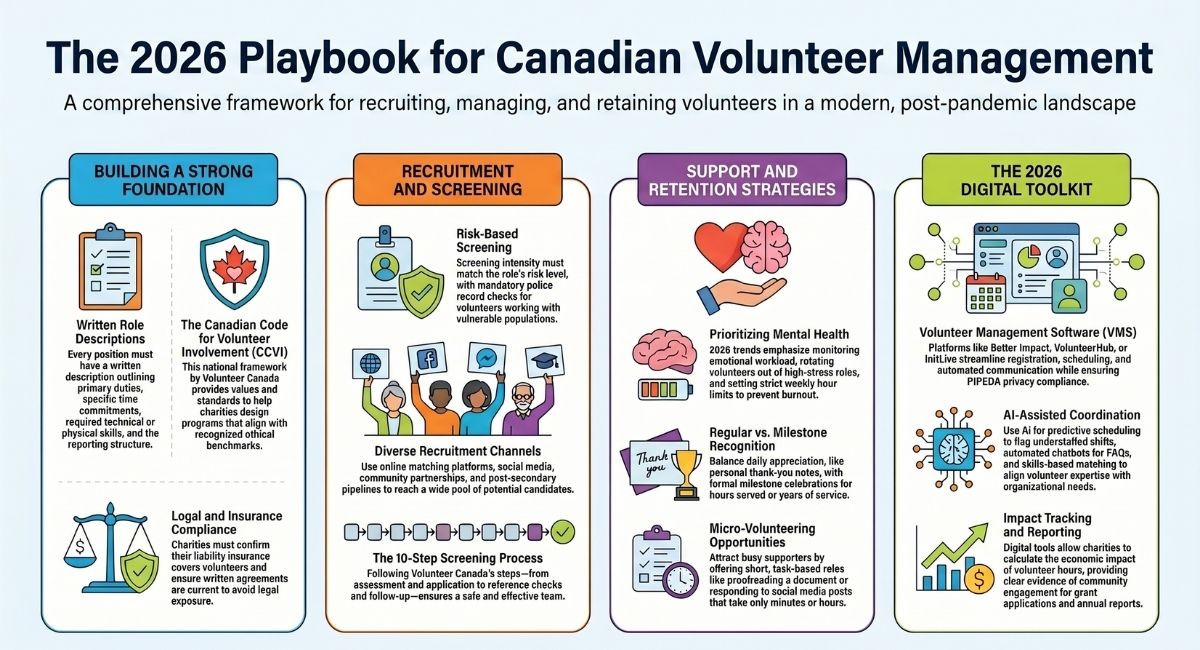
Building a Strong Volunteer Management Framework
A solid framework for volunteer management requires clear role definitions and written policies. These elements create consistency and help organizations manage volunteers effectively while meeting legal and ethical obligations. For a broader overview of how governance structures support this work, see our guide on charity governance best practices for Canadian nonprofits.
Defining Volunteer Roles and Responsibilities
Clear volunteer roles prevent confusion and help match the right people to the right tasks. Each position should have a written description outlining duties, time commitments, and required skills.
Role descriptions should include:
- Primary responsibilities and daily tasks
- Time requirements (hours per week or month)
- Skills needed (technical abilities, physical requirements, interpersonal skills)
- Reporting structure (who the volunteer works with and reports to)
- Training provided by the organization
Organizations should create distinct roles for different functions. A volunteer manager can use these descriptions during recruitment to attract suitable candidates.
Well-defined roles help volunteers understand how their work contributes to the organization's mission.
Establishing Policies and Procedures
Written policies create consistency in how an organization approaches volunteer management. These policies guide decision-making and help volunteer managers handle situations fairly.
Essential policies cover screening and selection, training requirements, expense reimbursement, conflict resolution, and recognition practices. Organizations should document procedures for onboarding, tracking hours, providing supervision, and handling performance issues.
Policies must address health and safety, confidentiality, and the process for ending a volunteer relationship. Clear documentation sets expectations and protects both the organization and its volunteers. Charities should also ensure they have a formal conflict of interest policy in place that covers volunteer leadership roles.
The Legal Framework and the Code for Volunteer Involvement
The Canadian Code for Volunteer Involvement (CCVI) provides a national framework for organizations that engage volunteers. This guide, developed by Volunteer Canada, helps charities design volunteer programs that align with recognized standards.
The CCVI outlines values and benefits of volunteerism while offering a structure for organizational decisions. It supports meaningful volunteer involvement that serves both organizational needs and volunteer goals.
While volunteers are not employees, charities still have significant legal responsibilities toward them. Volunteers are not covered by employment standards legislation in most provinces, but some provincial occupational health and safety laws do extend protections to volunteers in certain settings. In Ontario, for example, the Occupational Health and Safety Act (OHSA) applies to some volunteer contexts depending on the nature of the work performed.
Charities should also ensure their volunteer agreements are current and in writing. Unwritten or outdated agreements expose organizations to liability that can be easily avoided with proper documentation. Organizations must also confirm that their general liability insurance policy covers volunteers, or that they carry a separate volunteers-as-insureds policy.
Understanding the full scope of director and organizational liability is important when building a volunteer program. Our article on liabilities for charity directors and members provides useful context for board members overseeing volunteer operations.
For legal questions about volunteer agreements, insurance requirements, or compliance with provincial legislation, consulting a Canadian charity law specialist is strongly recommended.
Recruiting and Screening Volunteers in Canada
Canadian charities need structured approaches to find and vet volunteers who align with their mission. Organizations must balance efficient recruitment with thorough screening to build safe, effective teams.
Effective Volunteer Recruitment Channels
Charities can use multiple recruitment channels to reach potential volunteers. Online platforms like volunteer matching websites connect organizations with people seeking opportunities.
Social media helps charities share volunteer needs with wider audiences and encourages referrals. Community partnerships with schools, businesses, and faith groups provide access to organized volunteer pools.
Many post-secondary institutions require students to complete volunteer hours, creating natural recruitment pipelines. Local volunteer centres across Canada also maintain databases of people interested in volunteering.
Direct outreach at community events allows charities to meet potential volunteers face-to-face. Organizations should maintain waitlists during periods when they cannot accommodate new volunteers.
Clear position descriptions posted across multiple channels help attract candidates whose skills match organizational needs.
Volunteer Screening and Background Checks
Volunteer screening is an ongoing process that ensures volunteers meet organizational needs while protecting clients and communities. Volunteer Canada identifies 10 key steps: assessment, position assignment, recruitment, application, interview, references, police checks, orientation and training, support and supervision, and follow-up and feedback.
The screening process must match the level of risk associated with each role. Volunteers working with vulnerable populations require more extensive screening than those in low-risk positions.
Applications should collect relevant information about skills, experience, and availability. Essential screening components include:
- Written applications documenting qualifications and interests
- In-person or virtual interviews to assess suitability
- Reference checks from previous volunteer or work experiences
- Police record checks when positions involve vulnerable populations
- Clear policies outlining organizational expectations
Organizations carry moral, legal, and ethical responsibilities to screen volunteers appropriately. Boards of directors must establish screening policies that address their specific mandate and populations served. The charity board of directors carries ultimate responsibility for ensuring these standards are met.
Matching Volunteers to Opportunities
Effective matching considers both organizational needs and volunteer goals. Organizations should identify the specific skills, time commitment, and qualifications required for each position before recruitment.
This clarity helps managers place volunteers in roles where they can succeed and contribute meaningfully. The screening process reveals volunteer interests, available hours, and relevant experience.
Managers should discuss expectations openly during interviews to ensure mutual understanding. Some volunteers seek skill development, while others prefer familiar tasks or social connection.
Organizations benefit when they offer varied opportunities with different time commitments and skill requirements. Short-term projects attract people who cannot commit to ongoing roles.
Skill-based volunteering appeals to professionals wanting to use their expertise. Regular check-ins help organizations adjust assignments as volunteer interests or availability change.
Onboarding, Training, and Supporting Volunteers
A strong onboarding process sets the foundation for volunteer engagement. Ongoing training and accessible resources help volunteers feel prepared and valued in their roles.
Comprehensive Orientation Process
New volunteers need structured orientation to understand their role within the organization. The orientation should cover the charity's mission, values, and how volunteer work contributes to goals.
Volunteer coordinators must provide clear information about expectations, schedules, and performance standards. Screening procedures appropriate to the role should be implemented, including reference checks and police record checks where necessary.
The Canadian Code for Volunteer Involvement emphasizes that screening protects both the organization and the people it serves. Orientation materials should be available in multiple formats to accommodate different learning styles.
Written handbooks, video tutorials, and in-person sessions all play a role in effective onboarding. Volunteers should receive contact information for their manager and know who to approach with questions.
Ongoing Training and Supervision
Managing volunteers requires continuous skill development beyond initial orientation. Regular training sessions keep volunteers updated on best practices, new procedures, and safety protocols.
These sessions also provide opportunities for volunteers to share experiences and learn from each other. Volunteer managers should schedule regular check-ins to discuss progress and address challenges.
Supervision means providing guidance and feedback when needed. Clear communication channels between volunteers and coordinators ensure issues are resolved quickly.
Organizations should offer advancement opportunities for volunteers who want to take on more responsibility. Specialized training for leadership roles or new program areas demonstrates investment in volunteer growth. Charities may also find it useful to review the annual checklist for charity boards of directors to ensure volunteer oversight is built into regular governance cycles.
Providing Resources and Accessibility
Volunteers need proper tools and materials to perform their duties effectively. This includes equipment, supplies, and digital access to schedules and training materials.
A well-organized resource system saves time and reduces frustration. Accessibility must be a priority in volunteer program design.
Organizations should accommodate volunteers with disabilities, language barriers, or transportation challenges. Flexible scheduling options and remote volunteer opportunities expand participation.
Documentation of policies, procedures, and volunteer rights should be readily available. Volunteers need to know their responsibilities and what support they can expect from the organization.
Clear guidelines about expense reimbursement, insurance coverage, and recognition programs help volunteers feel secure in their roles.
Enhancing Volunteer Engagement and Satisfaction
Keeping volunteers engaged and satisfied requires deliberate effort from volunteer managers. Consistent recognition, clear communication, and meaningful opportunities are key.
Organizations that invest in these areas see better retention rates and build stronger volunteer communities.
Volunteer Engagement Strategies
Volunteer managers should match volunteers with roles that align with their skills and interests. This creates more meaningful experiences and helps volunteers feel their time is well spent.
Organizations can improve engagement by conducting initial interviews to understand what motivates each person. Clear communication stands as a cornerstone of effective engagement strategies.
Volunteers need to know what is expected of them and how their work contributes to the mission. Regular updates through email, text messages, or volunteer management platforms keep everyone informed.
Providing flexible scheduling options helps volunteers balance their commitments. Organizations that accommodate different availability levels attract and retain more volunteers.
Training and skill development opportunities also boost engagement. When volunteers learn new skills, they feel their time investment provides personal growth alongside community impact.
Supporting Volunteer Mental Health and Preventing Burnout
Volunteer burnout is one of the leading reasons Canadians step back from organizations they once committed to. This is especially true for volunteers working in high-demand roles — supporting vulnerable populations, responding to crises, or filling in gaps left by understaffed teams.
In 2025 and 2026, the nonprofit sector has placed increasing attention on volunteer wellbeing as a direct driver of retention. Charities that monitor emotional workload and respond to early warning signs keep volunteers engaged far longer than those that focus only on task completion.
Practical steps to support volunteer mental health include:
- Scheduling regular check-ins that ask how the volunteer is feeling, not just how their tasks are going
- Rotating volunteers out of high-stress roles periodically to prevent emotional exhaustion
- Setting clear limits on weekly hours so volunteers are not quietly overcommitted
- Creating a psychologically safe environment where volunteers can raise concerns without fear of losing their role
- Offering peer support connections so volunteers working in isolation feel part of a wider team
Exit interviews with departing volunteers frequently reveal burnout as an underlying factor, even when the stated reason is scheduling or availability. Building mental health awareness into volunteer coordination is no longer optional — it is a core retention strategy for Canadian charities in 2026.
Recognition and Volunteer Appreciation
Volunteer appreciation should happen regularly, not just during special events. Simple thank-you notes, phone calls, or emails acknowledge contributions and make volunteers feel valued.
Public recognition through social media posts, newsletters, or annual reports highlights volunteer impact to the broader community. Recognition programs can include milestone celebrations for hours served, years of service, or special achievements.
These markers give volunteers something to work toward and show attention to individual contributions. Effective appreciation methods include:
- Personal thank-you messages from staff or board members
- Volunteer spotlights in organizational communications
- Small tokens like certificates, pins, or gift cards
- Annual volunteer appreciation events
- Reference letters or LinkedIn recommendations
Fostering Volunteer Satisfaction and Retention
Volunteer satisfaction grows when organizations create welcoming environments where people feel respected and supported. Managers should check in regularly with volunteers to ask about their experiences and address concerns promptly.
These conversations reveal what is working well and what needs improvement. Volunteers stay longer with organizations that provide meaningful work and show genuine appreciation for their efforts.
Exit interviews with departing volunteers offer valuable insights into why people leave and how the organization can improve. Building community among volunteers through team activities or social gatherings strengthens connections and increases satisfaction.
When volunteers form friendships and feel part of a team, they are more likely to continue volunteering. Organizations should also solicit volunteer feedback through surveys or suggestion boxes to improve their programs.
Leveraging Technology and Volunteer Management Tools
Technology has transformed how Canadian charities coordinate their volunteer programs. The right digital tools help organizations save time on administrative work and improve communication with volunteers. They also help track the success of their programs.
Choosing Volunteer Management Software
Canadian charities should look for software that matches their specific needs and budget. Essential features include volunteer registration, scheduling tools, and a centralized database to store volunteer information.
Many platforms offer additional capabilities like automated communications, waiver management, and mobile check-in options. Organizations should consider whether the software integrates with their existing systems.
Integration with fundraising platforms or CRM systems helps maintain accurate data. The interface needs to be simple so both staff and volunteers can use it easily.
Price structures vary among providers. Some platforms charge based on the number of active volunteers, while others offer unlimited volunteers at a flat rate.
Charities should also evaluate the level of customer support and whether the software complies with Canadian privacy laws. Popular platforms used by Canadian charities in 2025–2026 include Better Impact, VolunteerHub, and InitLive. Charities should confirm that any platform selected complies with PIPEDA and applicable provincial privacy legislation before storing volunteer data.
Streamlining Communication and Scheduling
Volunteer management software reduces the time managers spend on routine tasks. Automated email and text reminders help decrease no-shows and keep volunteers informed about upcoming shifts.
These systems allow charities to send targeted messages to specific volunteer groups. Digital scheduling tools let volunteers sign up for opportunities that fit their availability.
They can view open shifts, register online, and receive confirmation instantly. Managers can track who is scheduled for each event and quickly fill gaps when volunteers cancel.
Many platforms include volunteer portals where people can update their profiles, log hours, and communicate with staff. This self-service approach frees up staff time and gives volunteers more control over their participation.
Using AI Tools to Strengthen Volunteer Programs in 2026
Artificial intelligence is beginning to reshape how Canadian charities coordinate and retain volunteers. While adoption is still growing across the nonprofit sector, AI-powered tools now offer practical benefits that organizations of any size can access.
Key applications include:
- Predictive scheduling: AI tools can analyze patterns in volunteer attendance and flag shifts at risk of being understaffed before they become a problem, prompting managers to reach out early
- Automated volunteer support: Chatbots and AI-powered messaging tools handle routine inquiries, onboarding FAQs, and shift reminders without requiring staff involvement — freeing coordinators to focus on relationship-building
- Skills-based matching: AI-assisted platforms can match volunteer skills and availability to organizational needs more accurately than manual sorting, reducing mismatched placements and improving retention
- Volunteer feedback analysis: Some platforms now use AI to identify patterns in volunteer survey responses, helping managers spot emerging dissatisfaction before it leads to departures
Charities adopting AI tools must ensure these systems comply with Canadian privacy legislation. PIPEDA and provincial privacy laws apply to the collection and use of volunteer data, and charities should review data handling practices before deploying any AI platform that processes personal information.
AI tools work best as a complement to, not a replacement for, human relationship-building. Volunteers stay because they feel valued and connected — technology supports that goal but does not substitute for it.
Tracking Impact and Reporting
Digital tools make it easier to measure the value volunteers bring to an organization. Software can automatically track volunteer hours and calculate their economic impact using standard hourly rates.
This data helps charities demonstrate their effectiveness to funders and community stakeholders. Reporting features allow managers to generate summaries of volunteer activities, participation trends, and program outcomes.
Organizations can identify which opportunities attract the most volunteers and which need improvement. These insights support better planning and resource allocation.
Data collected through volunteer management systems strengthens grant applications and annual reports. Charts and reports showing volunteer contributions provide clear evidence of community engagement and program success.
Ensuring Sustainability of Volunteer Programs
Volunteer programs need financial stability, adaptable practices, and connections to broader networks to remain effective over time. Organizations must respond to changing volunteer expectations while refining their approaches based on feedback and sector strategies.
Adapting to Changing Trends in Volunteerism
Volunteerism in Canada has shifted significantly in recent years. Volunteers now expect flexible scheduling, meaningful experiences, and efficient communication from organizations.
Many prefer short-term commitments or project-based opportunities instead of ongoing roles. Post-pandemic trends have accelerated this shift, with Volunteer Canada's research indicating that formal volunteering rates declined and have been slow to recover, placing greater pressure on charities to make the most of every volunteer interaction.
Organizations must modernize their recruitment and engagement strategies to meet these expectations. This includes offering virtual volunteering options, creating varied role types, and using digital platforms for communication and coordination.
Managers of volunteers should regularly assess which opportunities attract new participants and which formats work best for retention. Demographic changes also affect volunteer availability. Younger volunteers often seek skill-building experiences, while older volunteers may want social connection alongside their service.
Programs that offer diverse opportunities across different time commitments and skill levels are better positioned to attract a broader range of participants.
Micro-Volunteering and Skills-Based Opportunities
One of the most significant shifts in Canadian volunteerism in 2025–2026 is the growth of micro-volunteering — short, task-based contributions that take minutes or hours rather than requiring an ongoing commitment.
Micro-volunteering examples include:
- Reviewing a document or proofreading a grant application
- Responding to a social media post on behalf of the organization
- Completing a short survey or providing professional feedback
- Participating in a one-time virtual event or information session
This model matters because busy Canadians who cannot commit to weekly shifts are often willing to contribute in smaller bursts. Organizations that offer micro-volunteering opportunities widen their recruitment pool significantly and build a pipeline of supporters who may eventually take on larger roles.
Skills-based volunteering is a related trend with strong momentum. This involves engaging professionals — lawyers, accountants, graphic designers, IT specialists, HR professionals — to donate their expertise directly to charity operations. Skills-based volunteers often provide services the organization could not afford to purchase, and they tend to be highly motivated because their contribution is directly tied to their professional identity.
Charities looking to launch skills-based volunteering programs should:
- Identify specific operational gaps where professional expertise would have the most impact
- Create project-based role descriptions with defined start and end dates
- Partner with professional associations or firms interested in corporate social responsibility initiatives
- Treat skills-based volunteers with the same onboarding, recognition, and communication standards applied to all other volunteers
Continuous Improvement and Feedback
Collecting and acting on volunteer feedback keeps programs relevant and effective. Organizations should create regular opportunities for volunteers to share their experiences, suggestions, and concerns through surveys, informal check-ins, or focus groups.
Managers of volunteers need to review this feedback systematically and implement changes where appropriate. This might include adjusting training methods, revising role descriptions, or improving communication processes.
Tracking volunteer satisfaction and retention rates helps identify areas needing attention before small issues become larger problems. Organizations should also document what works well in their volunteer programs.
Creating written procedures and updating policies based on lessons learned ensures knowledge remains within the organization even when personnel changes occur. For charities thinking about long-term organizational continuity, our article on charity succession planning in Canada is a useful companion resource.
Connecting with Sector Leaders and National Strategies
Volunteer Canada created the Canadian Code for Volunteer Involvement (CCVI) to support organizations that engage volunteers. The CCVI provides a framework for involving volunteers at all levels and is designed to be adaptable for organizations of any size.
Organizations benefit from connecting with sector networks and professional associations like Volunteer Management Professionals of Canada. These connections provide access to standards of practice, training resources, and peer support from other managers of volunteers.
Financial sustainability requires stable funding for volunteer coordination. Organizations need dedicated resources to cover staff time, volunteer expenses, and program materials.
Managers should build volunteer program costs into budget planning and seek funding sources that recognize volunteer engagement as essential infrastructure. For context on the ongoing legal and financial obligations that come with running a nonprofit, see our overview of the ongoing obligations of running a not-for-profit corporation.
Conclusion
Managing volunteers effectively in 2026 requires more than good intentions — it requires clear policies, proper oversight, dedicated resources, and a willingness to adapt to a changing sector. Canadian charities that invest in structured volunteer management programs see better outcomes, stronger community connections, and more resilient operations.
Key elements for success include:
- Written volunteer policies and role descriptions
- Regular communication and recognition programs
- Proper screening and training procedures
- Clear expectations and accountability measures
- Technology tools that comply with Canadian privacy law
- Flexible formats including micro-volunteering and virtual roles
- Genuine attention to volunteer mental health and wellbeing
Charities should treat volunteer management as a core organizational function. This means allocating staff time and financial resources to support volunteer coordinators and implementing systems that make it easier for volunteers to participate.
If your charity needs guidance on volunteer policies, legal compliance, or effective management practices, contact B.I.G. Charity Law Group for support. Their team understands the unique challenges Canadian charities face when working with volunteers.
Reach them at 416-488-5888 or dov.goldberg@charitylawgroup.ca to discuss your organization's specific needs. Visit CharityLawGroup.ca or schedule a FREE consultation to learn how proper legal frameworks can strengthen your volunteer program and protect your organization.
Frequently Asked Questions
Canadian charities need clear processes for recruiting, managing, and retaining volunteers while meeting legal obligations and maintaining effective communication. These answers address common questions about volunteer management from initial recruitment through long-term engagement.
What steps should a charity take to recruit and screen volunteers in Canada?
Charities should start by identifying specific volunteer needs and creating clear role descriptions that outline required skills and time commitments. Recruitment works best when organizations use multiple channels, including social media, community boards, volunteer-matching websites, and partnerships with local schools or businesses.
The screening process must match the level of responsibility and risk associated with each role. Volunteers working with vulnerable populations need police record checks, which may include vulnerable sector checks depending on provincial requirements.
Reference checks and interviews help organizations assess whether potential volunteers have the right skills and motivations for the role. Organizations should develop a consistent screening policy that treats all applicants fairly while protecting the people they serve.
Documentation of the screening process protects both the charity and its volunteers. For guidance on building screening policies that align with your governance structure, see our resource on charity governance best practices.
How can volunteer roles and responsibilities be defined to improve accountability and retention?
Each volunteer position needs a written description that includes specific tasks, time requirements, reporting relationships, and expected outcomes. Clear role definitions help volunteers understand what they are committing to and allow organizations to match people with positions that fit their skills and interests.
Position descriptions should outline any training requirements, physical demands, and safety considerations. They also need to specify who volunteers report to and how their work will be supervised or supported.
Setting measurable goals and expectations within each role gives volunteers a sense of purpose and achievement. When volunteers know exactly what success looks like in their position, they feel more confident and engaged in their work.
What are the best practices for onboarding and training volunteers for consistent service delivery?
New volunteers need a structured orientation that covers the organization's mission, values, policies, and procedures. This initial training should include workplace safety information, confidentiality requirements, and an introduction to staff members and other volunteers.
Role-specific training must provide volunteers with the knowledge and skills needed to perform their duties effectively. Hands-on practice, shadowing experienced volunteers, and access to written resources help new volunteers build confidence.
Organizations should assign each new volunteer a contact person who can answer questions and provide guidance during the first few weeks. Regular check-ins during onboarding help identify and address any concerns early.
How should a charity schedule, track, and communicate with volunteers to reduce no-shows and burnout?
Flexible scheduling options help volunteers balance their commitments and reduce the likelihood of last-minute cancellations. Organizations should ask volunteers about their availability preferences and try to accommodate these whenever possible.
Volunteer management software or simple scheduling tools allow charities to track volunteer hours, manage shift assignments, and send automated reminders. Popular platforms used by Canadian charities include Better Impact and VolunteerHub. Regular communication about upcoming shifts, schedule changes, and organizational updates keeps volunteers informed and engaged.
Charities need to monitor volunteer workloads and watch for signs of burnout, such as declining attendance or decreased enthusiasm. Providing opportunities for volunteers to take breaks, adjust their commitments, or switch to different roles helps maintain long-term engagement.
What legal, safety, and privacy obligations should Canadian charities consider when working with volunteers?
While volunteers are not employees, charities still have a duty of care to provide a safe environment and protect volunteers from foreseeable harm. This includes conducting workplace safety training, providing necessary equipment, and maintaining adequate liability insurance.
Provincial occupational health and safety legislation may apply to volunteers in some situations, particularly in Ontario under the Occupational Health and Safety Act. Charities should review their provincial requirements and implement appropriate safety policies and incident reporting procedures.
Privacy legislation requires organizations to protect personal information collected from and about volunteers. PIPEDA and applicable provincial laws govern how volunteer data is collected, stored, and used. Volunteers who handle confidential information about clients, donors, or other stakeholders need training on privacy obligations and data protection practices.
Organizations must obtain consent before collecting volunteer information and use it only for purposes related to volunteer management.
What volunteer management software do Canadian charities use in 2025–2026?
Popular platforms used by Canadian charities include Better Impact, VolunteerHub, and InitLive. Charities should choose software that complies with Canadian privacy law, integrates with their existing CRM or fundraising tools, and offers both volunteer-facing portals and administrator reporting features. Budget matters — many small charities benefit from platforms with tiered pricing based on volunteer count.
Are volunteers covered by workers' compensation in Canada?
Workers' compensation coverage for volunteers varies by province. In Ontario, for example, some volunteers may be eligible for WSIB coverage depending on the nature of their work and the organization type. Charities should confirm coverage with their provincial workers' compensation board and consult a charity law specialist to ensure they are not exposed to liability gaps.
What are the most common reasons Canadian volunteers leave organizations?
The most common reasons include feeling undervalued or unrecognized, poor communication from the organization, role mismatch, lack of flexibility in scheduling, and burnout from high-demand positions. Addressing these issues through regular check-ins, diverse role options, and genuine appreciation programs is the most effective way to improve volunteer retention rates in Canadian charities.
How can a charity measure volunteer impact and recognize contributions to support long-term engagement?
Tracking volunteer hours provides basic data about the scope of volunteer involvement. Impact measurement should also assess the outcomes volunteers help achieve — including the number of clients served, events completed, and specific program goals met through volunteer contributions.
Regular feedback sessions allow volunteers to share their experiences and help organizations identify what is working well and what needs improvement. Surveys and informal conversations provide valuable insights into volunteer satisfaction and motivation.
Recognition programs need to be meaningful and aligned with what volunteers value. Some volunteers appreciate public acknowledgment at events or through social media. Others prefer private thanks or opportunities for skill development. Offering diverse recognition options — such as certificates, reference letters, training opportunities, or social gatherings — ensures that all volunteers feel valued for their contributions.
The material provided on this website is for information purposes only.. You should not act or abstain from acting based upon such information without first consulting a Charity Lawyer. We do not warrant the accuracy or completeness of any information on this site. E-mail contact with anyone at B.I.G. Charity Law Group Professional Corporation is not intended to create, and receipt will not constitute, a solicitor-client relationship. Solicitor client relationship will only be created after we have reviewed your case or particulars, decided to accept your case and entered into a written retainer agreement or retainer letter with you.
DOV GOLDBERG, J.D. is a lawyer at B.I.G. Charity Law Group and has dedicated his career exclusively to Charity and Not-for-Profit Law for over a decade. Dov guides charities, foundations, and non-profit organizations through every stage of the registration process, offering practical legal advice with a focus on compliance, governance, and long-term success. Known for his hands-on approach and deep knowledge of CRA requirements, Dov is committed to helping clients build strong, sustainable, and legally sound organizations.
.png)


