
Can a Non-Profit Make Money in Canada?

When you hear the word non-profit, you might think of an organization that barely scrapes by — always fundraising, always asking for help. But here’s something that surprises a lot of people: Non-profits and charities in Canada can make money.
Yes, you read that right. They’re allowed to earn income — and many do! The important thing is what they do with the money.
Let’s walk through how this works in Canada, in simple, real-life terms.
What Exactly Is a Non-Profit or Charity?
In Canada, a non-profit organization is a group set up to support a cause or serve a community — not to make money for owners or shareholders. A charity is a special kind of nonprofit that’s registered with the CRA (Canada Revenue Agency) and can give charitable tax receipts when people donate.
These organizations focus on making a difference — whether that’s helping kids, feeding families, protecting animals, supporting education, or something else entirely.
But here’s the key difference between a regular business and a nonprofit or charity: nonprofits can earn money, but they can’t personally profit from it.
So... Can Non-Profits Make Money?
Absolutely.
If you’ve been wondering, “Can a non-profit make money in Canada?” — the answer is yes.
They can run programs, charge fees, host events, sell products, even run businesses — as long as the money goes back into the organization. That means paying staff, running services, improving programs, and covering everyday costs like rent and supplies.
Here are just a few ways nonprofits and charities in Canada can make money:
- Donations (from people, businesses, or foundations)
- Government grants
- Memberships or program fees
- Corporate sponsorships
- Fundraisers (like walk-a-thons or charity dinners)
- Selling goods or services (like a secondhand shop or a summer camp)
In short, if you’re asking “how can non-profits make money?” — the options are wide open.
What Are the Rules for Non-Profit and Charity Income in Canada?
While nonprofits and charities can generate income, there are critical rules to follow:
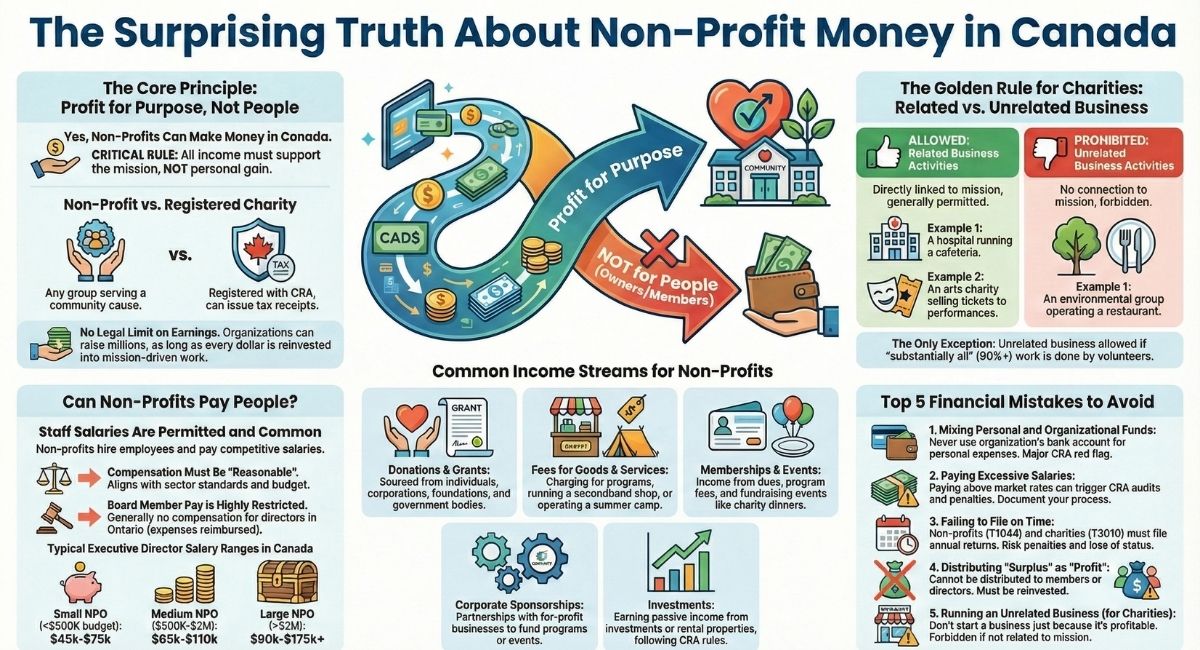
Related vs. Unrelated Business Activities (For Registered Charities)
The CRA makes a crucial distinction between two types of business income for registered charities:
Related business activities are directly connected to your charitable purpose. Examples:
- A hospital running a cafeteria
- An arts charity selling tickets to performances
- An animal rescue operating a pet adoption centre
These activities are generally fine and don't create compliance problems.
Unrelated business activities have nothing to do with your mission. Examples:
- A youth charity running a commercial car wash
- An environmental group operating a restaurant
- A health charity selling advertising space
Here's what you must understand: For registered charities in Canada, carrying on an unrelated business is a prohibited activity that can result in immediate revocation of charitable status. This is not just a tax issue — it's an outright prohibition.
The Only Exception: A registered charity can operate an unrelated business if it is run "substantially all" (90% or more) by volunteers.
Source: Income Tax Act, Section 149.1(1) definition of "related business" and CRA Guidance CPS-019, What is a Related Business?
The Investment Income Rules
Non-profits can invest their funds, but there are limits. If investment income from an unrelated business exceeds certain thresholds, it may be taxable. Registered charities must also meet disbursement quota requirements, meaning they must spend a minimum percentage of their investment assets on charitable activities each year.
Provincial Rules Matter Too
Each province has its own rules about how incorporated non-profits can use surplus funds. For example:
- Ontario (under the Not-for-Profit Corporations Act): Surplus must be used for the organisation's purposes, not distributed to members
- British Columbia: Similar restrictions under the Societies Act
- Federal incorporation: Governed by the Canada Not-for-Profit Corporations Act
Always check your provincial legislation and your organisation's governing documents.
What Happens If You Break the Rules?
Violating income rules can lead to:
- Loss of tax-exempt status
- Penalties and fines from the CRA
- Revocation of charitable registration (for registered charities)
- Required payment of back taxes
- Personal liability for directors in serious cases
Where Do Nonprofits Get Most of Their Money?
This is one of the most common questions we hear: “Where do nonprofits get most of their money?”
In Canada, many nonprofits rely on a mix of:
- Government funding
- Public donations
- Corporate sponsorships
- Events and campaigns
- Sometimes, earned income (like workshops, merchandise, or training)
Some larger charities even earn money from investments or rental properties, and that’s okay too, as long as the money supports their mission and follows CRA guidelines for related business.
How Much Money Can Non-Profits Make?
This might surprise you: there’s no legal limit to how much money non-profits can make in Canada.
Some Canadian charities raise millions of dollars every year. Others may bring in smaller amounts, but still enough to keep their programs running and grow their impact.
What really matters isn’t how much they earn — it’s how they spend it. Every dollar must be used to support their mission. No one can pocket the profits, and any money left over at the end of the year should be reinvested into the work they do.
Can Non-Profits Have Employees and Pay Salaries?
Yes, absolutely. Non-profits and charities in Canada can hire employees and pay competitive salaries. In fact, most successful non-profits have paid staff.
Who Can Be Paid?
- Executive directors and CEOs
- Programme coordinators and managers
- Administrative staff
- Fundraising professionals
- Contractors and consultants
- Board members (in some cases, but this varies by province and comes with restrictions)
What's a Reasonable Salary?
The CRA requires that all salaries be "reasonable" for the work being done. This means:
- Salaries should match similar positions in the sector
- Compensation should reflect the person's qualifications and experience
- Pay shouldn't be excessive compared to the organisation's budget
Typical salary ranges in Canada:
- Small non-profits (budget under $500K): Executive Director $45,000-$75,000
- Medium non-profits (budget $500K-$2M): Executive Director $65,000-$110,000
- Large non-profits (budget over $2M): Executive Director $90,000-$175,000+
- Programme coordinators: $40,000-$65,000
- Development directors: $55,000-$95,000
Board Member Compensation
This is one of the most restricted areas in Canadian charity law, and the rules are far stricter than many people realize.
For Registered Charities in Ontario:
There is a strict common law rule (enforced by the Public Guardian and Trustee) that directors of registered charities generally cannot be compensated for their role as a director. This means:
- Board members typically serve as volunteers
- They can be reimbursed for reasonable expenses (travel, meals, accommodation)
- Direct compensation for board service is generally prohibited
Limited Exception Under Ontario Regulation 4/22:
Ontario Regulation 4/22 under the Charities Accounting Act does allow for some payments to directors under very specific circumstances:
- The charity must have a minimum of five directors
- Strict conflict-of-interest protocols must be in place
- The director receiving compensation must not participate in discussions or votes about their own compensation
- Proper disclosure is required
- The payments must be reasonable and documented
For Non-Profit Organizations:
The rules vary more by province and by the organization's governing documents, but compensation is still heavily restricted and must be:
- Clearly authorized in the bylaws
- Approved by the board (with the interested director absent from the vote)
- Reasonable and documented
- Disclosed to members
General Best Practice:
Executive directors should generally not serve on the board while employed. If board compensation is being considered, seek legal advice first — this is a high-risk area for compliance problems.
What Happens If You Pay Too Much?
Excessive compensation can:
- Trigger CRA audits
- Result in penalties
- Lead to loss of charitable status
- Create public relations problems
- Result in personal liability for directors who approved excessive pay
Documentation Is Key
Always document:
- How you determined salary ranges
- Comparable positions you researched
- Board approval of compensation policies
- Any benefits or perks included in total compensation
What Is the Most Profitable Non-Profit?
Now you might be asking, “What is the most profitable non-profit?” Well, it depends on how you define “profitable.” Some of the biggest, most successful charities in Canada are:
- Hospitals and healthcare foundations
- Universities and education charities
- Large humanitarian organizations, like the Canadian Red Cross
These organizations raise and spend millions, but all of it goes toward helping people, running programs, or improving systems. That’s the difference: profit doesn’t go into someone’s pocket — it goes back into the cause.
Can a For-Profit Own a Nonprofit in Canada?
This is an important one: Can a for-profit own a nonprofit in Canada?
The answer is more nuanced than a simple "no."
What You Cannot Do:
You cannot "buy" a nonprofit like you would buy a business. Nonprofits and charities must be independent and governed by a board of directors that acts in the organization's best interest.
What You Can Do:
However, under the Canada Not-for-profit Corporations Act (Section 7(1)), a for-profit corporation can be the sole member of a non-profit corporation. This effectively gives the for-profit company significant control through:
- Membership rights
- The power to appoint and remove board members
- Voting on major organizational decisions
This structure is commonly used for corporate foundations, where a business establishes and controls a charitable foundation while maintaining the foundation's legal independence.
The Key Point:
While a for-profit can support, sponsor, or even effectively control a nonprofit through membership structure, the nonprofit must still:
- Operate independently under its own board
- Use all funds exclusively for its charitable or non-profit purpose
- Comply with all CRA regulations
In other words, control is possible through proper legal structure, but the nonprofit's mission and operations must remain genuinely charitable or non-profit in nature.
Curious how this applies to registered charities?Read our full guide on whether charities are allowed to make money in Canada.
Common Mistakes Non-Profits Make with Money in Canada
Even well-intentioned organisations can make costly errors. Here are the mistakes we see most often:
1. Paying Excessive Salaries to Founders
It's natural to want to compensate founders for their hard work, but paying yourself or other founders salaries far above market rates will attract CRA attention. Always benchmark against similar organisations and document your reasoning.
2. Not Maintaining Proper Financial Documentation
The CRA requires detailed records of all income and expenses. Keep:
- Bank statements and reconciliations
- Receipts for all expenses
- Donation records and receipt copies
- Board minutes approving major financial decisions
- Annual financial statements
Poor records can result in audits, penalties, or loss of charitable status.
3. Mixing Personal and Organisational Funds
Never use the organisation's bank account for personal expenses, even temporarily. This is a serious red flag for the CRA and can:
- Jeopardise your tax-exempt status
- Create personal tax liability
- Result in criminal charges in extreme cases
Always maintain separate bank accounts and credit cards.
4. Running Unrelated Businesses Without Proper Structure
If your charity wants to run a business unrelated to your mission, you need proper legal structure. Options include:
- Creating a separate for-profit subsidiary
- Ensuring the business is actually related to your charitable purpose
- Getting professional legal advice before proceeding
Don't just start a business because it seems profitable.
5. Failing to File T1044 or T3010 on Time
Non-profits must file Form T1044 (if claiming tax exemption). Registered charities must file Form T3010.
Missing deadlines can result in:
- Penalties of $500-$1,000 per late filing
- Loss of tax-exempt status
- Revocation of charitable registration
- Public disclosure of non-compliance
Set calendar reminders for filing deadlines (typically 6 months after your fiscal year-end).
6. Not Understanding Investment Income Rules
Many organisations don't realise that investment income from unrelated business activities may be taxable, even for tax-exempt organisations. Get advice before making significant investments.
7. Confusing "Surplus" with "Profit Distribution"
Having surplus funds at year-end is fine — it means you're building financial stability. But you cannot:
- Distribute surplus to members
- Give bonuses to directors based on surplus
- Treat surplus like dividends
Surplus must remain in the organisation for future charitable use.
8. Accepting Donations with Inappropriate Strings Attached
Be careful accepting donations that:
- Require you to operate outside your charitable purpose
- Give the donor too much control over your operations
- Require political activity
- Benefit the donor or their family
These "directed donations" can create serious compliance problems.
Real Talk: Making Money the Right Way
So let’s bring it all together:
- Can non-profits make money? Yes
- Can a non-profit make money in Canada? 100% yes
- How can non-profits make money? Through donations, grants, events, fees, and even business activities
- How much money can non-profits make? As much as they need, if it goes back into their cause
- Can a for-profit own a nonprofit in Canada? Nope — but it can support or sponsor one
- What is the most profitable non-profit? Many hospitals, universities, and large national charities lead the way
Final Thoughts
Running a nonprofit or charity in Canada doesn’t mean you have to struggle. It does mean you need to use your money responsibly and for the greater good. If done right, your nonprofit can be financially strong and make a big difference in people’s lives.
And if you're thinking of starting your own nonprofit or charity in Canada, don’t be afraid to dream big. Just make sure your heart — and your books — are in the right place.
Need help getting started? We help Canadians register nonprofits and charities with clear, predictable, fixed-fee legal support — no hidden costs, no confusion, just a simple path to getting your organization off the ground and registered with the CRA. Schedule a complimentary consultation with our team to determine the best and quickest way to register your charity.
B.I.G. Charity Law Group Professional Corporation
Frequently Asked Questions
Non-profits in Canada can earn money through several different methods.
They can make a profit as long as they use the money to support their mission instead of giving it to owners or shareholders.Non-profits in Canada can earn money through several different methods. They can make a profit as long as they use the money to support their mission instead of giving it to owners or shareholders.
This depends on the type of organization. Registered charities can earn income and have surpluses that support their mission. Non-profit organizations (NPOs) under Section 149(1)(l) must be organized exclusively for purposes other than profit — they can have year-end surpluses, but cannot operate with the intention of generating profit.
How do non profits make money?
Non-profits earn money from donations, government grants, membership fees, corporate sponsorships, fundraising events, and selling goods or services. Some also earn from investments or rental properties. All income must support the organisation's mission.
Can a not-for-profit make a profit in Canada?
Not-for-profits can have a year-end surplus (money left over after expenses), but they cannot be organized or operated with profit as a goal. Under Section 149(1)(l) of the Income Tax Act, NPOs must be exclusively for purposes other than profit. If an NPO appears to intend to earn profit (even to fund programs), it may lose its tax-exempt status. Registered charities have more flexibility with earned income, as long as it supports their charitable purpose.
Can you make money with a nonprofit?
You can earn a salary working for a nonprofit. Many pay competitive wages to staff. Directors and board members can get paid too, but rules vary by province. Your pay must be reasonable for your work. You cannot take excessive payments or profits.
Can you make money from starting a nonprofit organization?
No, you cannot make money as profit from starting a nonprofit. If you work for it, you can get a reasonable salary that matches your work. You cannot use a nonprofit to avoid personal taxes. Starting a nonprofit should be about the mission, not personal money.
Can a non-profit organization (Canada) put money in a Wealthsimple savings account?
Yes, non-profits can put money in investment accounts like Wealthsimple. They can invest to earn extra income. The investment income must support the organisation's charitable purpose. All returns must go back into supporting the mission.
What are the reporting requirements for non-profits in Canada with regards to their financial activities?
Most non-profits in Canada must file form T1044 with the Canada Revenue Agency each year. This form reports their financial activities and confirms they maintain their tax-exempt status.
Registered charities have additional requirements. They must file form T3010 and give detailed information about their programs and finances.
The reporting deadline is usually six months after the organisation's fiscal year end. Filing late can lead to penalties or loss of tax-exempt status.
Non-profits must keep detailed financial records. These records should show all income sources and how they spent money on charitable activities.
Legal Sources & References
- CPS-019, What is a Related Business?
- IT-496R, Non-Profit Organizations
- Ontario Regulation 4/22 under the Charities Accounting Act
- CG-027, Public policy dialogue and development activities by charities
The material provided on this website is for information purposes only.. You should not act or abstain from acting based upon such information without first consulting a Charity Lawyer. We do not warrant the accuracy or completeness of any information on this site. E-mail contact with anyone at B.I.G. Charity Law Group Professional Corporation is not intended to create, and receipt will not constitute, a solicitor-client relationship. Solicitor client relationship will only be created after we have reviewed your case or particulars, decided to accept your case and entered into a written retainer agreement or retainer letter with you.
.png)


