
Canadian Charity Registration and Revocation Statistics 2026

Published on
October 14, 2026
Last updated on
November 18, 2026
Two numbers in the CRA's newest Charities Program report should get the attention of founders and boards. More applications are ending up incomplete, and failure to file the annual return is now the most common reason charities lose their registration. Below, we look at what changed in the latest figures and what it means for groups applying now and for charities that are already registered.
This edition draws on the CRA's Report on the Charities Program 2025‑2026, which covers the fiscal year from April 1, 2025 to March 31, 2026. We compare recent registration outcomes with the prior year and keep the revocation history going back to 2015‑2016. Where we mention faster approvals in our own practice, we keep that separate from the national statistics.
Key findings
Registration and revocation findings at a glance
A note on scope: the revocation figures follow whatever each CRA report covered. Recent reports group charities with other qualified donees, so the history below tracks reported program counts, not a clean charity-only series.
What do the latest application volumes tell us?
Applications received and decisions reported [8][9]
Applications went up 13.1%, but the number of decisions barely moved. That puts more pressure on processing capacity, even if some files are still moving quickly. These annual totals can't tell us whether wait times are longer or how big the backlog is, though. Receipts and decisions in a given year may involve different groups of applications, and the decision count also includes other qualified donees (OQDs).
Why does completeness matter?
Of the applications closed in 2025‑26, 35% were incomplete when they were first submitted. That figure covers both charity and OQD applications. [9]
We haven't treated this as a trend line. Last year's report measured completeness among applications received, while this year's measures it among applications closed. Those aren't the same group. It's also worth remembering that an application can come in incomplete, get fixed during review and still be approved.
Before you submit, check three things: your governing documents are complete, your purposes line up with the programs you plan to run, and your activity descriptions explain who will benefit, what the charity will do and how it will use its resources. A clear application gives the CRA what it needs to assess eligibility and saves you follow-up questions you could have avoided.
According to the CRA's current application review guidance, an incomplete file may lead to a phone call or a letter. The same guidance explains how applicants can respond to concerns, including by proposing changes to their charitable purposes. [20]
What can a charity lawyer contribute?
A lawyer can look at whether your purposes and activities qualify, prepare governing documents that are consistent with each other, and help you respond to the CRA's concerns before the deadline. The national figures don't separate applicants who had representation from those who didn't, so they can't show what effect a lawyer has on approval rates or timing.
What share of charity applications is approved?
Charity application outcomes [8][9]
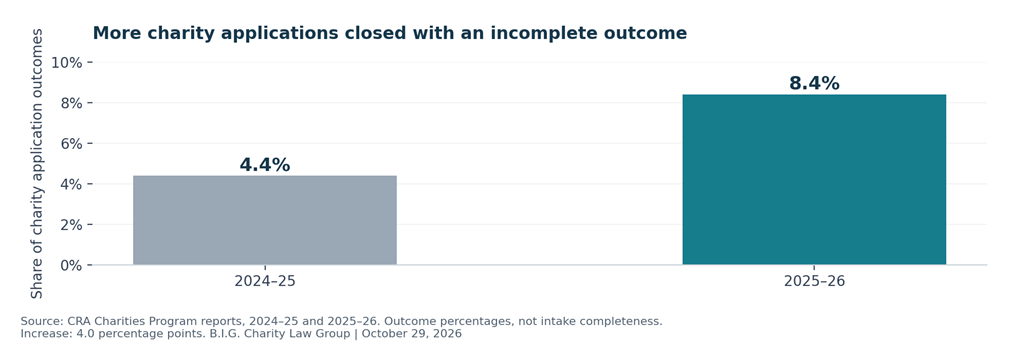
Figure 1. Incomplete outcomes increased by 4.0 percentage points. This is distinct from being incomplete at submission. [8][9]
*The 2024‑25 report's narrative gives approximately 81.9% registered; its chart rounds that figure to 82%. Percentages retain the CRA's published precision and may not sum exactly to 100%.
In plain terms, about one in five charity application outcomes last year did not end in registration. Formal denials are only a small part of that. Withdrawn, abandoned and incomplete outcomes each mean something different, so we keep them separate when looking at how hard it is to register.
The report doesn't say how many applicants received a fairness letter. The CRA does explain that missing a response deadline can lead to an application being treated as abandoned. Even so, we can't assume that every withdrawn or incomplete file started with a fairness letter. [20]
How long does it take to register a charity in Canada?
In our October 8, 2026 practice update, we reported that many of our charity approvals were coming through in about two to three months. Historically, we commonly saw six to nine months. That is our own experience on individual files, not a national figure. Some applications still take longer, and the CRA's published numbers do not show a two-to-three-month average.
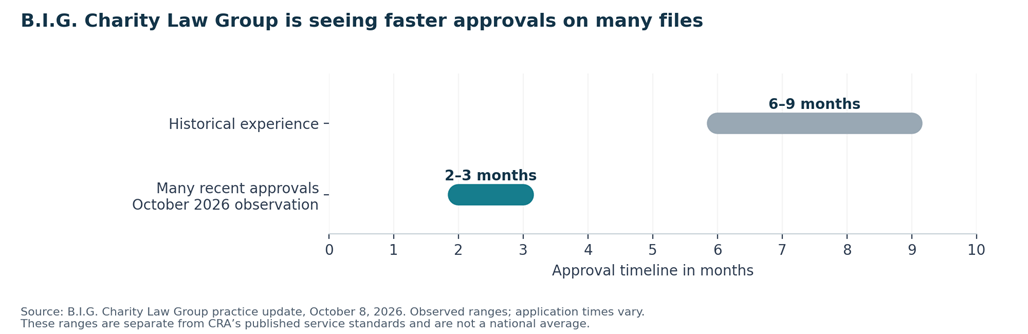
Figure 2. B.I.G. Charity Law Group's observed approval ranges. These are practice observations, not CRA service-standard results or a measured national average.
The CRA's own reports offer some background. Its 2018‑2020 report described a screening process that identified 56% of applications as low risk or low complexity, which allowed faster processing. Its 2024‑25 report describes a more streamlined way of handling applications. Both point to a focus on efficiency, but neither explains why any particular application was approved quickly. [3][8]
Faster approvals on some files can happen at the same time as higher volumes and more incomplete outcomes. Speed, eligibility and completeness are three different questions. If you're planning an application, plan around how complex your own file is. Someone else's quick approval doesn't predict yours.
The most useful thing an applicant can do is submit governing documents, charitable purposes, activity descriptions and financial information that are complete and tell the same story. Our guide to charity registration timelines covers planning in more detail.
What do CRA's service standards tell us about registration timelines?
The CRA's current standard is to give a final decision within nine months of receiving a complete charity registration application, 80% of the time. Earlier standards measured something different: an initial response within six months, which could simply be a request for more information. [16][17][15]
An initial response, a final decision and an approval are three separate milestones. The service results don't give a consistent year-by-year series of average or median approval times.
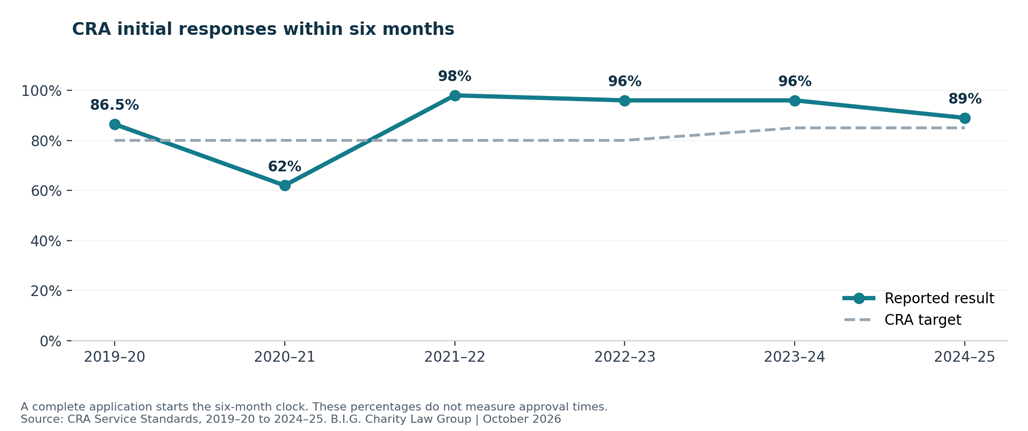
Figure 3. Share of complete applications receiving an initial response within six months, 2019‑20 to 2024‑25. [10][11][12][13][14][15]
CRA registration service standards and results
*The cited 2025‑26 service-standards page and Charities Program report do not state a performance result for the new final-decision measure. The clock starts when the application is complete. [16][9]
The initial-response result fell to 62% in 2020‑21, bounced back to 98% the next year, then eased to 89% by 2024‑25. That latest result still beat the 85% target, but the series doesn't show steady improvement year after year. [11][12][15]
How many registrations does CRA revoke each year?
Our analysis of the CRA's published totals shows an average of 2,090 reported revocations a year from 2023‑24 to 2025‑26. Over six years, from 2020‑21 to 2025‑26, the average was 1,767.8, or about 1,768 a year. That longer window includes the unusually low pandemic year.
Annual reported revocations from 2015‑16 onward
A dash means the figure wasn't reported separately. It doesn't mean zero. The 2018‑2020 report doesn't give annual revocation totals for 2018‑19 or 2019‑20, so we've left those years blank. "For cause or after audit" combines the CRA's older category labels. Reporting scope follows each source. [3]
Annual averages using specified reporting windows
Each average is the sum of the published annual totals divided by the number of years in the window. The five-year figure leaves out 2020‑21, although the CRA notes that the pandemic was still affecting compliance work in 2021‑22. [5]
How have reported revocations changed since 2015?
Reported revocations went from 1,429 in 2015‑16 to 2,076 in 2025‑26. That's 647 more, an increase of 45.3%. This compares two endpoints whose reporting scopes differ. It doesn't show a steady climb, and it doesn't mean any individual charity is more at risk. [1][9]
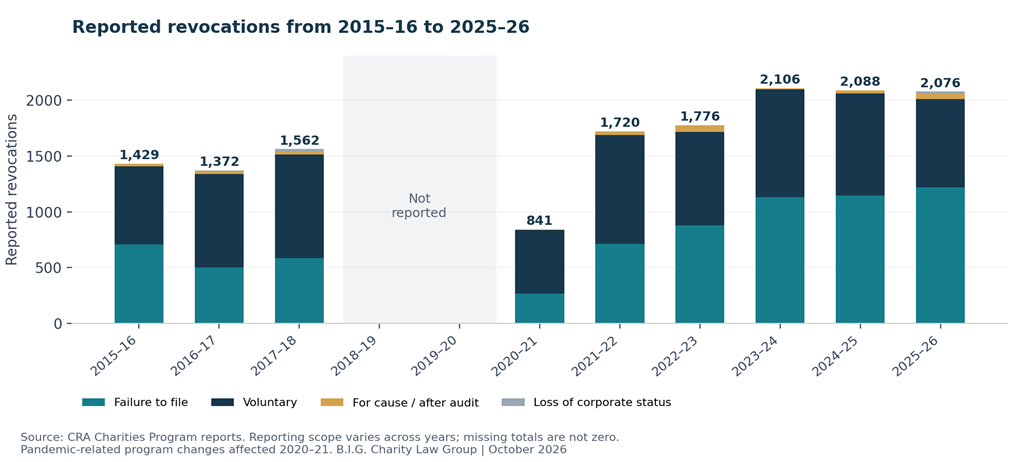
Figure 4. Published revocation counts from 2015‑16 through 2025‑26. Reporting scope varies; the two missing years are not treated as zero. [1][2][3][4][5][6][7][8][9]
The average for 2015‑16 to 2017‑18 was 1,454.3, compared with 2,090 for 2023‑24 to 2025‑26. The missing years and changes in what the reports cover make a ten-year comparison weaker than it first looks.
Have revocations continued to rise in the latest years?
Not overall. Total revocations dipped slightly over the last three years: 2,106, then 2,088, then 2,076. Over the same years, failure-to-file revocations went up, from 1,131 to 1,146 to 1,219. Filing compliance is the trend that matters most right now. [7][8][9]
By our year-over-year calculation, total revocations fell 0.6%, while failure-to-file revocations rose 6.4%. A board that only watches the overall number would miss how much of it now comes down to annual returns.
In 2016‑17 and 2017‑18, voluntary revocation was the biggest category. That has changed: failure to file now makes up the largest share. [2][9]
Why does CRA revoke registered status?
Failure to file accounted for 1,219 of the 2,076 reported revocations in 2025‑26, or 58.7%. The rest were voluntary (790), for cause (52) and loss of corporate status (15). [9]
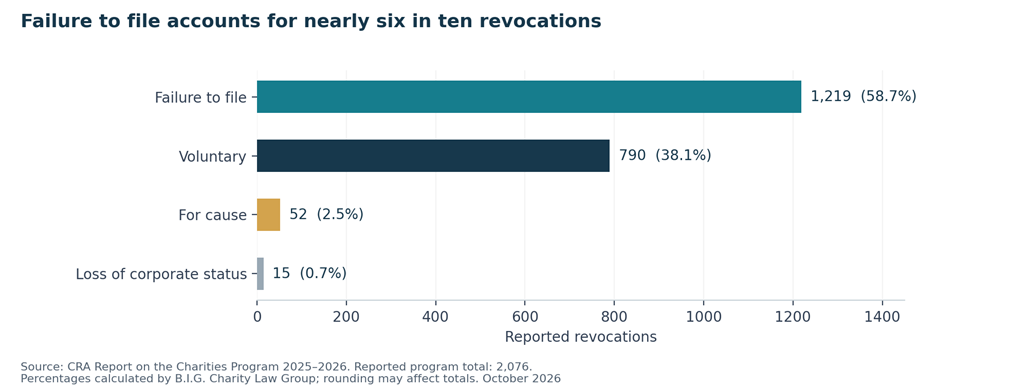
Figure 5. Reasons for reported revocations in 2025‑26. Percentages are B.I.G. Charity Law Group calculations using the total of 2,076. [9]
A high revocation count doesn't mean there's a lot of wrongdoing. A charity may choose voluntary revocation after a merger or when it decides to stop operating. The CRA has discretion over voluntary revocation, and a charity can't use it to avoid compliance action that's already under way. [18]
Revocations for cause rose from 26 to 52 in the latest year, but they were still only 2.5% of all reported revocations. The majority of these revocations for cause were Ontario charities, at 15 charities, with B.C. charities trailing slightly behind at 13. A notice of intention to revoke and the revocation itself can fall in different fiscal years, so these numbers don't show that misconduct across the sector has doubled. [8][9]
What should charity boards do to protect registered status?
The CRA requires a complete T3010 Registered Charity Information Return within six months of fiscal year-end. Make one person responsible for the return, set an internal deadline well ahead of the CRA's, and keep proof that it was filed. [19]
Filing online gives you a record that the CRA received the return. With the CRA's new certified-software option, you get confirmation right away in the charity's CRA account. Keep that confirmation with the complete return and supporting documents. It shows the return was submitted, but the charity is still responsible for making sure it's accurate. [21]
What do the audit figures mean for charity boards?
Selected compliance measures [8][9]
The share of audits finding serious non-compliance jumped 24 percentage points. Keep in mind that the CRA's audit program is risk-based. The charities it audits are chosen because something drew regulatory attention, so these percentages can't be applied to all Canadian charities or read as a sector-wide misconduct rate.
The drop in non-audit interventions doesn't, on its own, mean that charities became more compliant or that enforcement eased. The figures count different kinds of work and don't explain why the number changed. A phone call and a completed audit take very different amounts of time and review.
What evidence should the board request?
Practical records for board oversight
These suggestions come from the registration and revocation data above. Whether the work is done by staff or an outside adviser, the board should be able to confirm what was filed and when. Keeping the filing confirmation with the board's records is an easy way to do that.
Our charity compliance checklist and guide to charity revocation cover more issues for directors and advisers.
How were these statistics calculated?
The revocation data come from the CRA's Report on the Charities Program series, and the registration timing measures come from the CRA's annual service-standards pages. Fiscal years end on March 31. This edition covers program results through 2025‑26 and the 2026‑27 service standard, which is still in progress.
Scope. We transcribed published tables and chart descriptions. Recent reports discuss charities and other qualified donees together, so the totals are reported Charities Program revocations. We have not reconstructed a separate charity-only series or adjusted for changes in reporting scope and category presentation.
Calculations. Annual means use the arithmetic mean of published counts. Percentages use the relevant annual total as the denominator and are rounded to one decimal place. Missing annual totals are excluded from calculations. Categories that are not separately reported are left blank in the downloadable data.
Applications. Intake, closed-file completeness and application outcomes have different bases. Outcome percentages cover charities only; total decisions include OQDs. We retain the published precision and do not derive outcome counts from the combined decision total. Changes in shares are stated in percentage points.
Timing and interpretation. The earlier six-month measure concerns initial responses, while the nine-month measure concerns final decisions. Neither gives a national average time to approval. Our firm's 2–3 and 6–9 month ranges are qualitative practice observations. We have not calculated a percentage speed improvement from those ranges.
Pandemic effects. CRA says program changes affected revocations in 2020‑21, and compliance activities continued to be affected in 2021‑22. Changes in annual counts can reflect administrative timing, voluntary closures and filing compliance as well as enforcement activity. [4][5]
How can journalists and sector publications cite this report?
"B.I.G. Charity Law Group's analysis of CRA reports shows an average of 2,090 reported revocations annually over the three fiscal years ending March 31, 2026." [7][8][9]
"Total reported revocations fell slightly in 2025‑26, while failure-to-file revocations increased 6.4%. The overall total masks a growing annual-filing problem." — B.I.G. Charity Law Group analysis [8][9]
"Roughly one in five charity application outcomes did not result in registration in 2025‑26. Preparation matters even when formal denials are uncommon." — B.I.G. Charity Law Group analysis [9]
Goldberg, Dov. Canadian Charity Registration and Revocation Statistics 2026. B.I.G. Charity Law Group, updated October 29, 2026. Identify the fiscal period when quoting a statistic, and link to this report and the underlying CRA source.
Sources and downloadable data
We reviewed the latest program report, the previous year's report, the current service standards and the CRA's application and filing guidance on October 29, 2026. The older historical figures carry over from our October 8 compilation. The numbered references point to the CRA sources listed below.
[1] CRA Report on the Charities Program 2015-2016
[2] CRA Report on the Charities Program 2016-2018
[3] CRA Report on the Charities Program 2018-2020
[4] CRA Report on the Charities Program 2020-2021
[5] CRA Report on the Charities Program 2021-2022
[6] CRA Report on the Charities Program 2022-2023
[7] CRA Report on the Charities Program 2023-2024
[8] CRA Report on the Charities Program 2024-2025
[9] CRA Report on the Charities Program 2025-2026
[10] CRA Service Standards 2019-20
[11] CRA Service Standards 2020-21
[12] CRA Service Standards 2021-22
[13] CRA Service Standards 2022-23
[14] CRA Service Standards 2023-24
[15] CRA Service Standards 2024-25
[16] CRA Service Standards 2025-26
[17] CRA Service Standards 2026-27
[19] CRA Filing a Registered Charity Information Return
[20] CRA After you apply for charitable registration
[21] CRA Certified software for filing a charity information return
Download the data
Download the revocation history, service measures, application outcomes, program activity and source directory as CSV files. Each dataset identifies its source and reporting basis; missing annual totals remain blank.
Download the data from the report webpage.
Advice for your charity
If you need help with an application, a governance matter or a revocation issue, contact B.I.G. Charity Law Group to talk through your organization's situation. For related analysis, read our review of CRA's 2024‑2025 Charities Program report.
This report provides general information and does not replace advice about a particular organization.
The material provided on this website is for information purposes only.. You should not act or abstain from acting based upon such information without first consulting a Charity Lawyer. We do not warrant the accuracy or completeness of any information on this site. E-mail contact with anyone at B.I.G. Charity Law Group Professional Corporation is not intended to create, and receipt will not constitute, a solicitor-client relationship. Solicitor client relationship will only be created after we have reviewed your case or particulars, decided to accept your case and entered into a written retainer agreement or retainer letter with you.
DOV GOLDBERG, J.D. is a lawyer at B.I.G. Charity Law Group and has dedicated his career exclusively to Charity and Not-for-Profit Law for over a decade. Dov guides charities, foundations, and non-profit organizations through every stage of the registration process, offering practical legal advice with a focus on compliance, governance, and long-term success. Known for his hands-on approach and deep knowledge of CRA requirements, Dov is committed to helping clients build strong, sustainable, and legally sound organizations.


