
What Is a Registered Charity in Canada?

In Canada, a registered charity is an organization that has received official approval from the Canada Revenue Agency (CRA) to operate for charitable purposes. These organizations benefit from tax-exempt status and can issue donation receipts to donors, making them a crucial part of Canada's nonprofit sector.
If you're thinking about starting a charity or donating to one, it's important to understand what qualifies as a registered charity and the responsibilities that come with it.
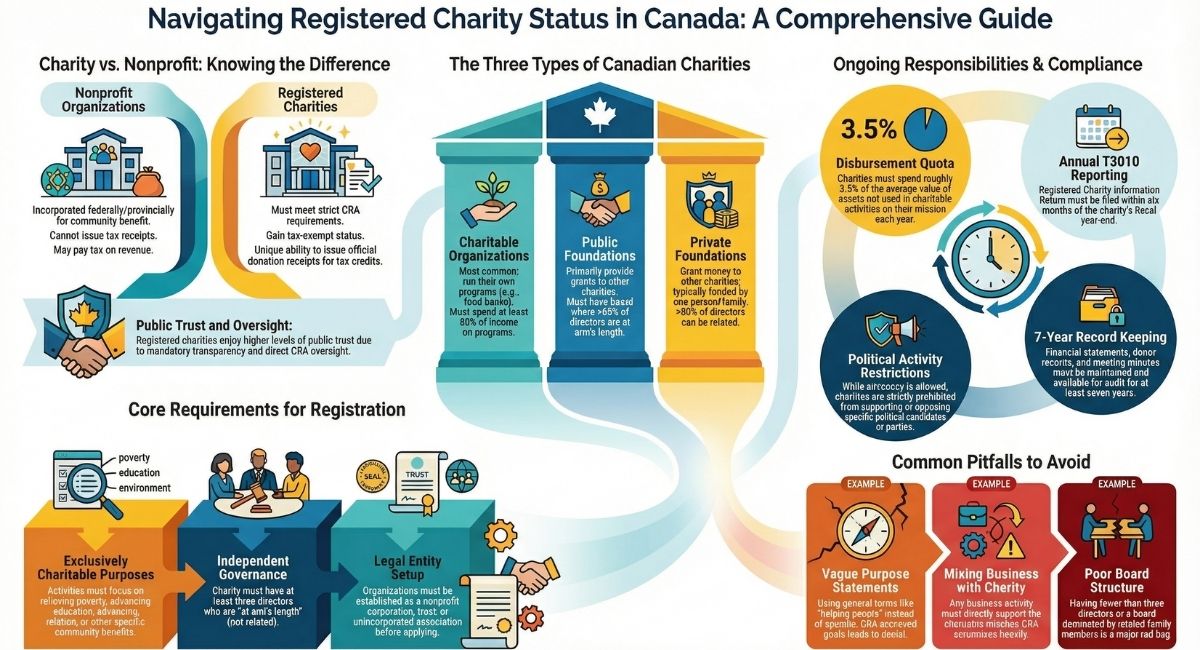
Registered Charity vs Nonprofit Organization in Canada
Before diving into registered charities, it's helpful to understand the key difference between a registered charity and a nonprofit organization.
Nonprofit organizations can be incorporated federally or provincially and operate for purposes that benefit the community, but they cannot issue tax receipts for donations. They may pay income tax on certain revenue.
Registered charities must meet stricter CRA requirements, but they receive significant benefits in return:
- Tax-exempt status on all income
- Ability to issue donation receipts for tax credits
- Access to government grants restricted to registered charities
- Public trust through CRA oversight and transparency
Not all nonprofits qualify as charities. To become a registered charity, your organization must meet the CRA's specific definition of charitable purposes, which we'll explore next.
What Makes an Organization a Registered Charity?
To become a registered charity in Canada, an organization must meet strict requirements set by the CRA. These requirements ensure that the charity operates for the public good and does not engage in profit-driven activities.
A registered charity must:
Have exclusively charitable purposes – The organization must focus on purposes that fit within the CRA's definition of charity, such as:
- Relieving poverty
- Advancing education
- Advancing religion
- Other activities that benefit the community, such as environmental protection or supporting marginalized groups
Be set up as a legal entity – This could be a nonprofit corporation, a trust, or an unincorporated association. Many organizations choose to incorporate provincially or federally before applying for charitable status.
Have proper governance – The charity must have at least three directors who are at arm's length (not related by blood, marriage, or common-law partnership, and not in a business relationship). This ensures independent oversight.
Operate for the public benefit – The charity's work must serve a broad section of the public, not just a small group of individuals.
Follow CRA compliance rules – Registered charities must submit financial records and reports to show they are using donations properly.
Types of Registered Charities in Canada
The CRA recognizes three types of registered charities, each with different structures and requirements:
Charitable Organizations
These charities run their own programs and activities. They must spend at least 50% of their income directly on charitable programs. Most registered charities fall into this category. Examples include food banks, homeless shelters, and educational programs.
Public Foundations
These organizations primarily provide grants to other qualified donees rather than running programs themselves. Public foundations receive funding from the general public and must have a board where more than 50% of directors deal with each other at arm's length.
Private Foundations
Similar to public foundations, private foundations make grants to other charities. However, they're typically funded by a single donor, family, or corporation. More than 50% of their directors may be related or not at arm's length.
Understanding which type fits your organization helps determine the right structure when applying for registration.
Benefits of Registering as a Charity in Canada
Being a registered charity comes with significant advantages:
Tax-Exempt Status
Registered charities do not pay income tax on the money they raise, allowing more funds to go directly toward charitable programs.
Ability to Issue Donation Receipts
This allows donors to claim tax credits, making fundraising easier and encouraging larger donations.
Access to Funding Opportunities
Many government grants and corporate donations are only available to CRA registered charities.
Increased Public Trust
Registration with the CRA shows transparency and credibility, which encourages more donations and partnerships. Donors can verify your status on the CRA's public database.
How to start a registered charity in Canada?
Creating a new registered charity involves establishing the organization's legal structure before applying for charitable status. This guide explains how to start a registered charity in Canada.
Follow the same steps as above. You'll need to:
- Create governing documents (articles of incorporation, constitution, or trust deed)
- Demonstrate exclusively charitable purposes
- Show you'll operate for public benefit, not private gain
- Have proper governance structure with a board of directors
Common Mistakes When Registering a Charity
Many charity applications are delayed or denied due to preventable errors. Avoid these common mistakes:
Vague or Non-Charitable Purpose Statements
Your charitable purposes must be clear, specific, and fit within CRA's four categories. General statements like "helping people" aren't sufficient.
Poor Governance Structure
Having related directors (family members) make up more than 50% of your board, or having fewer than three directors, can cause problems.
Mixing Business and Charitable Activities
If you plan to operate a business, you must clearly demonstrate how it directly supports your charitable purpose. The CRA scrutinizes business activities carefully.
Insufficient Program Details
Describing activities without showing how they achieve charitable purposes leads to requests for clarification and delays.
Directors Without Charity Knowledge
Board members must understand their legal responsibilities. The CRA expects directors to be informed and actively involved in governance.
Incomplete or Inconsistent Documentation
Your application, governing documents, and program descriptions must align. Contradictions raise red flags.
Responsibilities of a Registered Charity
Once an organization becomes a registered charity, it must follow strict rules to maintain its status. Failure to comply with these rules can lead to penalties or even revocation of charity status.
Annual Reporting to the CRA
Every registered charity must file a T3010 Registered Charity Information Return with the CRA. This report details financial activities, programs, and how donations are used. The deadline is within six months of your fiscal year-end.
Proper Use of Funds
Charities must ensure that all donations and revenue go toward their charitable activities and are not used for private gain. Directors and staff cannot benefit personally from the charity's resources.
Conducting Only Charitable Activities
A charity cannot engage in business activities that do not directly support its charitable mission. If a charity wants to run a business, it must ensure that it meets the CRA's guidelines for related businesses.
Political Activities Restrictions
While charities can engage in some advocacy work, they cannot support or oppose political candidates or parties. Non-partisan public policy work is allowed if it connects to the charity's purposes.
Keeping Proper Records
Financial statements, donor records, and board meeting minutes must be properly maintained and available for CRA audits. Most records must be kept for at least seven years.
Issuing Proper Donation Receipts
Charities must follow specific rules when issuing official donation receipts, including proper formatting, eligible donation types, and record-keeping requirements.
How to Apply for Registered Charity Status in Canada
If you want to register a charity in Canada, you need to submit an application to the CRA’s Charities Directorate. The process involves:
Incorporating or Setting Up the Organization – While not mandatory, incorporating the charity can make governance easier and improve credibility.
Defining the Charitable Purpose and Activities – The organization must clearly outline how it meets the CRA’s definition of charity.
Completing the Application to Register a Charity – This is the main document required by the CRA. It must include:
- A detailed description of the charity’s programs
- A financial plan
- A list of board members and governance structure
Submitting the Application to the CRA – The CRA will review the application to ensure the organization meets the legal requirements. The review process can take several months.
Receiving Charity Status and a Registered Charity Number – If approved, the charity will receive a unique registration number and will be listed in the CRA’s database of registered charities.
Understanding the Disbursement Quota
Registered charities in Canada must spend a minimum amount on charitable activities each year. This requirement, called the disbursement quota, ensures charities actively work toward their purposes rather than simply accumulating funds.
How the Disbursement Quota Works:
For most registered charities, the disbursement quota is calculated based on the value of assets not used in charitable activities. The current requirement is approximately 3.5% of the average value of property (assets) owned by the charity in the previous 24 months.
What Counts Toward Your Quota:
- Money spent directly on charitable programs
- Grants to qualified donees
- Certain administrative costs related to charitable activities
What Doesn't Count:
- Fundraising expenses
- Investment management fees
- Amounts spent on enduring property (buildings, equipment)
Consequences of Not Meeting the Quota:
Charities that fail to meet their disbursement quota may face:
- Financial penalties
- Suspension of tax-receipting privileges
- Revocation of charitable registration
Exceptions exist for new charities (first two years) and certain types of foundations. Working with a charity accountant ensures you properly calculate and meet this important requirement.
How to Verify a Registered Charity's Status
Whether you're a donor considering a contribution or working with a charity, verifying registration status is important.
Use the CRA's Charities Listing
The CRA maintains a searchable public database at https://apps.cra-arc.gc.ca/ebci/hacc/srch/pub/dsplyBscSrch. You can search by:
- Charity name
- Registration number
- City or postal code
What Information Is Publicly Available:
- Charity's legal name and operating names
- Registration number
- Designation type (charitable organization, foundation)
- Date of registration
- Contact information
- Most recent T3010 financial information
- Programs and activities description
Why Verification Matters:
For donors, confirming registration ensures:
- Your donation is eligible for a tax receipt
- The charity meets CRA standards
- You can review their financial information and programs
For partners and grantmakers, verification confirms:
- The organization is in good standing
- They can legally issue receipts
- They meet compliance requirements
Always verify before making significant donations or entering partnerships.
What Happens If a Charity Loses Its Registration?
If a charity fails to follow CRA regulations, it may lose its registered status. Common reasons for revocation include:
Not filing the annual T3010 return – Missing annual filings can lead to automatic revocation.
Using funds improperly – Spending donations on non-charitable activities can result in penalties.
Engaging in prohibited political activities – Supporting political candidates or campaigns is not allowed.
Failure to meet disbursement quota – Not spending the required minimum on charitable activities.
If a charity is revoked, it loses tax-exempt status and can no longer issue donation receipts. It may also have to pay a revocation tax equal to its remaining assets. Revoked charities are publicly listed on the CRA website.
Final Thoughts
Registering as a charity in Canada is a valuable step for organizations that want to make a difference while benefiting from tax advantages and donor support. However, registered charities must carefully follow CRA guidelines to maintain compliance.
Understanding the requirements, responsibilities, and ongoing obligations ensures your charity operates successfully while maintaining public trust. From meeting disbursement quotas to proper financial reporting, every aspect of charity operations requires attention to detail.
If you're considering applying for charity status, it's essential to understand the legal requirements and responsibilities involved. Seeking legal advice from an experienced charity lawyer can help ensure a smooth application process and long-term success.
Ready to start your charity registration journey? Contact B.I.G. Charity Law Group at 416-488-5888 or book a consultation to discuss your charitable vision and get expert guidance through the registration process.
Frequently Asked Questions
What Makes an Organization a Registered Charity?
It must have only charitable goals like relieving poverty or advancing education. The group needs a legal setup, such as a nonprofit corporation or trust, and works for the public good.
Can a registered charity make a profit?
Charities can generate surplus revenue, but all funds must be reinvested in charitable activities. Profits cannot be distributed to members, directors, or private individuals.
How much does it cost to register a charity in Canada?
The CRA application fee is $500. Additional costs may include incorporation fees ($200-$400), legal fees for document preparation, and accounting setup costs. Total startup costs typically range from $1,000-$5,000 depending on complexity.
Can Canadian charities operate internationally?
Yes, but international activities require additional documentation and oversight. You must show how international programs achieve your charitable purposes and demonstrate proper controls over foreign spending.
The material provided on this website is for information purposes only.. You should not act or abstain from acting based upon such information without first consulting a Charity Lawyer. We do not warrant the accuracy or completeness of any information on this site. E-mail contact with anyone at B.I.G. Charity Law Group Professional Corporation is not intended to create, and receipt will not constitute, a solicitor-client relationship. Solicitor client relationship will only be created after we have reviewed your case or particulars, decided to accept your case and entered into a written retainer agreement or retainer letter with you.
.png)


