
ONCA Compliance: Step-by-Step Guide for Ontario Nonprofits

Published on
June 9, 2025
Last updated on
October 26, 2026
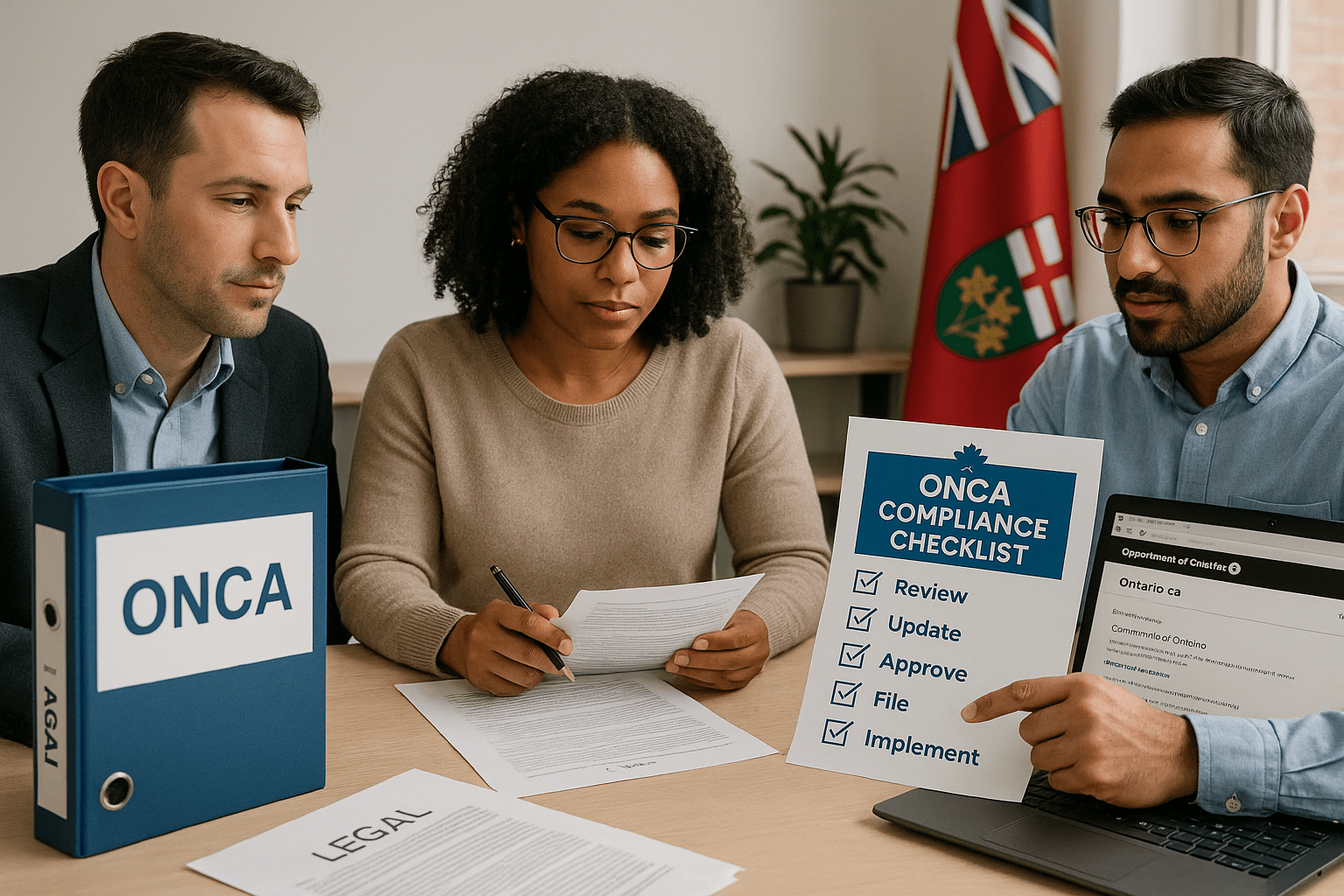
The Ontario Not-for-Profit Corporations Act, 2010 (ONCA) came into force on October 19, 2021, and gave existing Ontario nonprofits a three-year transition period that ended on October 19, 2024. If your organization hasn’t transitioned yet, it isn’t too late. This guide walks you through each step, from gathering your documents to filing articles of amendment.
What Is ONCA?
ONCA is the law that governs nonprofit corporations incorporated in Ontario. It replaced the former Corporations Act for nonprofits and aims to:
- Provide a modern, more flexible legal framework for nonprofit operations
- Strengthen corporate governance and accountability
- Expand members’ rights and remedies
- Clarify the duties and protections of directors and officers
- Simplify incorporation, which now requires only one incorporator and uses articles of incorporation instead of letters patent
For a plain-language overview, see What Is ONCA?
Who Must Comply
ONCA applies to all nonprofit corporations incorporated under Ontario law, including charities, social clubs, professional associations and service organizations.
It does not apply to:
- Federally incorporated nonprofits, which are governed by the Canada Not-for-profit Corporations Act (CNCA)
- Nonprofits incorporated in other provinces or territories
- For-profit corporations, which are governed by the Business Corporations Act
The ONCA Transition Deadline Has Passed: What Now?
The three-year transition period ended on October 19, 2024. Organizations that did not transition by then:
- Were not dissolved and can continue operating
- Face no fines or penalties for missing the date
- Had non-conforming provisions deemed amended. As of October 19, 2024, provisions in their letters patent, bylaws and special resolutions that did not conform to ONCA were deemed amended to comply, except for certain provisions under s. 207(3).
The deemed amendments are the problem. They can leave your governing documents unclear, because your written bylaws may no longer match the rules that legally apply. That uncertainty causes problems at member meetings, board elections and votes, and it raises questions from banks, funders and the CRA. Formally amending your articles and adopting ONCA-compliant bylaws removes that uncertainty.
For more on what missing the date means, see Is It Too Late to Comply with the ONCA?
Key Changes Under ONCA
Before you update your documents, it helps to know what changed:
- Enhanced member rights: members can access financial statements, submit proposals, requisition meetings and seek remedies for oppression.
- Public benefit corporations: charities, and nonprofits that receive more than $10,000 in a financial year in donations or government funding, are public benefit corporations and are subject to additional rules, including stricter financial review requirements.
- Director and officer provisions: clearer rules on duties, liability, conflicts of interest and indemnification.
- Modern meetings and voting: meetings can be held electronically, subject to the bylaws.
- Corporate records: specific requirements for the records a corporation must keep.
- Financial review: audit and review engagement requirements based on revenue (see the table below).
Step 1: Gather Your Current Governing Documents
Collect:
- Letters patent and any supplementary letters patent
- All current bylaws and amendments
- Special resolutions
- Governance policies
- Membership rules and records
- Board minutes recording past bylaw changes
If documents are missing: you can request copies of your letters patent from ServiceOntario. Check your minute book, past secretaries’ files and your lawyer’s files for bylaws. Record what you find in a simple inventory that lists each document and its approval date, so you know which version is current.
Step 2: Review Your Letters Patent Against ONCA
Your letters patent will be replaced by articles once you file articles of amendment. Review:
- Corporate name: is it still accurate and available?
- Purposes: are they clear and current? For registered charities, any change to purposes needs to be checked with the CRA first.
- Special provisions: do any refer to the former Corporations Act or conflict with ONCA?
- Membership classes: does the structure still fit your organization?
- Number of directors: is the fixed number or range appropriate?
- Dissolution clause: charities must provide for remaining assets to go to qualified donees.
Step 3: Draft ONCA-Compliant Bylaws
ONCA requires your bylaws to address key matters, including:
- Conditions of membership and members’ rights, including voting
- How membership is transferred or terminated
- Notice of members’ meetings
- Quorum for members’ meetings
- Whether proxy voting or other absentee voting is permitted
- How directors are elected or appointed
- How officers are appointed
Where your bylaws are silent, ONCA’s default rules apply. Many organizations also add provisions on electronic meetings, director qualifications and term limits, committees, conflicts of interest, member discipline and indemnification. For guidance on who drafts these changes, see Who Is Responsible for Creating ONCA Amendments to My Bylaws?
Step 4: Review Your Membership Structure
ONCA gives members, including those in so-called “non-voting” classes, important rights. All members are entitled to vote separately as a class on certain fundamental changes, such as changes affecting their class, amalgamation, the sale of all or substantially all of the corporation’s property, and dissolution.
When you review your structure:
- Consider simplifying overly complex membership classes
- Define each class and its rights clearly in the articles or bylaws
- Plan how existing members will move into the new structure
- Give members clear notice and explanation of any changes
See also Membership Structures Under the ONCA.
Step 5: Align Your Board and Officer Structure
Director qualifications under ONCA. A director must be:
- At least 18 years old
- An individual, not a corporation
- Not declared incapable by a court
- Not an undischarged bankrupt
Directors do not need to be members unless your bylaws require it. Your bylaws can add qualifications, but cannot remove these basic requirements.
Officers. ONCA does not require specific officers, but most organizations appoint a chair or president, a secretary and a treasurer. Officers are generally appointed by the board, and their duties should be set out in the bylaws.
Meetings. Electronic participation is permitted, subject to the bylaws. A written resolution of directors must be signed by all directors, and directors cannot vote by proxy.
Step 6: Approve the Changes
- Board approval: the board approves the proposed articles of amendment and bylaws at a properly called meeting.
- Member approval: members approve the articles of amendment by special resolution (at least two-thirds of the votes cast). New bylaws are confirmed by members, and some bylaw changes also require a special resolution.
- Class votes: if you have more than one membership class, some changes require a separate class vote.
- Records: keep minutes showing proper notice, quorum, vote counts and the final approved documents.
Step 7: File Articles of Amendment
File your articles of amendment online through the Ontario Business Registry. You will need your corporation’s company key to file. If you don’t have one, order it in advance, because it is mailed to your registered office address. A government filing fee applies, and once the filing is accepted you can download your certificate and amended articles.
Registered charities: after filing, send the amended articles and new bylaws to the CRA Charities Directorate through My Business Account so its records stay current.
Ongoing ONCA Requirements
Financial review requirements
See also What Are the Financial Reporting Obligations Under the ONCA?
Records and annual filings
ONCA requires corporations to keep their articles, bylaws, minutes and resolutions, along with registers of members, directors, officers and debt obligations, and adequate accounting records. Ontario nonprofits must also file an annual return through the Ontario Business Registry. Registered charities must still file the T3010 with the CRA within six months of their fiscal year-end.
Special Considerations for Registered Charities
Charities must satisfy both ONCA and CRA requirements:
- Charitable purposes must meet CRA standards, so check any proposed change with the CRA before filing.
- Charities are public benefit corporations and are subject to the stricter financial review rules.
- Restrictions on paying directors are stricter for charities.
- Articles must include a dissolution clause that directs remaining assets to qualified donees.
When ONCA and CRA requirements differ, follow the stricter one. For registration basics, see our guide to registering a charity in Canada.
Frequently Asked Questions
When did the ONCA transition period end?
ONCA came into force on October 19, 2021, and the three-year transition period for existing Ontario nonprofits ended on October 19, 2024.
Is it too late to transition to ONCA?
No. You can still file articles of amendment and adopt ONCA-compliant bylaws. Doing so is recommended, because non-conforming provisions in your existing documents were deemed amended as of October 19, 2024, which can leave your governing documents unclear.
Will my nonprofit be dissolved if it didn’t transition?
No. ONCA does not dissolve nonprofits for missing the transition date, and there are no fines.
Do federally incorporated nonprofits need to comply with ONCA?
No. Federal nonprofits are governed by the CNCA. However, a federal nonprofit operating in Ontario may need to register extra-provincially.
Do I need a lawyer to transition to ONCA?
It isn’t legally required, but reviewing purposes, membership structures and charity requirements involves legal judgment. A charity and nonprofit lawyer can help you avoid filings that create new problems, especially for registered charities.
Get Help With ONCA Compliance
B.I.G. Charity Law Group helps Ontario nonprofits and charities review their governing documents, draft ONCA-compliant articles and bylaws, and file articles of amendment. Call 416-488-5888 or book a free consultation.
For a quick refresher on officers’ roles under ONCA, watch ONCA 101: Rules for Officers of Ontario Nonprofits.
The material provided on this website is for information purposes only.. You should not act or abstain from acting based upon such information without first consulting a Charity Lawyer. We do not warrant the accuracy or completeness of any information on this site. E-mail contact with anyone at B.I.G. Charity Law Group Professional Corporation is not intended to create, and receipt will not constitute, a solicitor-client relationship. Solicitor client relationship will only be created after we have reviewed your case or particulars, decided to accept your case and entered into a written retainer agreement or retainer letter with you.
DOV GOLDBERG, J.D. is a lawyer at B.I.G. Charity Law Group and has dedicated his career exclusively to Charity and Not-for-Profit Law for over a decade. Dov guides charities, foundations, and non-profit organizations through every stage of the registration process, offering practical legal advice with a focus on compliance, governance, and long-term success. Known for his hands-on approach and deep knowledge of CRA requirements, Dov is committed to helping clients build strong, sustainable, and legally sound organizations.


