
Employment Risks for Charity Directors: A Comprehensive Guide to Ontario Compliance

Published on
April 20, 2026
Last updated on
August 12, 2026
Employment risks for charity directors in Ontario have grown significantly more complex since 2024. With Ontario's Working for Workers Act amendments now in full effect and new obligations around job posting transparency, artificial intelligence use in hiring, and digital platform workers, charity boards face a compliance landscape that changes year to year. A single misstep in employment classification, termination, or volunteer management can trigger tens of thousands of dollars in liability, and personal exposure for directors.
This guide covers the six highest-risk areas for Ontario charity directors in 2026, with updated compliance steps for each.
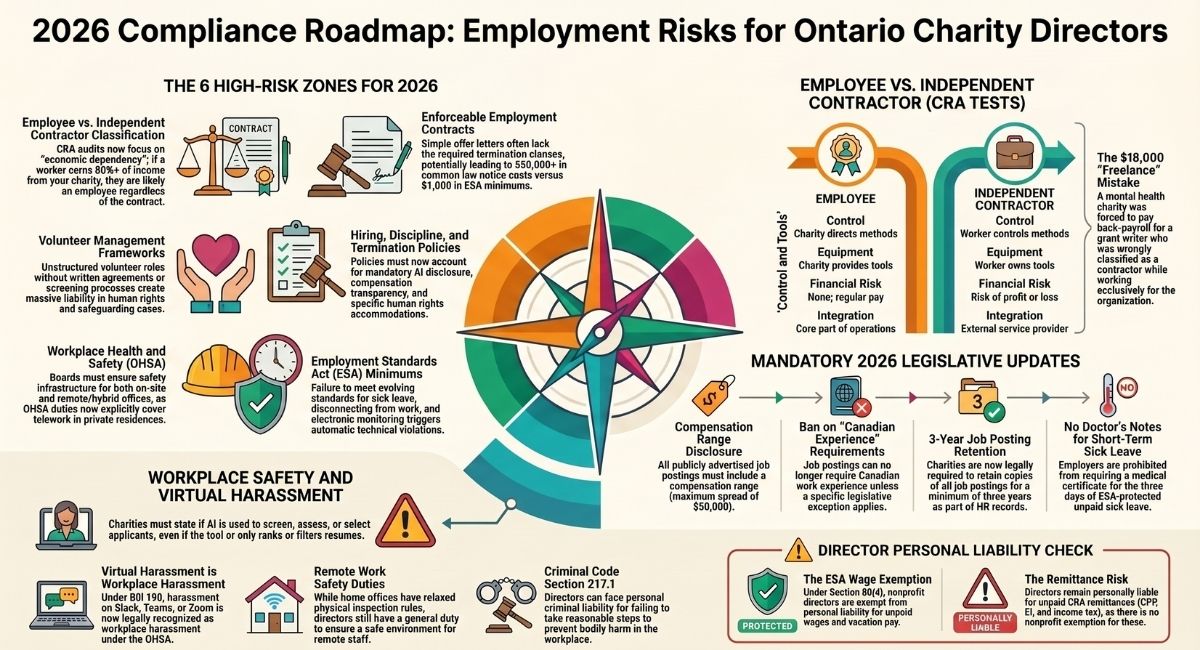
Employee vs. Independent Contractor Classification
The Core Issue: Are individuals being paid as employees or independent contractors, and if classified as contractors, does this align with CRA requirements?
The Canada Revenue Agency doesn't accept your classification at face value. They examine the actual working relationship using established tests around control, ownership of tools, chance of profit/risk of loss, and integration into operations.
How CRA Distinguishes Employees from Independent Contractors
Real-Life Example: A mental health charity hired a "freelance" grant writer who worked exclusively for them 30 hours per week, used the charity's computer and office space, followed the charity's grant application procedures, and received detailed supervision from the executive director. Despite calling her a contractor, CRA reclassified her as an employee, triggering $18,000 in back payroll remittances plus penalties.
The Risk: Misclassification triggers back-payment obligations for CPP, EI, income tax withholdings, plus penalties and interest that can devastate a small charity's budget.
2026 Update: CRA has increased audit activity on worker classification in the nonprofit sector. Charities that reclassify volunteers or program contractors as employees during audits face retroactive remittance obligations going back up to four years. If your charity has not reviewed contractor relationships since 2023, treat that review as overdue.
A critical enforcement shift in 2026: CRA's focus is now on economic dependency. If a contractor earns more than 80% of their income from your charity, CRA's default position is that they are an employee — regardless of what the contract says. Do not rely on the label in the agreement; rely on the economic reality of the relationship.
Key Compliance Steps:
- Review all contractor relationships against CRA criteria
- Document the business rationale for contractor classification
- Ensure contracts reflect true independence, not disguised employment
Employment Contract Essentials
Current State Check: Do you have written employment contracts with all employees, and are these contracts current and enforceable?
Real-Life Example: An environmental charity hired their program coordinator with a simple offer letter stating "employment may be terminated with reasonable notice." When they had to terminate the role due to funding cuts, they discovered they owed 8 months' notice under common law instead of the 2 weeks required by the Employment Standards Act. The termination cost $32,000 instead of $1,200.
Critical Contract Elements:
Enforceable Termination Clauses: Without proper termination language, you may owe common law notice periods extending for months rather than Employment Standards Act minimums.
Non-Competition Restrictions: Employment law has evolved significantly regarding non-compete clauses. Ensure any restrictions comply with current legislation, particularly for non-executive positions.
Regular Updates: Employment law changes frequently. Contracts that were compliant years ago may now expose you to liability.
2026 Legislative Update: Ontario's Working for Workers Act amendments (Bills 149, 190, and subsequent legislation) have introduced several enforceable obligations that now apply to registered charities.
Compensation Disclosure (in force as of January 1, 2026): Under Ontario's Working for Workers Four Act, 2023 (Bill 149), all Ontario employers — regardless of size — must include a compensation range in all publicly advertised job postings. The range provided cannot exceed $50,000, unless the upper limit of the range is above $200,000 annually. Charities cannot circumvent this requirement by posting a vague "general recruitment" advertisement — if the intention is to hire for a role, a compensation range must be included. Charities with existing job posting templates should review and update them before their next hire.
AI Disclosure in Hiring (in force as of January 1, 2026): All Ontario employers must explicitly disclose in any publicly advertised job posting whether artificial intelligence is used to screen, assess, or select applicants. This obligation applies to all employers regardless of size, and applies even where the AI tool only filters or ranks applications and does not make final decisions.
Mandatory Candidate Notification (in force as of January 1, 2026): Employers must now notify every candidate who was interviewed whether a hiring decision has been made, within the legally prescribed timeframe following their final interview. Failure to comply is a technical violation of the Employment Standards Act. Charities should update their recruitment workflows to ensure this notification step is built into the process.
Job Posting Retention (in force as of January 1, 2026): Employers are required to retain copies of all job postings for a minimum of three years. Charities should confirm they have a document retention process in place that captures job postings as part of their HR records.
Ban on Requiring Canadian Experience (in force as of January 1, 2026): All Ontario employers — regardless of size — may not include requirements for Canadian work experience in job postings or application processes unless an exception applies under applicable legislation. Existing posting templates should be reviewed to ensure no such requirement appears.
Volunteer Management Framework
Often Overlooked: Even volunteers require structured legal frameworks. Do you have volunteer agreements and application processes in place?
Real-Life Example: A youth sports charity relied on volunteer coaches without written agreements or screening. When a parent accused a volunteer coach of inappropriate conduct with children, the charity faced not only a human rights complaint but also criticism from funders for inadequate safeguarding policies. The resulting investigation and legal costs exceeded $25,000, and they lost a major funding relationship.
Essential Elements:
- Written volunteer agreements outlining expectations and boundaries
- Application and screening processes appropriate to volunteer roles
- Clear termination procedures for volunteer relationships
This framework protects both the organization and volunteers while establishing clear expectations.
Note for 2026: The distinction between volunteers and workers has received renewed scrutiny in Ontario. Where a "volunteer" receives any form of material benefit — including honoraria, gift cards, or transportation allowances — the relationship may attract Employment Standards Act protections. Legal counsel should review any compensation arrangements for volunteers, particularly in long-term or recurring roles.
Hiring, Discipline, and Termination Policies
Compliance Foundation: Have you developed and implemented appropriate policies for hiring, disciplining, and terminating employees and volunteers?
Real-Life Example: A food bank hired a warehouse coordinator and never conducted criminal record checks, despite the role involving access to donation records with donor addresses and contact information. When the employee was later arrested for identity theft involving stolen mail, the charity faced questions about their hiring practices from both police and their insurance company, which initially denied coverage for related losses.
Human Rights Compliance: Your hiring processes must comply with human rights legislation. This includes:
- Job posting requirements and recruitment practices
- Accommodation policies for employees from disadvantaged groups
- Screening procedures, including criminal record checks where appropriate
Special Considerations for Religious Charities: If you require lifestyle statements from employees or volunteers, these must comply with Human Rights Code exceptions available to special interest organizations.
Vulnerable Sector Considerations: Employees and volunteers dealing with children or vulnerable populations require enhanced screening, including criminal record checks and vulnerable sector verification under applicable legislation.
Essential Policy Framework
Mandatory Policies: Modern charities need comprehensive policy coverage:
Real-Life Example: A small arts charity ignored developing workplace harassment policies until a board member made repeated inappropriate comments to the part-time administrative assistant. Without proper policies or procedures, the situation escalated to a human rights complaint that cost $15,000 to resolve and resulted in the resignation of three board members, disrupting operations for months.
Accommodation Procedures: Formal processes for accommodating employees and volunteers from disadvantaged groups.
Technology and Social Media Guidelines: Policies covering computing, technology use, and electronic monitoring of employees.
Current Requirements (2026): Ontario charities with 25 or more employees are legally required to maintain written policies on disconnecting from work and electronic monitoring. These are enforceable obligations, not emerging recommendations. Charities that have grown since 2022 should confirm whether they have crossed the 25-employee threshold that triggers these requirements.
Workplace Harassment — Virtual Expansion: Under Bill 190 (Working for Workers Five Act), the definition of workplace harassment and sexual harassment under the Occupational Health and Safety Act has been explicitly expanded to include harassment occurring virtually through the use of information and communications technology. This means harassment conducted over platforms such as Slack, Microsoft Teams, Zoom, or social media is now statutorily recognized under the OHSA in the same way as in-person harassment. Charities must update their OHSA-mandated harassment policies to specifically address digital conduct. Any harassment policy that does not reference virtual or online interactions is currently out of compliance.
Sick Leave Certificates — Ban on Requiring Doctor's Notes: Effective late 2024 and continuing as an enforceable obligation in 2026, employers are prohibited from requiring a certificate from a qualified health practitioner — commonly referred to as a doctor's note — as evidence of entitlement to the three days of ESA-protected unpaid sick leave. Charities whose internal handbooks or HR policies still require a doctor's note for short-term absences are currently in violation of the Employment Standards Act and should remove this requirement immediately.
Drug, Alcohol, and Cannabis Standards: Fitness-for-work policies addressing drug, alcohol, and cannabis use remain an important risk management tool, particularly for roles involving driving, operating equipment, or working with vulnerable populations.
Risk-Specific Policies: Assess whether your workplace presents opioid overdose risks requiring naloxone kits and trained personnel.
Intellectual Property Protection: Address ownership of intellectual property created by employees and volunteers, including copyright assignments and moral rights waivers.
Workplace Safety and Liability Exposure
Board Director Liability: Are the charity and board exposed to liability regarding employee and volunteer actions?
Real-Life Example: A community garden charity organized volunteer workdays involving power tools and heavy lifting without safety training or procedures. When a volunteer suffered a serious back injury, the investigation revealed the charity had no safety committee, no incident reporting procedures, and no insurance coverage for volunteer injuries. The resulting workers' compensation claim and legal action personally named the board chair and executive director.
Reasonable Precautions: Directors must ensure every reasonable precaution is taken for worker, volunteer, and public safety, including compliance with federal and provincial occupational health and safety legislation.
Safety Infrastructure: Establish safety committees or equivalent programs and ensure ongoing effectiveness.
Criminal Code Obligations: Section 217.1 of the Criminal Code creates potential criminal liability for failing to take reasonable steps to prevent bodily harm arising from directed work or tasks.
OHSA and Remote Work — Important Clarification: A common misconception among charity directors is that the Occupational Health and Safety Act does not apply to employees working from home. Bill 190 (Working for Workers Five Act) has clarified that OHSA does apply to telework performed in a private residence. While a private residence office is excluded from the definition of an industrial establishment — meaning certain physical inspection rules are relaxed — the general duty to provide employees with a safe work environment remains in full effect. Charities with remote or hybrid staff should ensure their safety policies address the home office environment and that employees have a mechanism to report workplace safety concerns regardless of where they are working.
Professional Assessment: Consider occupational health and safety audits conducted by experienced workplace safety consultants.
Employment Standards and Termination
Termination Risk Management: Have you developed appropriate termination policies and practices complying with provincial and federal legislation?
Real-Life Example: A social services charity terminated their communications director for poor performance, but the executive director became frustrated during the termination meeting and told the employee she was "incompetent" and "should never work in nonprofits again." These comments, witnessed by the HR volunteer, later supported a successful wrongful dismissal claim that included $45,000 in punitive damages for the charity's harsh and vindictive conduct.
Wrongful Dismissal Protection: Employment contracts should include termination clauses limiting liability to Employment Standards Act minimums. Without these, you face potential punitive damages for harsh, vindictive, reprehensible, or malicious conduct.
Employment Standards Act Compliance: Ensure ongoing compliance with Employment Standards Act requirements, including recent updates to hiring and termination procedures.
Construction Work Considerations: For charities hiring construction services, obtain Workplace Safety and Insurance Board clearance certificates before work begins.
Digital and Remote Work Compliance
Hybrid and remote work arrangements have become standard across the nonprofit sector, and Ontario charity directors face a growing set of obligations in this area that did not exist when many charities last reviewed their employment frameworks.
Disconnecting from Work Policy (required for charities with 25+ employees): Since 2022, Ontario employers with 25 or more employees must maintain a written disconnecting-from-work policy and provide it to all employees. Charities that have grown since this obligation came into effect should confirm whether they have crossed this threshold and implement the required policy if they have not already done so.
Electronic Monitoring Policy (required for charities with 25+ employees): Charities that monitor employee devices, location, internet usage, or activity must maintain a written electronic monitoring policy and disclose it to employees within 30 days of hiring. This obligation also applies to charities with 25 or more employees.
Remote Work and Provincial Jurisdiction: Employees who work remotely from outside Ontario may be subject to different provincial employment standards. This is particularly relevant for national charities whose employees have relocated while remaining employed. Legal counsel should advise on which province's employment standards apply where there is any ambiguity.
AI in Hiring Disclosure: Ontario charities using any machine-based system — including basic filters in applicant tracking systems — to screen, assess, or select applicants must disclose this in job postings. This obligation is in force as of January 1, 2026, and applies even where AI is used only to filter or rank applications rather than make final hiring decisions. Charities should audit their current recruitment tools and update their job posting templates accordingly.
Specialized Compliance Areas
Confidentiality and Conflict of Interest: Implement appropriate policies addressing confidentiality and conflict of interest situations.
Real-Life Example: A health advocacy charity discovered their part-time bookkeeper was also working for a pharmaceutical company that the charity frequently criticized in public campaigns. Without clear conflict of interest policies, they couldn't address the situation effectively and eventually had to terminate the relationship, disrupting their financial management during a critical funding period.
Job Descriptions: Develop clear job descriptions for employment and volunteer positions to establish expectations and accountability.
Age-Related Employment Issues: Manage performance and expectations of older employees carefully to avoid wrongful dismissal or human rights claims.
Intern and Remote Work Considerations:
- Ensure unpaid interns meet Employment Standards Act exemptions
- Develop policies for remote work addressing hours, overtime, and provincial employment determination
Competition Act Compliance: Take steps to ensure compliance regarding wage fixing and no-poaching agreements.
International Work: For employees or volunteers working abroad, ensure proper legal documentation including visas and local authority permissions.
Accessibility Compliance: Under the Accessibility for Ontarians with Disabilities Act, implement employment standards including accommodation in recruitment, individualized accommodation plans, return-to-work processes, and performance management. Organizations with 50+ employees must prepare multi-year accessibility plans and file compliance reports.
2026 Statutory Compliance Summary
The following table consolidates the key 2026 legislative obligations that apply to Ontario charities. Directors should use this as a quick audit reference.
Practical Implementation Strategy
Immediate Assessment:
- Audit current employment relationships and classifications
- Review existing employment contracts and volunteer agreements
- Evaluate current policy framework against legal requirements
Risk Mitigation:
- Update contracts to reflect current employment law
- Implement mandatory policy frameworks
- Establish regular compliance review schedules
Ongoing Management:
- Train senior staff and board members on compliance requirements
- Create incident response procedures
- Schedule regular legal compliance reviews
Frequently Asked Questions: Employment Risks for Ontario Charity Directors
Can an Ontario charity director be personally liable for employment law violations?
Yes, but with an important exception specific to nonprofit corporations. Under Section 80(4) of the Employment Standards Act, 2000, directors of not-for-profit corporations are explicitly exempt from personal liability for unpaid wages and vacation pay owed by the organization. This is a meaningful protection that distinguishes nonprofit directors from their for-profit counterparts, who can be held personally liable for unpaid wages under the ESA.
That said, this exemption does not eliminate all forms of personal director liability. Directors of Ontario charities can still face personal exposure for unpaid CRA remittances (CPP, EI, and income tax), as the Income Tax Act does not contain an equivalent nonprofit exemption. Directors can also face liability under the Occupational Health and Safety Act and potential criminal liability under Section 217.1 of the Criminal Code for failing to take reasonable steps to prevent workplace bodily harm. The ESA wage exemption is significant, but it does not create a complete liability shield.
What is the biggest employment law risk for small Ontario charities?
For small charities, the highest-risk area is typically an unenforceable or absent termination clause in the employment contract. Without a properly drafted termination clause, a dismissed employee may be entitled to months of common law notice rather than the ESA minimum, resulting in unexpected five-figure liabilities.
Do Ontario charities need written employment contracts?
While not strictly required by law, written employment contracts with clear termination clauses are strongly recommended for all charities. Without them, common law notice obligations apply automatically and can significantly exceed ESA minimums, particularly for long-tenured employees.
Are volunteers covered by Ontario employment law?
Generally, volunteers are not employees under the Employment Standards Act. However, if volunteers receive remuneration — including honoraria or regular allowances — the relationship may be reclassified. All volunteer relationships should be supported by written volunteer agreements regardless of whether compensation is involved.
What policies are legally required for Ontario charities in 2026?
Ontario charities with 25 or more employees must maintain: (1) a written disconnecting-from-work policy; and (2) a written electronic monitoring policy. All Ontario charities — regardless of size — must comply with human rights accommodation obligations, occupational health and safety requirements including the updated virtual harassment provisions under Bill 190, and the ban on requiring doctor's notes for ESA-protected sick leave. Charities with 50 or more employees must also comply with AODA multi-year accessibility plan and reporting obligations.
All Ontario charities — regardless of size — must also comply with the 2026 job posting requirements under the Working for Workers Four Act, 2023 (Bill 149). These include disclosing compensation ranges in publicly advertised job postings, disclosing the use of AI in hiring, notifying candidates of hiring outcomes within the legally prescribed timeframe, retaining job postings for three years, and removing any requirement for Canadian work experience from postings and application processes.
How often should an Ontario charity review its employment compliance?
At minimum, annually. Ontario has passed Working for Workers Act amendments in successive years, each introducing new employer obligations. A compliance framework reviewed in 2023 or earlier may already be out of date in several areas, including job posting requirements, AI disclosure, and remote work policy obligations.
Is there a specific deadline for notifying candidates who were not selected after an interview?
Ontario's Working for Workers Four Act, 2023 (Bill 149) requires employers to inform interviewed candidates that a hiring decision has been made and that the candidate was not selected. The exact notification timeline is governed by regulation rather than being hardcoded in the primary legislation, which means the specific timeframe may be updated without an Act amendment. Charities should ensure candidate notification is built into their standard recruitment workflow and seek current legal guidance on the prescribed timeline applicable at the time of hiring.
Can an Ontario charity require employees to provide a doctor's note for short-term sick leave?
No. As of late 2024, Ontario employers are prohibited from requiring a certificate from a qualified health practitioner as evidence of entitlement to the three days of ESA-protected unpaid sick leave. Charities whose HR handbooks or absence management policies still include this requirement are currently in violation of the Employment Standards Act. The requirement should be removed from all internal policies immediately.
What should a charity do if it suspects a worker has been misclassified?
Do not simply reclassify the worker without legal advice. Voluntary reclassification may trigger retroactive obligations for CPP, EI, and income tax remittances, and could expose the charity to penalties. Seek guidance from an employment or charity lawyer before making any changes to the working arrangement.
The Bottom Line
Employment law compliance isn't optional for Ontario charities. The regulatory landscape continues evolving, creating new obligations and liability exposures. Directors who treat employment compliance as foundational to operations protect their organizations from devastating legal and financial consequences.
The cost of proper compliance is always less than the cost of getting it wrong. Employment law violations can result in significant financial liability, reputational damage, and mission disruption that threatens your organization's very existence.
In 2026, the compliance burden on Ontario charity directors is higher than at any previous point. Ontario has passed successive rounds of Working for Workers legislation, introducing obligations around job posting transparency, AI disclosure in hiring, disconnecting from work, and electronic monitoring — most of which apply to charities in the same way they apply to for-profit employers. Directors who last reviewed their employment framework before 2024 should treat that review as overdue. B.I.G. Charity Law Group advises Ontario charities on all aspects of employment compliance — contact us to schedule a compliance review.
The material provided on this website is for information purposes only.. You should not act or abstain from acting based upon such information without first consulting a Charity Lawyer. We do not warrant the accuracy or completeness of any information on this site. E-mail contact with anyone at B.I.G. Charity Law Group Professional Corporation is not intended to create, and receipt will not constitute, a solicitor-client relationship. Solicitor client relationship will only be created after we have reviewed your case or particulars, decided to accept your case and entered into a written retainer agreement or retainer letter with you.
DOV GOLDBERG, J.D. is a lawyer at B.I.G. Charity Law Group and has dedicated his career exclusively to Charity and Not-for-Profit Law for over a decade. Dov guides charities, foundations, and non-profit organizations through every stage of the registration process, offering practical legal advice with a focus on compliance, governance, and long-term success. Known for his hands-on approach and deep knowledge of CRA requirements, Dov is committed to helping clients build strong, sustainable, and legally sound organizations.
.png)


