
How to Register a Church in Canada: Step-by-Step Guide

Published on
March 24, 2025
Last updated on
March 10, 2026
Starting a church in Canada involves more than gathering a congregation and holding services. To operate legally and access benefits such as tax exemptions and issuing tax receipts to donors, your church needs proper registration. But how do you register a church in Canada, and is it considered a charity? This guide will walk you through the steps to establish and register a church in compliance with Canadian laws.
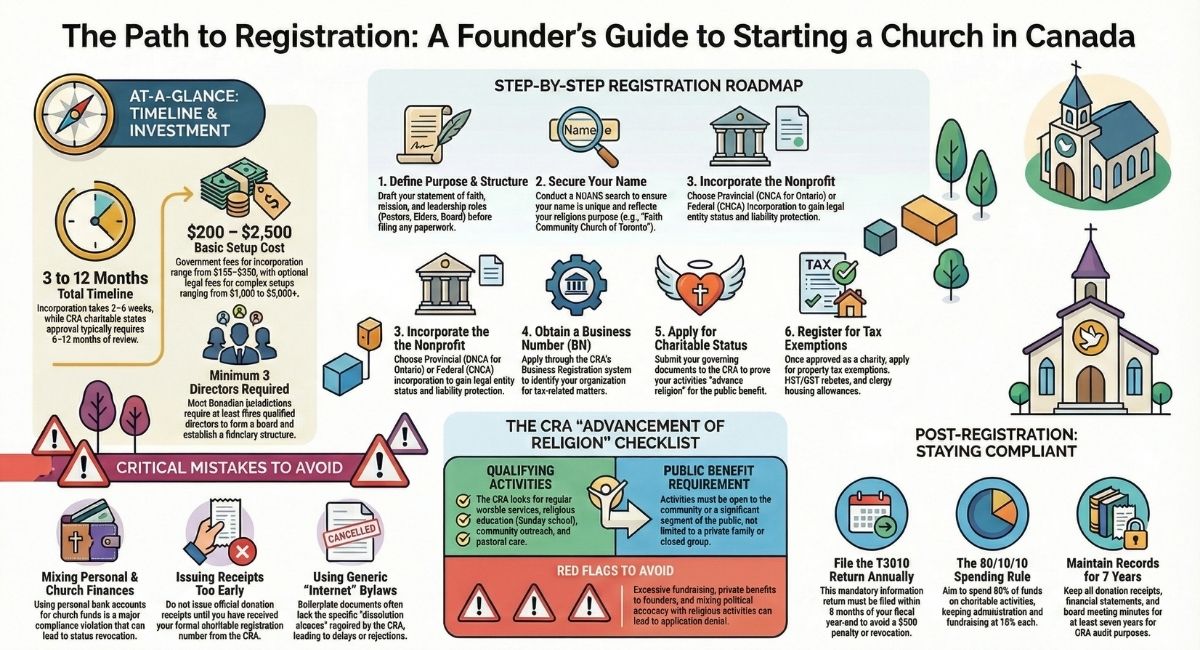
Church Registration in Canada: Quick Overview
Before diving into the details, here's what you need to know at a glance:
Timeline: 3-12 months total (2-4 weeks for provincial incorporation, 4-6 weeks for federal incorporation, 6-12 months for CRA charitable status approval)
Total Costs: $200-$2,500
- Provincial incorporation: $200-$350
- Federal incorporation: $200-$250
- CRA charitable registration: Free
- Legal fees (optional): $1,500-$5,000
Basic Requirements:
- Minimum 3 directors
- Governing documents (articles and bylaws)
- Religious purposes that benefit the public
- Proper organizational structure
Key Benefits:
- Legal entity status and limited liability protection
- Tax-exempt status
- Ability to issue donation receipts
- Enhanced credibility and public trust
What Is Church Registration in Canada?
Churches in Canada generally fall under the category of nonprofit organizations. Many churches also apply for charitable status with the Canada Revenue Agency (CRA) to receive tax-exempt benefits and issue donation receipts. However, registering a church requires meeting specific legal requirements.
A church can be incorporated as a nonprofit religious corporation under the Ontario Not-for-Profit Corporations Act (ONCA) for those in Ontario or the Canada Not-for-Profit Corporations Act (CNCA) for those operating across multiple provinces. This incorporation provides the church with legal recognition, limited liability protection, and a formal governance structure.
Step 1: Define the Purpose and Structure of the Church
Before registering, it’s essential to determine:
- The church’s mission, beliefs, and statement of faith
- Leadership structure (e.g., pastors, elders, board of directors)
- Governance policies (e.g., decision-making, membership rules)
Creating a clear structure helps ensure your church operates effectively and meets incorporation requirements.
Step 2: Choose a Name for Your Church
Your church’s name must be unique and comply with government regulations. In Canada:
- The name cannot be identical or too similar to an existing organization.
- It should clearly reflect the religious purpose (e.g., “Faith Community Church of Toronto”).
- You can conduct a NUANS name search to check for name availability.
If your name is available, you can reserve it before proceeding with incorporation.
Step 3: Incorporate Your Church as a Nonprofit
Incorporating your church as a nonprofit provides legal recognition and limited liability protection. You have two options:
Option 1: Provincial Incorporation (Ontario Example)
If your church primarily operates in Ontario, you can incorporate under ONCA by filing:
- Articles of Incorporation (Form 2)
- A NUANS name search report (if applicable)
- A cover letter and government fee
For other provinces, similar processes exist under respective provincial nonprofit legislation.
Option 2: Federal Incorporation
If your church will operate across multiple provinces, federal incorporation under CNCA may be better. You’ll need to file:
- Articles of Incorporation
- A NUANS name search report
- Bylaws and governance structure
Once incorporated, your church exists as a legal entity.
Other Provincial Options
British Columbia: Incorporate under the BC Societies Act through BC Registry Services. Cost: approximately $100-$150. Processing time: 1-2 weeks.
Alberta: Use the Alberta Societies Act through Alberta Corporate Registry. Cost: approximately $100. Processing time: 1-2 weeks.
Saskatchewan: Register under the Saskatchewan Non-profit Corporations Act. Cost: approximately $125-$200. Processing time: 2-3 weeks.
Manitoba: Incorporate under The Corporations Act through Companies Office. Cost: approximately $330. Processing time: 2-4 weeks.
Quebec: Quebec has unique requirements under Part III of the Companies Act. Churches may incorporate as legal persons or register under the Civil Code. It's highly recommended to consult a Quebec charity lawyer due to the province's distinct legal system. Cost: approximately $200-$400. Processing time: 4-6 weeks.
Maritime Provinces: Each has its own societies or nonprofit corporations legislation with similar processes to other provinces.
Note: Processing times are approximate and can vary based on government workload and application completeness.
Step 4: Apply for a Business Number (BN) and CRA Registration
After incorporation, your church needs a Business Number (BN) from the CRA for tax-related matters. You can apply online through the CRA’s Business Registration system.
Step 5: Apply for Charitable Status (Optional but Recommended)
Not all churches automatically qualify as charities. However, obtaining charitable status allows the church to issue donation receipts and receive tax-exempt status. To apply:
- Submit governing documents (e.g., articles of incorporation, bylaws)
- Demonstrate the church’s charitable purposes (e.g., advancing religion, providing community services)
The CRA reviews applications to ensure the organization meets the requirements for religious charities.
What Qualifies as "Advancement of Religion" for the CRA?
To receive charitable registration, your church must demonstrate that it advances religion in a way that benefits the public. Here's what the CRA looks for:
Activities That Qualify:
Regular Worship Services:
- Scheduled religious services open to the community
- Prayer meetings and religious observances
- Celebration of religious holidays and sacraments
Religious Education:
- Sunday school or religious education programs
- Bible studies and scripture classes
- Training programs for religious leaders
- Youth programs with religious instruction
Community Outreach:
- Missionary work aligned with religious beliefs
- Community support programs rooted in religious doctrine
- Pastoral care and counselling
- Religious publications and media
Maintenance of Places of Worship:
- Operating churches, temples, or houses of worship
- Providing space for religious ceremonies
- Maintaining religious artifacts and symbols
What the CRA Examines:
Public Benefit:
- Activities must be available to a significant segment of the public
- Cannot be limited to a private group or family
- Must demonstrate community benefit
Religious Doctrine:
- Clear statement of faith and beliefs
- Recognized religious practices
- Genuine religious purpose (not primarily social or recreational)
Operational Structure:
- Regular religious services and activities
- Trained or ordained religious leaders
- Formal membership or congregation
Financial Accountability:
- At least 80% of resources directed to charitable activities
- Proper donation receipting procedures
- Transparent financial reporting
Red Flags the CRA Watches For:
- Private benefit to founders or directors
- Primarily social or cultural activities without religious component
- Unclear or constantly changing religious doctrine
- Limited public access to activities
- Mixing political advocacy with religious activities
- Excessive fundraising with minimal religious programming
Pro Tip: When completing Application to Register a Charity, provide specific examples of your religious activities, worship schedules, and how you'll benefit the public. Vague descriptions like "spreading faith" are insufficient – the CRA wants concrete details about what your church will actually do.
Step 6: Register for Tax Exemptions and Other Benefits
Once approved as a charity, your church can apply for:
- Property tax exemptions (varies by municipality)
- HST/GST rebates
- Payroll deductions for clergy housing allowances
Maintaining tax-exempt status requires compliance with CRA regulations, such as annual reporting and proper financial management.
Annual Compliance Requirements for Registered Churches
After receiving charitable registration, your church has ongoing obligations to maintain its status. Failing to meet these requirements can result in penalties, loss of charitable status, or even legal consequences.
Annual Filing Requirements:
T3010 Registered Charity Information Return:
- Must be filed within 6 months of your fiscal year-end
- Reports all revenue, expenses, and activities
- Publicly available on CRA website
- Filing fee: $0
- Deadline is strict – late filing results in $500 penalty and possible revocation
Provincial/Federal Annual Returns:
- Ontario corporations: Annual return required (currently no fee under ONCA)
- Federal corporations: Annual return required ($0-$40 fee)
- Update any changes to directors, registered office address
- Due dates vary by incorporation jurisdiction
Financial Requirements:
Minimum Spending on Charitable Activities:
- Must spend at least 80% of donated funds on religious/charitable activities
- Maximum 10% on administration
- Maximum 10% on fundraising
- These are guidelines; actual spending must be reasonable
Record Keeping (Minimum 7 Years):
- All donation receipts and donor records
- Financial statements and bank records
- Minutes of board meetings
- Contracts and agreements
- Correspondence with CRA
- Property and asset records
Donation Receipts:
- Must follow CRA guidelines exactly
- Include mandatory information: charity name, registration number, date, amount, donor name
- Only issue receipts for eligible donations
- Keep copies of all issued receipts
Governance Requirements:
Board Meetings:
- Hold regular board meetings (at least annually, ideally quarterly)
- Keep detailed minutes
- Ensure quorum requirements are met
- Document all major decisions
Member Meetings:
- Hold annual general meetings if you have members
- Provide financial reports to members
- Hold director elections as per bylaws
Director Obligations:
- Maintain minimum number of directors (usually 3)
- Ensure directors are not disqualified (not bankrupt, not convicted of fraud)
- Directors must act in the church's best interests
- Update CRA within 30 days of director changes
Operational Requirements:
Stay Within Charitable Purposes:
- Activities must align with registered purposes
- Cannot change purposes without CRA approval
- Cannot engage in prohibited political activities
- Limited business activities (must be related to religious purposes)
Avoid Private Benefit:
- No distribution of income to members or directors
- Compensation must be reasonable for services rendered
- Arms-length transactions required
- No personal use of church assets
Political Activities (Limited):
- Can devote up to 10% of resources to political activities
- Must be non-partisan
- Must relate to your charitable purposes
- Cannot support or oppose political parties or candidates directly
Public Transparency:
Information Available on CRA Website:
- T3010 returns (publicly searchable)
- Charity registration details
- Contact information
- Financial summaries
Your Responsibilities:
- Keep public informed about activities
- Respond to reasonable information requests
- Maintain up-to-date contact information with CRA
Consequences of Non-Compliance:
Minor Issues:
- Written warnings from CRA
- Education letters
- Compliance agreements
Serious Issues:
- $500-$5,000 penalties
- Suspension of donation receipting privileges
- Compliance audits
Severe Issues:
- Revocation of charitable status
- Public disclosure of non-compliance
- Legal action for misuse of charitable funds
Pro Tip: Many churches hire a bookkeeper or accountant familiar with charity requirements to ensure compliance. The small cost prevents major problems down the road.
Before registering a church, many faith groups begin by forming a ministry. Learn more in our guide How to Start a Ministry in Canada.
Are Churches Considered Nonprofits or Charities in Canada?
Churches in Canada are generally nonprofits, but not all qualify as registered charities. A nonprofit church can operate legally but won’t receive charitable tax benefits unless it registers with the CRA. To be recognized as a charity, a church must prove its activities advance religion and benefit the public.
How Much Does It Cost to Register a Church in Canada?
The costs vary depending on the registration process:
- NUANS name search: $15–$35
- Provincial incorporation: $155 (Ontario government fee, other provinces may vary)
- Federal incorporation: $200 (Corporations Canada fee)
- Charity registration: Legal assistance may cost $5,500–$15,000, on average
While DIY registration is possible, hiring an experienced charity lawyer ensures compliance, provides for ideal membership structure, and increases approval chances.
How Long Does It Take to Register a Church in Canada?
- Federal incorporation: 1–3 days
- Charity registration: 5–12 months (depending on CRA review and how well the application is drafted)
Planning ahead helps avoid delays and ensures smooth registration.
Common Mistakes When Registering a Church in Canada (And How to Avoid Them)
Learning from others' mistakes can save you time, money, and frustration. Here are the most common errors churches make during registration:
1. Not Having Proper Bylaws Before Incorporating
The Mistake: Rushing to incorporate with generic or incomplete bylaws copied from the internet.
Why It's a Problem:
- CRA will scrutinize your bylaws during charitable registration
- Poorly drafted bylaws cause delays or rejection
- Bylaws are hard to change once incorporated
How to Avoid It: Have a lawyer draft or review your bylaws before incorporation. Ensure they include mandatory dissolution clauses and comply with CRA requirements.
2. Insufficient Board Members
The Mistake: Starting with only 1-2 directors to keep things simple.
Why It's a Problem:
- Most provinces require minimum 3 directors
- CRA looks unfavorably on very small boards
- Creates succession problems if a director leaves
How to Avoid It: Start with at least 3-5 qualified directors who understand their fiduciary duties and are committed to the church's mission.
3. Mixing Personal and Church Finances
The Mistake: Using personal bank accounts for church income and expenses, especially in the early stages.
Why It's a Problem:
- Violates nonprofit and charity rules
- Creates personal tax liability
- CRA will deny or revoke charitable status
- Exposes personal assets to church liabilities
How to Avoid It: Open a dedicated church bank account immediately after incorporation. Never deposit church funds into personal accounts.
4. Not Keeping Proper Donation Records
The Mistake: Informal tracking of donations, issuing receipts before charitable registration, or missing mandatory receipt information.
Why It's a Problem:
- Cannot prove financial accountability to CRA
- Donors lose tax credits if receipts are improper
- Penalty of 5% of receipted amount for each incorrect receipt
- Can lead to loss of charitable status
How to Avoid It:
- Only issue official donation receipts after receiving charitable registration
- Use CRA-approved receipt formats
- Keep detailed donor records for 7 years
- Consider donor management software
5. Failing to File Annual Returns on Time
The Mistake: Missing the T3010 filing deadline or forgetting provincial annual returns.
Why It's a Problem:
- Automatic $500 penalty for late T3010
- Can lead to revocation of charitable status after 1 year
- Provincial penalties for late corporate returns
- Creates compliance record with CRA
How to Avoid It:
- Mark filing deadlines on calendar (6 months after fiscal year-end)
- Consider hiring an accountant for T3010 preparation
- File even if you had no activity
- Set up CRA online account for reminders
6. Not Understanding the 80/10/10 Rule
The Mistake: Spending too much on administration or fundraising relative to actual charitable activities.
Why It's a Problem:
- CRA expects approximately 80% of resources on religious/charitable activities
- Excessive overhead raises red flags
- Can lead to CRA investigation or status loss
How to Avoid It:
- Budget carefully to prioritize religious programming
- Track expenses by category (charitable activities, administration, fundraising)
- Keep administration and fundraising each under 20% of total spending
- Document that spending is reasonable for your church's size and activities
7. Copying Another Church's Documents Without Customization
The Mistake: Using another church's articles, bylaws, or Application to Register a Charity as a template without proper adaptation.
Why It's a Problem:
- Each church has unique circumstances and needs
- Generic documents often contain errors or irrelevant clauses
- CRA notices boilerplate applications and scrutinizes them more carefully
- May not comply with your specific provincial requirements
How to Avoid It: Use templates as a starting point only. Customize all documents to reflect your church's actual structure, beliefs, and plans. Have a lawyer review before filing.
8. Unclear or Overly Broad Purpose Statements
The Mistake: Writing vague purposes like "to help people" or overly broad purposes that include non-charitable activities.
Why It's a Problem:
- CRA requires specific charitable purposes
- Vague purposes invite CRA questions and delays
- Broad purposes may include non-charitable elements that disqualify you
How to Avoid It: Be specific about your religious purposes. Use language like "to advance the Christian faith through worship, religious education, and community ministry" rather than "to help the community."
9. Starting Operations Before Proper Registration
The Mistake: Holding services, collecting donations, and issuing receipts before completing incorporation and charitable registration.
Why It's a Problem:
- Operating without incorporation removes liability protection
- Cannot legally issue donation receipts without charitable registration
- Donors cannot claim tax credits
- May create personal tax liability
How to Avoid It:
- Complete incorporation before commencing formal operations
- Wait for charitable registration before issuing donation receipts
- You can hold informal gatherings, but don't collect significant funds until properly registered
10. Ignoring Provincial Requirements When Federally Incorporated
The Mistake: Thinking federal incorporation means you don't need to register in provinces where you operate.
Why It's a Problem:
- May still need to register for provincial sales tax
- Need to register for provincial payroll accounts if hiring staff
- May need extra-provincial registration for certain activities
How to Avoid It: Research specific requirements in each province where you'll operate, even with federal incorporation.
What If My Church's Charitable Application Is Denied?
Not all church applications for charitable status are approved on the first try. Here's what you need to know if you receive a denial:
Common Reasons for CRA Denial:
Insufficient Public Benefit:
- Activities appear to benefit a private group rather than the broader public
- Limited access to services or membership
- Family-run organization with insufficient community involvement
Unclear Religious Purposes:
- Statement of faith is vague or inconsistent
- Proposed activities don't clearly advance religion
- Mix of charitable and non-charitable purposes
Poor Financial Planning:
- Unrealistic budget projections
- Insufficient demonstration of financial accountability
- No clear plan for sustainability
Governance Concerns:
- Inadequate bylaws or articles
- Board members who don't meet CRA requirements
- Conflicts of interest not properly addressed
Documentation Issues:
- Incomplete Application to Register a Charity
- Missing required supporting documents
- Inconsistencies between different documents
What Happens After a Denial?
CRA Notification:
- You'll receive a detailed letter explaining the reasons for denial
- Letter will specify what requirements weren't met
- You have 90 days to respond or appeal
Your Options:
Option 1: Provide Additional Information (Within 90 Days)
- Submit clarifying documents
- Explain misunderstandings
- Provide evidence you meet requirements
- CRA will reconsider based on new information
Option 2: Revise and Reapply (After Addressing Issues)
- Fix the problems identified in the denial letter
- Revise governing documents if needed
- Submit a new application
- No waiting period required if you address the issues properly
Option 3: File an Objection (Within 90 Days)
- Formal appeal process if you believe the denial was incorrect
- Must provide detailed reasons why you disagree
- CRA Appeals Division will review
- Can take 6-12 months for resolution
Option 4: Operate as Nonprofit Without Charitable Status
- Continue operating as an incorporated nonprofit
- Cannot issue donation receipts
- No tax-exempt status
- Can reapply for charitable status in the future
Tips for Successful Reapplication:
Address Every Issue:
- Carefully read the denial letter
- Fix each specific problem mentioned
- Don't just resubmit the same application
Strengthen Your Application:
- Provide more detailed activity descriptions
- Include concrete examples of how you'll benefit the public
- Show evidence of community need
- Demonstrate financial viability
Seek Professional Help:
- Consider hiring a charity lawyer for reapplication
- Lawyers familiar with CRA requirements can significantly improve approval chances
- Investment in legal help often saves time and future problems
Document Everything:
- Keep copies of all correspondence with CRA
- Maintain records of how you addressed each concern
- Show progress on implementing required changes
How Long Until You Can Reapply?
Good news: There's no mandatory waiting period. You can reapply as soon as you've addressed the issues that caused the denial. However:
- Take time to properly fix the problems
- Don't rush a reapplication with the same flaws
- Most successful reapplications happen 2-6 months after denial
Operating Without Charitable Status:
If you decide not to reapply or need time to build your church before trying again:
You Can:
- Operate legally as an incorporated nonprofit
- Hold religious services and activities
- Accept donations (but cannot issue tax receipts)
- Build a track record of activities
- Reapply for charitable status later when better positioned
Benefits of Waiting:
- Demonstrate established operations and community benefit
- Build financial history and stability
- Refine governance structure
- Develop clear track record for CRA
Many churches successfully operate for 1-2 years as nonprofits before applying for charitable status, which can actually strengthen their applications.
Final Thoughts: Should You Register Your Church as a Charity?
Registering a church as a nonprofit provides legal protection and structure, while obtaining charitable status offers tax benefits and donation advantages. If your church relies on donations, charitable registration is highly recommended.
For expert guidance on church registration in Canada, consider consulting a charity lawyer to ensure compliance with all legal requirements. Have more questions about registering your Canadian church? Call our charity lawyers at 416-488-5888, email us at ask@charitylawgroup.ca, or schedule a free consultation at the link above.
Frequently Asked Questions
How long does it take to register a church in Canada?
The complete process takes 3-12 months total. Incorporation takes 2-6 weeks, while CRA charitable registration takes 6-12 months. You can operate as a nonprofit immediately after incorporation, but must wait for charitable registration before issuing donation receipts.
Can I start a church without incorporation?
Yes, but it's not recommended. Without incorporation, you have no liability protection, cannot apply for charitable status, cannot own property in the church's name, and have less credibility with donors. Most churches incorporate immediately for legal protection.
Do I need a physical location to register a church in Canada?
No, you don't need a church building. Many churches start by meeting in homes or renting community spaces. You only need a registered office address (can be a home address) and evidence of regular religious activities.
How many members do I need to start a church in Canada?
There's no minimum number of members, but you need at least 3 directors for your board. For charitable registration, most churches have at least 15-25 regular participants to demonstrate public benefit rather than being a private family group.
What's the difference between registered and unregistered churches in Canada?
An unregistered church has no legal status or liability protection and cannot issue donation receipts. A registered nonprofit church has legal protection but still cannot issue receipts. A registered charity church can issue donation receipts, receives tax-exempt status, but must meet CRA compliance requirements.
The material provided on this website is for information purposes only.. You should not act or abstain from acting based upon such information without first consulting a Charity Lawyer. We do not warrant the accuracy or completeness of any information on this site. E-mail contact with anyone at B.I.G. Charity Law Group Professional Corporation is not intended to create, and receipt will not constitute, a solicitor-client relationship. Solicitor client relationship will only be created after we have reviewed your case or particulars, decided to accept your case and entered into a written retainer agreement or retainer letter with you.
DOV GOLDBERG, J.D. is a lawyer at B.I.G. Charity Law Group and has dedicated his career exclusively to Charity and Not-for-Profit Law for over a decade. Dov guides charities, foundations, and non-profit organizations through every stage of the registration process, offering practical legal advice with a focus on compliance, governance, and long-term success. Known for his hands-on approach and deep knowledge of CRA requirements, Dov is committed to helping clients build strong, sustainable, and legally sound organizations.
.png)


