
How Can Members Remove Directors Under ONCA?

Published on
July 17, 2024
Last updated on
September 6, 2026
Under the Ontario Not-for-Profit Corporations Act (ONCA), members of a nonprofit corporation have a clear and enforceable right to remove directors from the board. As of 2026, all Ontario nonprofits are required to operate under ONCA-compliant bylaws — including the rule that director removal requires only a simple majority (50% plus one) vote, not a two-thirds supermajority.
If your organization's bylaws still require a higher threshold, those provisions are invalid and unenforceable under ONCA. This article explains the full process, your rights as a member, and the steps your organization must follow to carry out a lawful director removal in Ontario.
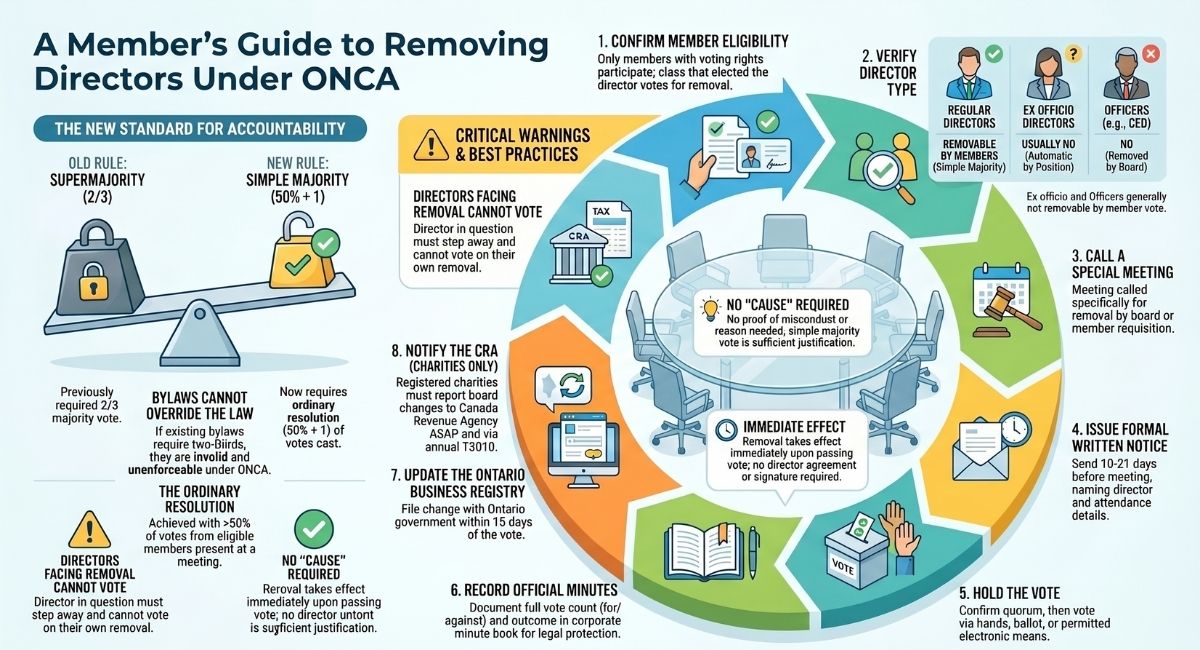
The Change: Simpler Majority to Remove Directors
Old Rule: Previously, under ONCA, if members of a nonprofit wanted to remove a sitting director, they often needed a two-thirds majority vote. This high threshold was set by the organization's bylaws or articles of incorporation.
New Rule: Now, under ONCA, members can remove a director with just a simple majority (51 percent) vote during a members’ meeting. This change means that it’s easier for members to hold directors accountable and make changes to the board.
Why This Change Matters
Accountability to Members: Directors of a nonprofit are accountable to the members. They make crucial decisions that affect the direction and success of the organization. By lowering the voting threshold to a simple majority, members now have a stronger voice in who represents them on the board.
Updating Governing Documents: Nonprofits must ensure their governing documents, such as bylaws and articles of incorporation, reflect this change. If these documents still require a two-thirds majority to remove a director, they are outdated and could wrongly prevent members from exercising their rights.
Empowering Stakeholders: This shift empowers stakeholders, giving them more control and ensuring that the board represents the current will of the members. It also encourages directors to remain accountable and responsive to the needs and concerns of the membership.
Step-by-Step: How to Remove a Director Under ONCA in 2026
Removing a director under ONCA follows a defined procedural sequence. Each step must be completed correctly for the removal to be legally valid. Missing a step — particularly around notice or voting eligibility — can invalidate the entire process.
Step 1: Confirm voting member eligibility
Only members with voting rights can participate in director removal. If your organization has multiple member classes, only the class that elected a specific director can vote to remove that director. Review your membership records and bylaws before issuing any notices to confirm who is eligible to vote.
Step 2: Verify that the director is removable by member vote
Not all directors can be removed through a member vote. Ex officio directors — those who hold their board position by virtue of another role they occupy — cannot be removed this way. Officers such as the president, secretary, or treasurer are not removed by members; they are appointed and removed by the board. Confirm that the director you are targeting is a regular, elected director before proceeding.
Step 3: Call a special meeting
Call a special meeting of voting members for the specific purpose of removing the director. Your bylaws will specify who has authority to call this meeting. Typically, this is the board of directors, or it can be requisitioned by a prescribed percentage of voting members if the board refuses to act.
Step 4: Issue proper written notice
Send written notice to all voting members within the timeframe required by your bylaws — typically between 10 and 21 days before the meeting. The notice must clearly state:
- The date, time, and location of the meeting
- The name of the director to be removed
- That a vote on removal will take place at the meeting
- How members can attend in person, by proxy, or electronically if permitted
The director facing removal must also receive notice and has the right to address the members before the vote is held.
Step 5: Hold the meeting and conduct the vote
Confirm that quorum is met before proceeding with any business. Members then vote on an ordinary resolution to remove the director. A simple majority — more than 50% of votes cast by eligible voting members present — is sufficient to pass the resolution. Voting may occur by show of hands, written ballot, or electronic means if your bylaws permit.
Step 6: Record the results in meeting minutes
Document the full vote in your meeting minutes, including the number of votes cast in favour and against, the names or count of voting members present, and the final outcome. This record is essential for your corporate books and is critical if the removal is ever challenged.
Step 7: Update the Ontario Business Registry
After a successful removal vote, file the director change with the Ontario Business Registry. Confirm the applicable filing deadline with your legal advisor. Update your corporate minute book immediately to reflect the new board composition.
Step 8: Notify the CRA (registered charities only)
If your organization is a registered charity, update your director information with the Canada Revenue Agency. Significant board changes should be reported as soon as possible. Director information is also reported through your annual T3010 Information Return.
Steps Nonprofits Should Take
1. Review and Update Governing Documents: Nonprofits should immediately review their bylaws and articles of incorporation. Any provisions requiring more than a simple majority to remove a director should be updated to comply with the new rule under ONCA.
2. Educate Members: It’s essential to inform members about their rights and the new process for removing directors. Clear communication ensures that all members understand how they can participate in governance.
3. Regularly Schedule Member Meetings: Frequent and regular member meetings provide opportunities for members to discuss and vote on important issues, including the removal of directors if necessary.
4. Encourage Active Participation: Nonprofits should encourage active participation from their members. When members are engaged and informed, they can better exercise their rights and contribute to the organization’s success.
The ability to remove directors with a 51 percent vote is a significant change in nonprofit governance under ONCA. It simplifies the process, enhances accountability, and ensures that the board remains responsive to the members' needs. Nonprofits must update their governing documents and educate their members to align with this new rule. By doing so, they can strengthen their governance practices and ensure that their organization operates effectively and democratically.
Legal Framework for Member Removal of Directors Under ONCA
ONCA sets specific rules for how members can remove directors from nonprofit boards. The Act creates different requirements for various types of organizations and defines clear roles for members, directors, and officers in the process.
Overview of the Ontario Not-for-Profit Corporations Act
ONCA replaced the previous Corporations Act in Ontario. It provides clear rules for how nonprofits must operate.
The Act applies to all not-for-profit corporations in Ontario, including charities and other nonprofit organizations. Members have specific rights to remove directors, and the Act sets minimum standards organizations must follow.
Key ONCA provisions include:
- Simple majority voting for director removal
- Mandatory member meeting procedures
- Protection for certain types of directors
- Requirements for proper notice
Organizations cannot create bylaws that make director removal harder than ONCA requires. They can, however, add extra protections for members during the process.
ONCA also sets different rules for ex officio directors. These directors often cannot be removed through the standard member vote process.
Key Definitions: Members, Directors, and Officers
Members are individuals with voting rights in the organization. They elect directors and can vote on important matters like director removal.
Only voting members can participate in director removal votes. Non-voting members cannot cast ballots in these decisions.
Directors serve on the board and make governance decisions. Members elect them, and directors are accountable to the members.
ONCA distinguishes between regular directors and ex officio directors. Ex officio directors hold their position because of another role they have.
Officers are appointed by directors to handle specific duties. Common officer positions include president, secretary, and treasurer.
Differences Between Nonprofit and Charity Requirements
All organizations under ONCA follow the same basic director removal rules. Both charities and other nonprofits must allow simple majority voting.
Charities have additional considerations:
- Must maintain charitable purposes
- Subject to Canada Revenue Agency oversight
- May have specific director qualifications
Some charities receive extra government funding and might have additional accountability requirements in their funding agreements.
Registered charities must also follow federal charity law. This can create extra steps when removing directors who have signing authority with CRA.
Both charity and nonprofit bylaws must align with ONCA requirements. Organizations cannot create bylaws that prevent members from exercising their removal rights.
The voting threshold remains the same regardless of organization type. Members need 50% plus one vote to remove a director at a properly called meeting.
Membership Rights and the Role in Director Removal
Under ONCA, different member classes hold specific voting rights that directly affect director removal procedures. The membership structure and quorum requirements determine how effectively members can exercise their removal powers.
Member Classes and Voting Rights
Only voting members can participate in director removal under ONCA. Non-voting members cannot vote on these matters, even if they attend meetings.
Different membership classes may have specific rights to elect certain directors. Only that class can remove the directors they elected.
For example, if Class A members elect three directors, only Class A members can vote to remove those specific directors. Class B members cannot participate in removing Class A's elected directors.
Ex officio directors are exempt from member removal procedures. These directors serve because of their position or role, not through member election.
The bylaws must clearly define which member classes exist and their specific voting rights. This prevents confusion during removal procedures.
Quorum and Voting Requirements
Members need a simple majority vote (51%) to remove a director at a properly called meeting. This is called an ordinary resolution under ONCA.
A valid quorum must be present before any voting can occur. The bylaws typically set the quorum requirements for member meetings.
Members must convene a special meeting specifically for director removal. Regular annual meetings can also address removal if properly noticed.
The meeting notice must clearly state that director removal will be discussed. Members need adequate time to prepare and attend.
Voting can happen in person, by proxy, or through other methods allowed in the bylaws.
How Membership Structure Impacts Removal Procedures
Large membership organizations face different challenges than smaller ones. Getting enough members to attend and reach quorum becomes more difficult as organizations grow.
Organizations with multiple member classes must track which members can vote on specific director removals. This requires clear record-keeping and proper meeting procedures.
Single-class membership structures simplify the removal process. All voting members participate equally in director removal decisions.
The geographic spread of members affects meeting logistics. Organizations may need to use electronic voting or proxy arrangements.
Membership fees and engagement levels influence participation rates. Active, engaged members are more likely to participate in governance decisions like director removal.
Procedural Steps for Removing Directors Under ONCA
The removal process requires careful attention to bylaw requirements and proper notice procedures. Members must follow specific steps to ensure the removal vote is valid and legally binding.
Reviewing and Applying Bylaw Provisions
We must first examine our organization's bylaws to understand the specific procedures for director removal. Under ONCA, members can remove directors with a simple majority vote through an ordinary resolution.
Our bylaws may contain additional requirements beyond ONCA's basic rules. These could include specific notice periods or meeting procedures we need to follow.
If our bylaws still require a two-thirds majority for removal, they conflict with ONCA's current provisions. We should update these outdated clauses to reflect the new simple majority standard.
Key bylaw elements to review:
- Notice requirements for special meetings
- Quorum requirements for member votes
- Voting procedures and eligibility rules
- Any specific removal provisions
Tools like CLEO's Bylaw Builder can help us create compliant bylaws that align with ONCA requirements.
Initiating a Removal Process
We can start the removal process through a member proposal or by calling a special meeting. Any voting member typically has the right to propose director removal.
The proposal must clearly identify which director we want to remove. We cannot remove ex officio directors through this process since their positions depend on holding other offices.
Only members from classes that elected specific directors can vote to remove those directors. This rule protects the voting rights of different member groups.
We should document our reasons for removal, though ONCA doesn't require us to prove cause. The simple majority vote is enough for removal.
Notice of Meeting and Proposal Requirements
We must provide proper written notice to all voting members before the meeting. The notice period depends on our bylaws but typically ranges from 10 to 21 days.
The notice must include:
- Meeting date, time, and location
- Clear statement about the director removal proposal
- Name of the director facing removal
- How members can participate or vote
We should send notices by methods specified in our bylaws, such as mail, email, or posting on our website.
The notice gives members time to consider the proposal and attend the meeting. Proper notice protects the democratic process and ensures validity.
Conducting the Member Vote for Removal
We must ensure quorum is present before conducting the removal vote. Our bylaws specify the minimum number of members needed for valid decisions.
The vote requires a simple majority of voting members present. We can conduct voting by show of hands, written ballot, or electronic means as permitted by our bylaws.
We should record the vote results in our meeting minutes. This creates an official record of the decision and the voting outcome.
After a successful removal vote, we must file updated director information with the Ontario Business Registry within 60 days. We also need to update our internal corporate records immediately.
The removed director's term ends immediately after the successful vote. We can then appoint or elect a replacement director according to our bylaws.
Special Considerations for Charities and Public Benefit Corporations
Registered charities and public benefit corporations face additional rules when removing directors. These organizations must follow extra steps and may need approval from government bodies.
Unique Rules for Registered Charities
Registered charities must notify the Canada Revenue Agency (CRA) when directors change. We need to update our charity information return within six months of any director removal.
The CRA requires that charity directors meet specific qualifications. All directors must be eligible under the Income Tax Act.
- Under 18 years old
- Convicted of certain criminal offences
- Previously involved with charities that lost their status
We must also ensure our charity maintains the minimum number of directors required by our governing documents. Most charities need at least three directors to operate legally.
Important: If we remove too many directors at once, our charity might not have enough people to make decisions. This could harm our charitable status with the CRA.
Employee Directors and Public Benefit Corporation Limits
Public benefit corporations have strict rules about employee directors. No more than one-third of our directors can be employees of the corporation.
This rule affects director removal in important ways:
- We cannot remove non-employee directors if it would make employee directors exceed the one-third limit
- We might need to remove employee directors first before removing other directors
- We must plan director changes carefully to stay within the legal limits
Employee directors include anyone who receives regular pay from our organization. This covers full-time staff, part-time workers, and contractors with ongoing relationships.
Engaging with the Public Guardian and Trustee
Some charities must involve the Public Guardian and Trustee (PGT) when removing directors. This applies mainly to charities that receive government funding or hold public trust property.
We must notify the PGT before removing directors if:
- Our charity manages funds for vulnerable people
- We hold property in trust for the public
- Our governing documents require PGT approval
The PGT may review our reasons for director removal. They want to ensure we protect charitable assets and serve the public interest properly.
Timeline matters: PGT reviews can take several weeks. We should contact them early in the removal process to avoid delays.
Corporate Governance and Director Removal Best Practices
When removing directors under ONCA, organizations must address conflicts of interest, maintain proper documentation, and complete required government filings. These practices protect the organization and ensure compliance with Ontario regulations.
Conflicts of Interest and Compliance Obligations
Directors facing removal cannot vote on their own removal. This creates an automatic conflict of interest under ONCA governance rules.
We must ensure the director steps away from all board discussions about their removal. They cannot participate in any votes or decisions related to the removal process.
Officers who are also directors face additional considerations. If we remove a director who holds an officer position, we need to address both roles separately.
The organization must follow its conflict of interest policy during removal proceedings. We should document that proper conflict procedures were followed.
Board members must act in good faith when considering director removal. Personal disputes cannot be the primary reason for removal under corporate governance standards. For guidance on resolving conduct issues at the board level before pursuing removal, see handling difficult directors in a charity.
We need to review our bylaws for specific conflict requirements. Some organizations have stricter rules than the basic ONCA requirements.
Documenting and Reporting Director Removal
Meeting minutes must record the removal resolution clearly. We need to include the exact vote count and the specific reasons for removal.
The minutes should show that proper notice was given to members. We must document that the meeting followed ONCA procedures.
We need to record which members voted and verify their voting rights. Not all members may have the right to remove specific directors.
The organization should keep copies of all removal notices and communications. This documentation protects us if someone later challenges the removal.
Financial records may need updates if the removed director had signing authority. We must change bank signatures and other financial controls immediately.
Board resolutions should formally accept the director's removal. This creates a clear corporate record of the governance change.
Government Filings and Registry Updates
We must file director changes with the Ontario government within 15 days of the removal. The corporate registry needs current director information.
Form 1 (Initial Return/Notice of Change) reports director changes to Corporations Canada. We need to submit this form with the required fees.
The organization's registered office must update its records. Corporate books need to reflect the new board composition accurately.
We should update all public directories and websites that list directors. This includes charity databases and professional associations.
Banking relationships require immediate attention. Financial institutions need updated director information and new signing authorities.
Professional advisors like lawyers and accountants should receive notice of director changes. This ensures they communicate with the correct board members going forward.
Common Mistakes When Removing Directors Under ONCA
Even well-intentioned organizations make procedural errors that can invalidate a director removal vote or expose the organization to legal challenge. Here are the most common mistakes to avoid in 2026.
1. Using bylaws that still require a two-thirds majority
If your organization has not yet updated its bylaws for ONCA compliance, your documents may still require a two-thirds vote to remove a director. While ONCA overrides that provision, following the outdated bylaw by mistake can create confusion and may give a removed director grounds to dispute the process. Update your bylaws before initiating any removal proceedings.
2. Failing to give proper written notice
Removing a director without providing adequate written notice to all eligible voting members can invalidate the entire meeting and vote. The notice must name the specific director, clearly state the purpose of the meeting, and comply with the notice period in your bylaws. Informal notice — such as a verbal announcement or a last-minute email — is not sufficient.
3. Allowing the wrong members to vote
In organizations with multiple membership classes, only the class that elected a specific director can vote to remove that director. Allowing other member classes to participate in that vote is a procedural error that can be used to challenge the outcome.
4. Attempting to remove an ex officio director by member vote
Ex officio directors cannot be removed through the standard member vote process. Their position on the board is tied to another role they hold, and it ends automatically when they vacate that role. Attempting to remove them by member resolution does not apply to their situation under ONCA.
5. Not updating the Ontario Business Registry promptly
Delaying your registry update after a successful removal vote creates legal and operational risk. Third parties — including banks, government agencies, and legal counterparties — rely on registry information to identify who sits on your board. Outdated registry records can cause signing authority disputes and call board decisions into question.
6. Removing too many directors at once
If multiple directors are removed in the same process, the board may fall below its minimum composition or quorum threshold. If that happens, the remaining board cannot make valid decisions — including appointing replacement directors. Plan the sequence of any multiple removals carefully, and ensure you have a path to restore a functioning board before proceeding.
What Happens If a Removed Director Refuses to Leave?
Once a valid ordinary resolution is passed at a properly called meeting, the director's removal takes effect immediately. The former director does not need to agree to the removal, sign any document, or cooperate in any way for it to be legally binding. Their position on the board ends at the moment the vote passes.
However, situations do arise where a removed director refuses to accept the outcome or continues to act as if they are still on the board. Here is what your organization can and should do.
Update the Ontario Business Registry immediately. Once you file the director change, the registry reflects your new board composition. Third parties — banks, lawyers, and government agencies — will recognize the updated records, not the removed director's claims.
Revoke all signing authorities and financial access without delay. Do not wait for the former director's cooperation. Contact your bank and any financial institutions on the same day as the vote if possible. Remove the former director from all accounts, signing authorities, and contracts immediately.
Document all communications. Keep copies of the meeting notice, attendance record, the signed or recorded vote result, minutes, and every subsequent communication. This documentation is critical if the removal is challenged in court or before a regulatory body.
Notify relevant parties. Inform your legal counsel, accountant, and any government funders or regulators that rely on director information. This limits the former director's ability to act on behalf of the organization.
Seek legal advice if interference continues. If a former director is actively interfering with the organization's operations, accessing its assets, or representing themselves to third parties as a current director, the organization can apply to the court for an order to enforce the removal and protect its interests. This is a serious matter and should be handled with legal support.
After Removal: Board Reconstitution and Membership Impacts
When members remove directors under ONCA, organizations must address immediate vacancy concerns. The removal may also affect board composition and member relationships.
Vacancy and Appointment of New Directors
The removal of a director creates an immediate vacancy on the board. Organizations must first determine if the remaining directors still meet quorum requirements.
Quorum Assessment
Most governing documents specify the minimum number of directors needed for a quorum. If the removal drops the board below this threshold, normal board operations cannot continue.
When quorum is lost, the organization must call a members' meeting. This meeting serves to elect new directors and restore proper board function.
Appointment Process
Organizations have several options for filling vacancies:
- Members' meeting election - The most common approach
- Board appointment - If permitted by bylaws and quorum exists
- Emergency provisions - Some bylaws allow temporary appointments
The bylaws typically outline procedures for each method. Organizations should review these requirements before filling vacancies.
Timeline Considerations
We recommend acting quickly to fill vacancies. Long periods without proper board composition can affect decision-making and compliance.
- Decision-making authority
- Legal compliance obligations
- Operational continuity
Effect on Board of Directors and Membership
Director removal impacts both board dynamics and member relationships. These changes require careful management to maintain stability.
Board Composition Changes
Removing directors can shift the balance of expertise and perspectives on the board. Organizations may lose valuable skills or institutional knowledge.
The remaining directors might need to redistribute responsibilities. Committee assignments and leadership roles may require adjustment.
Member Relations
The removal process can create divisions within the membership. Some members may support the decision while others oppose it.
Organizations should focus on rebuilding unity after contentious removals. Clear communication about reasons for removal helps maintain member confidence.
Governance Continuity
New directors require orientation and training. They need to understand:
- Organizational history and culture
- Current strategic priorities
- Legal and fiduciary responsibilities
- Board policies and procedures
Considerations in Case of Dissolution
Although not directly caused by director removal, organizations facing governance challenges may consider dissolution.
Dissolution Triggers
Several factors might lead to dissolution discussions:
- Inability to maintain minimum director requirements
- Loss of member confidence in governance
- Ongoing conflicts that prevent effective operations
Legal Requirements
ONCA sets specific requirements for dissolution. Members must pass a special resolution with detailed procedures for:
- Asset distribution
- Creditor notification
- Regulatory compliance
Alternative Solutions
Before considering dissolution, organizations can explore other options:
- Restructuring board composition
- Revising governance documents
- Implementing conflict resolution processes
- Seeking external mediation
These alternatives may address underlying issues without ending the organization.
Transitioning and Updating Bylaws for ONCA Compliance
Nonprofits must review their current governing documents and update them to meet ONCA's new requirements. The new rules include the simple majority rule for director removal.
Organizations can use CLEO's Bylaw Builder to make these changes. Nonprofits must complete their transition within the required timeline.
Reviewing Existing Governing Documents
We need to examine our current bylaws and articles of incorporation to find sections that conflict with ONCA. Many older documents require a two-thirds majority vote to remove directors. Under ONCA, this must change to a simple majority.
Our bylaws cannot override ONCA's requirement for a 50% + 1 vote. Any provision stating a higher threshold is invalid and must be updated.
We should also check for other outdated sections. These might include membership definitions, meeting procedures, and director appointment processes.
Key areas to review:
- Director removal procedures
- Voting thresholds for member decisions
- Membership class definitions
- Meeting notice requirements
- Officer appointment rules
Document all needed changes before starting the amendment process. This helps us avoid multiple rounds of government filings.
Making Amendments and Using CLEO's Bylaw Builder
CLEO's Bylaw Builder provides templates and guidance for ONCA-compliant bylaws. This free online tool helps us draft proper language that meets legal requirements.
We can use the Bylaw Builder to create new bylaws or modify existing ones. The tool includes standard clauses for director removal that comply with ONCA's simple majority rule.
Steps for using the Bylaw Builder:
- Access the tool through CLEO's website
- Select our organization type
- Complete each section with our information
- Review the generated bylaws carefully
- Make any necessary customizations
Once we approve new bylaws, our board of directors must pass a resolution adopting them. The bylaws take effect immediately upon this board vote.
We must then present the new bylaws to our members at the next meeting for confirmation.
2026 Compliance Status: The Transition Deadline Has Passed
The ONCA transition deadline of October 18, 2024 has now passed. All Ontario not-for-profit corporations — including registered charities — were required to complete their transition to ONCA-compliant governing documents by that date.
If your organization has not yet completed its transition, you are currently operating out of compliance. This is not a minor administrative issue. Non-compliant bylaws may contain provisions that directly conflict with ONCA — including invalid voting thresholds for director removal — which can expose your organization to governance disputes, member challenges, and regulatory scrutiny.
What to do if your organization has not yet transitioned:
- Contact a charity and nonprofit lawyer as soon as possible
- Review your current bylaws against ONCA's requirements to identify conflicts
- File updated governing documents with the Ontario Business Registry
- Hold a member meeting to confirm and ratify bylaw amendments
- Update all internal corporate records and government filings to reflect the changes
What to do if your organization has already transitioned:
- Confirm that your bylaws accurately reflect the simple majority rule for director removal
- Ensure your membership class definitions and voting rights provisions are current
- Review your notice and quorum requirements to confirm they comply with ONCA
- Keep your Ontario Business Registry information up to date at all times
If you are unsure whether your organization's governing documents are fully ONCA-compliant, a legal review is the safest step before initiating any director removal process.
Conclusion
ONCA's new director removal rules give nonprofit members real power to hold boards accountable. The simple majority vote requirement makes it easier for members to take action when needed.
Organizations must update their bylaws to reflect these changes. Members can now remove directors with just 51% support at a special meeting. This creates stronger democratic governance for Ontario nonprofits.
Ready to ensure your nonprofit complies with ONCA? Contact B.I.G. Charity Law Group today for expert guidance on updating your governing documents. We help Ontario nonprofits navigate these important legal changes with confidence.
Get started now:
- Email us at dov.goldberg@charitylawgroup.ca
- Call (416) 488-5888
- Visit CharityLawGroup.ca
- Schedule a FREE consultation
Frequently Asked Questions
Under ONCA, members can remove directors with a simple majority vote at a special meeting. The process requires proper notice and follows specific rules that nonprofits must understand.
How can members remove a director?
Members can remove directors by passing an ordinary resolution at a special meeting. This requires a simple majority vote of 50% plus one.
Only voting members can participate in director removal. The bylaws cannot change this voting percentage requirement.
Ex officio directors cannot be removed through this process. Their positions are not subject to member removal under ONCA rules.
What are the grounds for the removal of a director?
ONCA does not specify particular grounds for removing a director. Members can vote to remove any director for any reason they see fit.
The decision belongs entirely to the voting members. They do not need to prove wrongdoing or provide specific justification.
This gives members broad power to ensure directors remain accountable. It allows them to make changes when they feel it serves the organization's best interests.
How do you remove a director under the Corporation Act?
Under ONCA, members must call a special meeting for the purpose of removing a director. Proper notice must be given to all voting members.
The meeting notice should clearly state the intention to remove the specific director. This ensures members understand the meeting's purpose.
During the meeting, members vote on an ordinary resolution to remove the director. The resolution passes with a simple majority of votes cast.
What is the procedure for removing a director?
First, identify which members have the right to vote on director removal. Only members who can elect specific directors can remove those same directors.
Next, call a special meeting according to your organization's bylaws. Provide proper notice that includes the removal resolution.
Hold the meeting and vote on the ordinary resolution. Count the votes and announce the result based on a simple majority.
How can directors be removed from their positions?
Members can remove directors by voting at special meetings. This is the main method under ONCA for member-driven removal.
Directors can also resign by giving written notice. Some organizations allow removal through other rules in their governing documents.
The board or members choose when to fill the vacancy after removal. This timing depends on the organization's needs and bylaws.
What is the step to remove a director?
The key step is to convene a special meeting of voting members.
This meeting must follow the notice requirements in your bylaws.
Members vote on an ordinary resolution to remove the director.
The resolution needs support from more than half of the votes cast.
After the vote, update your corporate records to show the director's removal.
Notify relevant parties and start the process of filling the vacancy if needed.
Can a director be removed without a meeting?
Generally, no. Under ONCA, director removal requires a vote at a properly called members' meeting. Some organizations permit written resolutions in lieu of a meeting for certain decisions, but director removal is a significant governance action that requires a formal meeting with proper notice to protect the rights of all voting members — including the director being considered for removal.
Can the board of directors remove one of its own members?
Under ONCA, the board cannot remove a director who was elected by the members — that power belongs exclusively to the members. The board can, however, remove an officer (such as a president or secretary) since officers are appointed by the board, not elected by members. If a director also holds an officer role, the board can remove the officer role while a separate membership vote handles the director position.
What happens to a director's officer role when they are removed from the board?
When a member vote removes a director from the board, any officer role they hold ends as well, since you must be a director to serve as an officer. To be thorough and avoid any ambiguity, the board should also pass a separate resolution formally ending the officer appointment on the same day as the member vote.
Does ONCA require a reason to remove a director?
No. ONCA does not require members to state a specific reason or prove misconduct to remove a director. A valid ordinary resolution passed by a simple majority at a properly called meeting is sufficient. Members may choose to document their reasons in the meeting minutes, but this is not legally required under ONCA.
Can a removed director be re-elected to the board?
Yes, unless your bylaws specifically prohibit it or the individual is disqualified under ONCA — for example, if they are under 18, have been found to be of unsound mind by a court, or have been convicted of certain offences. The removal itself does not create a permanent bar from future board service.
Is the director removal process the same under ONCA and the Canada Not-for-Profit Corporations Act?
No. The Canada Not-for-Profit Corporations Act (CNCA) governs federally incorporated nonprofits, while ONCA governs Ontario-incorporated nonprofits. Both permit simple majority member removal of directors, but the specific procedures, notice requirements, filing obligations, and registry processes differ. If you are unsure which act governs your organization, review your incorporation documents or consult a charity and nonprofit lawyer.
What is the difference between removing a director and removing an officer under ONCA?
Directors are elected by members and can only be removed by members through an ordinary resolution at a meeting. Officers — such as the president, vice-president, secretary, and treasurer — are appointed by the board and can only be removed by the board. These are two separate governance processes and should not be confused. If the person you want removed holds both roles, you will need both processes to fully sever their involvement.
The material provided on this website is for information purposes only.. You should not act or abstain from acting based upon such information without first consulting a Charity Lawyer. We do not warrant the accuracy or completeness of any information on this site. E-mail contact with anyone at B.I.G. Charity Law Group Professional Corporation is not intended to create, and receipt will not constitute, a solicitor-client relationship. Solicitor client relationship will only be created after we have reviewed your case or particulars, decided to accept your case and entered into a written retainer agreement or retainer letter with you.
DOV GOLDBERG, J.D. is a lawyer at B.I.G. Charity Law Group and has dedicated his career exclusively to Charity and Not-for-Profit Law for over a decade. Dov guides charities, foundations, and non-profit organizations through every stage of the registration process, offering practical legal advice with a focus on compliance, governance, and long-term success. Known for his hands-on approach and deep knowledge of CRA requirements, Dov is committed to helping clients build strong, sustainable, and legally sound organizations.
.png)


